
Catalogue Search | MBRL


Are you sure you want to remove the book from the shelf?

{{itemTitle}}
205,083
result(s) for
"Holocaust"
Sort by:


Vanished history
Bohemia and Moravia, today part of the Czech Republic, was the first territory with a majority of non-German speakers occupied by Hitler's Third Reich on the eve of the World War II. Tens of thousands of Jewish inhabitants in the so called Protectorate of Bohemia and Moravia soon felt the tragic consequences of Nazi racial politics. Not all Czechs, however,remained passive bystanders during the genocide. After the destruction of Czechoslovakia in 1938-39, Slovakia became a formally independent but fully subordinate satellite of Germany. Despite the fact it was not occupied until 1944, Slovakia paid Germany to deport its own Jewish citizens to extermination camps.
About 270,000 out of the 360,000 Czech and Slovak casualties of World War II were victims of the Holocaust. Despite these statistics, the Holocaust vanished almost entirely from post-war Czechoslovak, and later Czech and Slovak, historical cultures. The communist dictatorship carried the main responsibility for this disappearance, yet the situation has not changed much since the fall of the communist regime. The main questions of this study are how and why the Holocaust was excluded from the Czech and Slovak history.
eBook

Dreams of silver
London, 1963. 'I dream about my sister almost every night'. Lilian Morrison has one memento of her beloved sister, Emma: a battered silver music box. A family heirloom that was passed down through two world wars, the box was the key to Lilian's recent, joyous reunion with the surviving members of her birth family, whom she lost many years earlier when she and her sister fled Hitler's Germany on the Kindertransport. Now Lilian is compelled to investigate Emma's final days after the girls were shipped to separate foster families in Britain and the time before Emma was killed in the London Blitz. In London, as she searches for clues to retrace the past, Lilian finds that the anguish of war still reverberates after two decades. In Cape Town, her grandmother courageously protects innocent victims of violence, and in Dublin, a gifted woodworker creates a music box that is strangely similar to the one that Lilian owns. Separate lives will intertwine on a path of healing and hope as the hazy secrets of the past finally come to light.
Book

We Remember with Reverence and Love
Winner of the 2009 National Jewish Book Award in American Jewish StudiesRecipient of the 2010 Guggenheim Fellowship in Humanities-Intellectual and Cultural HistoryIt has become an accepted truth: after World War II, American Jews chose to be silent about the mass murder of millions of their European brothers and sisters at the hands of the Nazis. In this compelling work, Hasia R. Diner shows the assumption of silence to be categorically false. Uncovering a rich and incredibly varied trove of remembrances - in song, literature, liturgy, public display, political activism, and hundreds of other forms - We Remember with Reverence and Love shows that publicly memorializing those who died in the Holocaust arose from a deep and powerful element of Jewish life in postwar America. Not only does she marshal enough evidence to dismantle the idea of American Jewish forgetfulness, she brings to life the moving and manifold ways that this widely diverse group paid tribute to the tragedy.Diner also offers a compelling new perspective on the 1960s and its potent legacy, by revealing how our typical understanding of the postwar years emerged from the cauldron of cultural divisions and campus battles a generation later. The student activists and new Jews of the 1960s who, in rebelling against the American Jewish world they had grown up in a world of remarkable affluence and broadening cultural possibilities created a flawed portrait of what their parents had, or rather, had not, done in the postwar years. This distorted legacy has been transformed by two generations of scholars, writers, rabbis, and Jewish community leaders into a taken-for-granted truth.
eBook
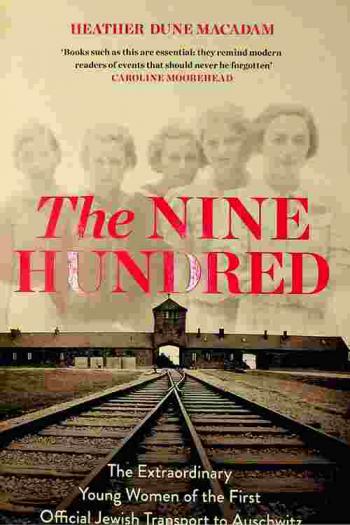
The nine hundred : the extraordinary young women of the first official transport to Auschwitz
On March 23, 1942, nearly a thousand young, unmarried Jewish women boarded a train in Poprad, Slovakia. Filled with a sense of adventure and national pride, they left their parents' homes wearing their best clothes and confidently waving goodbye. Believing they were going to work in a factory for a few months, they were eager to report for government service. Instead, the young women many of them teenagers were sent to Auschwitz. Of those 999 deportees only a few would survive.

Jewish histories of the holocaust
For many years, histories of the Holocaust focused on its perpetrators, and only recently have more scholars begun to consider in detail the experiences of victims and survivors, as well as the documents they left behind. This volume contains new research from internationally established scholars. It provides an introduction to and overview of Jewish narratives of the Holocaust. The essays include new considerations of sources ranging from diaries and oral testimony to the hidden Oyneg Shabbes archive of the Warsaw Ghetto; arguments regarding Jewish narratives and how they fit into the larger fields of Holocaust and Genocide studies; and new assessments of Jewish responses to mass murder ranging from ghetto leadership to resistance and memory.
eBook
Four scraps of bread : (quatre petits bouts de pain)
\"Born in Hungary in 1927, Magda Hollander-Lafon was among the 437,000 Jews deported from Hungary between May and July 1944. Magda, her mother, and her younger sister survived a three-day deportation to Auschwitz-Birkenau; there, she was considered fit for work and so spared, while her mother and sister were sent straight to their deaths. Hollander-Lafon recalls an experience she had in Birkenau: \"A dying woman gestured to me: as she opened her hand to reveal four scraps of moldy bread, she said to me in a barely audible voice, 'Take it. You are young. You must live to be a witness to what is happening here. You must tell people so that this never happens again in the world.' I took those four scraps of bread and ate them in front of her. In her look I read both kindness and release. I was very young and did not understand what this act meant, or the responsibility that it represented.\" Years later, the memory of that woman's act came to the fore, and Magda Hollander-Lafon could be silent no longer. In her words, she wrote her book not to obey the duty of remembering but in loyalty to the memory of those women and men who disappeared before her eyes. Her story is not a simple memoir or chronology of events. Instead, through a series of short chapters, she invites us to reflect on what she has endured. Often centered on one person or place, the scenes of brutality and horror she describes are intermixed with reflections of a more meditative cast. Four Scraps of Bread is both historical and deeply evocative, melancholic, and at times poetic in nature. Following the text is a \"Historical Note\" with a chronology of the author's life that complements her kaleidoscopic style. After liberation and a period in transit camps, she arrived in Belgium, where she remained. Eventually, she chose to be baptized a Christian and pursued a career as a child psychologist. The author records a journey through extreme suffering and loss that led to radiant personal growth and a life of meaning. As she states: \"Today I do not feel like a victim of the Holocaust but a witness reconciled with myself.\" Her ability to confront her experiences and free herself from her trauma allowed her to embrace a life of hope and peace. Her account is, finally, an exhortation to us all to discover life-giving joy\"-- Provided by publisher.
Book

Holocaust Literature of the Second Generation
This book gives detailed, theoretically-informed readings of a range of fictional and autobiographical writing by and about the 'second generation' of Holocaust survivors.
eBook

Transcending trauma : survival, resilience and clinical implications in survivor families
\"The Transcending Trauma Project (TTP), begun in 1991, is a large qualitative research endeavor based on 275 comprehensive life interviews of survivors of the Nazi Holocaust, their children, and their grandchildren. Using this research as a base, Transcending Trauma presents an integrated model of coping and adaptation after trauma that incorporates the best of recent work in the field with the expanded insights offered by Holocaust survivors. In the books' vignettes, interview transcripts, and audio excerpts, survivors of a broad range of traumas will recognize their own challenges, and mental health professionals will gain invaluable insight into the dominant themes of Holocaust survivors' experiences and of trauma survivors' experiences more generally. The study of lives conducted by TTP has illuminated universal aspects of the recovery from trauma, and Transcending Trauma makes a vital contribution to our understanding of how survivors find meaning after traumatic events\"--Provided by publisher.
Book

Witnessing Witnessing: On the Reception of Holocaust Survivor Testimony
Witnessing Witnessing focuses critical attention on those who receive the testimony of Holocaust survivors. Questioning the notion that traumatic experience is intrinsically unspeakable and that the Holocaust thus lies in a quasi-sacred realm beyond history, the book asks whether much current theory does not have the effect of silencing the voices of real historical victims. It thereby challenges widely accepted theoretical views about the representation of trauma in general and the Holocaust in particular as set forth by Giorgio Agamben, Cathy Caruth, Berel Lang, and Dori Laub. It also reconsiders, in the work of Theodor Adorno and Emmanuel Levinas, reflections on ethics and aesthetics after Auschwitz as these pertain to the reception of testimony. Referring at length to videotaped testimony and to texts by Charlotte Delbo, Primo Levi, and Jorge Semprun, the book aims to make these voices heard. In doing so, it clarifies the problems that anyone receiving testimony may encounter and emphasizes the degree to which listening to survivors depends on listening to ourselves and to one another. Witnessing Witnessing seeks to show how, in the situation of address in which Holocaust survivors call upon us, we discover our own tacit assumptions about the nature of community and the very manner in which we practice it.
eBook