
Catalogue Search | MBRL


Are you sure you want to remove the book from the shelf?

{{itemTitle}}
17
result(s) for
"Home rule Ireland History 19th century."
Sort by:


Ireland : the politics of enmity, 1789-2006
This book is an innovative interpretation of the history of Anglo–Irish relations from 1789 right to the present day. The French Revolution had an electrifying impact on Irish society, with the 1790s seeing the birth of modern Irish republicanism and Orangeism. This decade also saw the political integration between Ireland and the British elite, such as with Pitt and Castlereagh. The Irish, who were strongly influenced by Edmund Burke's freedom philosophies, argued that Britain's strategic interests were best served by a policy of Catholic emancipation. Britain's failure to achieve this objective — dramatised by the horrifying and tragic Irish famine of 1846–50 — set the context for the emergence of a popular mass nationalism. Eventually, the Fenian, Parnell, and Sinn Fein movements expelled the British from most of the island. This book reassesses all the key leaders of Irish nationalism, alongside key British political leaders — from Tone, Parnell and de Valera, to Haughey, Peel and Blair. It evaluates the changing ideological passions of the modern Irish question, while examining the changing economical and social worlds in London, Dublin and Belfast, all in one coherent analysis.
eBook

Irishness and Womanhood in Nineteenth-Century British Writing
In The Wild Irish Girl, the powerful Irish heroine's marriage to a heroic Englishman symbolizes the Anglo-Irish novelist Lady Morgan's re-imagining of the relationship between Ireland and Britain and between men and women. Using this most influential of pro-union novels as his point of departure, Thomas J. Tracy argues that nineteenth-century debates over what constitutes British national identity often revolved around representations of Irishness, especially Irish womanhood. He maps out the genealogy of this development, from Edgeworth's Castle Rackrent through Trollope's Irish novels, focusing on the pivotal period from 1806 through the 1870s. Tracy's model enables him to elaborate the ways in which gender ideals are specifically contested in fiction, the discourses of political debate and social reform, and the popular press, for the purpose of defining not only the place of the Irish in the union with Great Britain, but the nature of Britishness itself.
eBook

The Irish Question
From 1800 to 1922 the Irish Question was the most emotional and
divisive issue in British politics. It pitted Westminster
politicians, anti-Catholic British public opinion, and Irish
Protestant and Presbyterian champions of the Union against the
determination of Ireland's large Catholic majority to obtain civil
rights, economic justice, and cultural and political
independence.
In this completely revised and updated edition of The Irish
Question , Lawrence J. McCaffrey extends his classic analysis
of Irish nationalism to the present day. He makes clear the
tortured history of British-Irish relations and offers insight into
the difficulties now facing those who hope to create a permanent
peace in Northern Ireland.
The many dimensions of the Irish Question, 18001922, constituted
the most emotion-laden problem in British politics, often to the
detriment of other imperial interests-a Gordian knot only severed
by the establishment of the Irish Free State in 1922. In this
volume Lawrence J. McCaffrey presents a coherent view of the
evolution of Irish nationalism since 1800 and the impact of the
Irish Question on British culture, politics, and institutions.
The emotional nexus of the Irish Question was the religious
issue, but McCaffrey believes that nationalism emerged from the
attempt of the Irish Protestant minority, supported by Britain, to
maintain religious, political, economic, and social ascendancy over
a deprived and resentful majority. Although British concessions to
Irish agitation removed many grievances-granting to Ireland virtual
religious equality, along with substantial social, economic, and
political reforms-nationalism, often frustrated in its attempts to
secure reform and freedom, assumed an increasingly rigid position.
Nationalists were not willing to settle for less than
self-government, and as constitutional methods failed to achieve
this goal, violence seemed the only other alternative.
The bitter dissensions created by the Irish Question left
permanent marks upon British politics and institutions. The efforts
of two Prime Ministers, Peel and Gladstone, to resolve the conflict
split their parties, thus contributing to political confusion and
instability. But the Irish nationalistBritish Liberal alliance
achieved improvement in the condition of Ireland and speeded
advancement of democracy in Britain. And the attempt of British
politicians to deal with the economic and social aspects of the
Irish Question undermined laissez faire and encouraged the progress
of the welfare state in both islands. On the other hand, the
challenge of Irish nationalism sustained and stimulated the
no-Popery roots of British nativism, making it an influential
factor in politics until early in the twentieth century.
The Irish Question, McCaffrey believes, has particular relevance
in our contemporary world of emerging nations, wars of liberation,
and tensions between majorities and minorities. Ireland offers an
early example of the dreams of cultural nationalists becoming
realities and of the sobering fact that ideological revolutionaries
often make poor practical politicians.
eBook
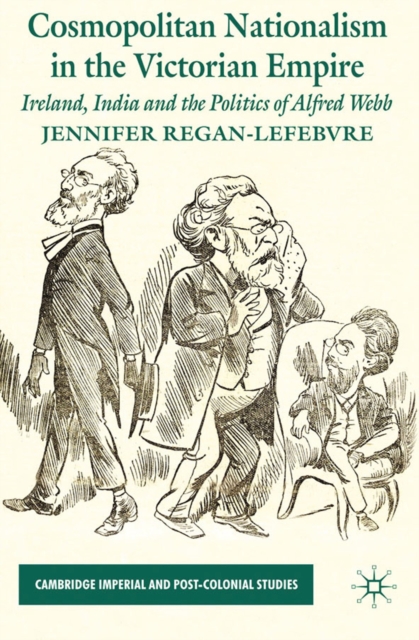
Cosmopolitan nationalism in the Victorian Empire : Ireland, India and the politics of Alfred Webb
The first biography of Alfred Webb, Irish nationalist and president of the 1894 Indian National Congress. The biography explores how Webb viewed nationalism as a vehicle for global social justice. Drawing on archives in Britain, Ireland and India the author reveals how Irish and Indians used cosmopolitan London to create networks across the Empire.
eBook

Business Creation and Political Turmoil: Ireland versus Scotland before 1900
What effect does political instability in the form of a potential secession from a political union have on business formation? Using newly collected data on business creation, we show that entrepreneurial activity in Ireland in the late nineteenth century was much lower than Scotland, and this divergence fluctuated over time. Several factors may have contributed to this, but we argue that political uncertainty about the prospect of a devolved government in Ireland played a role. The effects were most acute in the North of Ireland, the region that was most concerned by potential changes.
Journal Article

A Union Forever
In the mid-nineteenth century the Irish question-the governance of the island of Ireland-demanded attention on both sides of the Atlantic. InA Union Forever, David Sim examines how Irish nationalists and their American sympathizers attempted to convince legislators and statesmen to use the burgeoning global influence of the United States to achieve Irish independence. Simultaneously, he tracks how American politicians used the Irish question as means of furthering their own diplomatic and political ends.
Combining an innovative transnational methodology with attention to the complexities of American statecraft, Sim rewrites the diplomatic history of this neglected topic. He considers the impact that nonstate actors had on formal affairs between the United States and Britain, finding that not only did Irish nationalists fail to involve the United States in their cause but actually fostered an Anglo-American rapprochement in the final third of the nineteenth century. Their failures led them to seek out new means of promoting Irish self-determination, including an altogether more radical, revolutionary strategy that would alter the course of Irish and British history over the next century.
eBook

The Romantic National Tale and the Question of Ireland
Ina Ferris examines the way in which the problem of 'incomplete union' generated by the formation of the United Kingdom in 1800 destabilised British public discourse in the early decades of the nineteenth century. Ferris offers the first full-length study of the chief genre to emerge out of the political problem of Union: the national tale, an intercultural and mostly female-authored fictional mode that articulated Irish grievances to English readers. Ferris draws on current theory and archival research to show how the national tale crucially intersected with other public genres such as travel narratives, critical reviews and political discourse. In this fascinating study, Ferris shows how the national tales of Morgan, Edgeworth, Maturin, and the Banim brothers dislodged key British assumptions and foundational narratives of history, family and gender in the period.
eBook

England's Disgrace
Bruce L. Kinzer provides the first comprehensive investigation of J.S. Mill's multifaceted engagement with the Irish question, the fundamental issues inherent in British-Irish politics.
eBook

PRESBYTERIAN RELIGION, HISTORIOGRAPHY, AND ULSTER SCOTS IDENTITY, c. 1800 TO 1914
The links between Presbyterians in Scotland and the north of Ireland are obvious but have been largely ignored by historians of the nineteenth century. This article addresses this gap by showing how Ulster Presbyterians considered their relationship with their Scottish co-religionists and how they used the interplay of religious and ethnic considerations this entailed to articulate an Ulster Scots identity. For Presbyterians in Ireland, their Scottish origins and identity represented a collection of ideas that could be deployed at certain times for specific reasons – theological orthodoxy, civil and religious liberty, and certain character traits such as hard work, courage, and soberness. Ideas about the Scottish identity of Presbyterianism were reawakened for a more general audience in the first half of the nineteenth century, during the campaign for religious reform and revival within the Irish church, and were expressed through a distinctive denominational historiography inaugurated by James Seaton Reid. The formulation of a coherent narrative of Presbyterian religion and the improvement of Ulster laid the religious foundations of a distinct Ulster Scots identity and its utilization by unionist opponents of Home Rule between 1885 and 1914.
Journal Article