
Catalogue Search | MBRL


Are you sure you want to remove the book from the shelf?

{{itemTitle}}
6,744
result(s) for
"Home schooling"
Sort by:


Psychosocial impacts of home-schooling on parents and caregivers during the COVID-19 pandemic
Background
The COVID-19 pandemic has been highly disruptive, with the closure of schools causing sudden shifts for students, educators and parents/caregivers to remote learning from home (home-schooling). Limited research has focused on home-schooling during the COVID-19 pandemic, with most research to date being descriptive in nature. The aim of the current study was to comprehensively quantify the psychosocial impacts of home-schooling on parents and other caregivers, and identify factors associated with better outcomes.
Methods
A nationally representative sample of 1,296 Australian adults was recruited at the beginning of Australian COVID-19 restrictions in late-March 2020, and followed up every two weeks. Data for the current study were drawn from waves two and three. Surveys assessed psychosocial outcomes of psychological distress, work and social impairment, and wellbeing, as well as a range of home-schooling factors.
Results
Parents and caregivers who were home-schooling during the COVID-19 pandemic experienced significantly higher levels of psychological distress and work/social impairment compared to those who were not home-schooling or had no school-aged children. A current mental health diagnosis or lower levels of perceived support from their child’s school negatively affected levels of psychological distress, work and social impairment, and wellbeing in parents and caregivers involved in home-schooling.
Conclusions
The mental health impacts of home-schooling were high and may rise as periods of home-schooling increase in frequency and duration. Recognising and acknowledging the challenges of home-schooling is important, and should be included in psychosocial assessments of wellbeing during periods of school closure. Emotional and instrumental support is needed for those involved in home-schooling, as perceived levels of support is associated with improved outcomes. Proactive planning by schools to support parents may promote better outcomes and improved home-schooling experiences for students.
Journal Article

International perspectives on home education : do we still need schools?
This unique and enriching volume presents 21 chapters written by an eclectic mix of leading names in home-based education research worldwide. It is the first ever snapshot of global thinking in home based education issues with contributions from a diverse academic community from countries including the UK, USA, Australia, Israel, Afghanistan, Norway, Germany, Belgium, Colombia, Spain, India and Canada. The topic of home education is a unique and interesting lens through which to explore issues in contemporary education far beyond the field of homeschooling, and International Perspectives on Home Education uses this lens to explore education outside of school and place it into a global, political and critical context. This collection is accessible to a wide audience, providing a handy volume to have close at hand for home educators, academics and policymakers alike. -- Provided by the publisher
Book

Homeschooling : the history and philosophy of a controversial practice
In Homeschooling: The History and Philosophy of a Controversial Practice, James G. Dwyer and Shawn F. Peters examine homeschooling's history, its methods, and the fundamental questions at the root of the heated debate over whether and how the state should oversee and regulate it. The authors trace the evolution of homeschooling and the law relating to it from before America's founding to the present day. In the process they analyze the many arguments made for and against it, and set them in the context of larger questions about school and education. They then tackle the question of regulation, and they do so within a rigorous moral framework, one that is constructed from a clear-eyed assessment of what rights and duties children, parents, and the state each possess. Viewing the question through that lens allows Dwyer and Peters to even-handedly evaluate the competing arguments and ultimately generate policy prescriptions. Homeschooling is the definitive study of a vexed question, one that ultimately affects all citizens, regardless of their educational background.
eBook

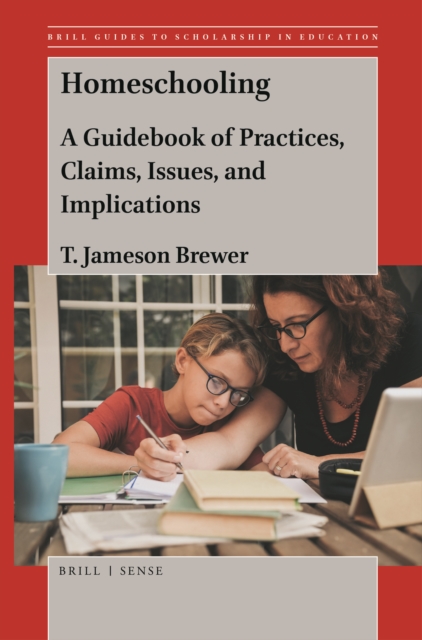
Homeschooling
In Homeschooling: A Guidebook of Practices, Claims, Issues, and Implications, T. Jameson Brewer offers an exploratory analysis of homeschooling, its practices and rationales, and implications for society.
eBook


COVID-19 conversations: A qualitative study of majority Hispanic/Latinx youth experiences during early stages of the pandemic
BackgroundGrowing evidence informs about the detrimental impact that COVID-19 has had on youths’ mental health and well-being. As of yet, no study has directly examined the experiences and perspectives of children and young adolescents from racial and ethnic minority groups in the U.S., despite being exposed to more adversity, which may affect coping with the many challenges posed by the pandemic.ObjectiveThis study aimed to give voice to a mostly Hispanic/Latinx group of youth regarding the impact of COVID-19 stay-at-home measures and to identify their emotional responses and coping strategies amid the pandemic in the U.S. when restrictions were at their hardest.MethodA total of 17 youths (70.6 % Hispanic; age range = 10–14 years; 52.9 % female) participated in four virtual semi-structured focus groups for each grade level (grades 5–8). Data was transcribed and analyzed using a gold standard thematic analysis approach.ResultsSeven themes were identified concerning the impact of COVID-19, centering around the impact of racism, loss of income, the role of community and family in coping with stress, information overload, home-schooling, loneliness and boredom, and lack of structured routines.ConclusionsOur findings suggest that cultural factors (e.g., collectivism and familism) in Hispanic communities may offer important buffering during COVID-19. Future research studies evaluating the implementation of structured programs that provide a space to talk about emotions and thoughts related to the impact of the pandemic and training in strategies to cope with distress during mandatory home-schooling are needed.
Journal Article


Teaching in the COVID-19 Era: Understanding the Opportunities and Barriers for Teacher Agency
The school closures necessitated by the COVID-19 pandemic created a rapid shift to alternative modes of educational delivery, primarily online learning and teacher-supported home-schooling. This shift has revealed deep inequities in education systems worldwide, as many children lost access to teachers and schooling. An effective response to these changes has tested teachers’ personal capacities and individual and collective agency intensely. The research lab we report on within this paper aimed to develop a better understanding of teacher agency in meeting the challenges of the pandemic and the physical and relational enablers and constraints of their environment. Drawing on case study reports from six international contexts and a series of online discussions with research lab participants, this study explores teachers’ enactment of agency in the context of various circumstances and environments. The authors argue that it is imperative that education systems support the enhancement of teachers’ personal and collective agency in the face of continued disruption to schooling and ongoing challenges to educational equity.
Journal Article