
Catalogue Search | MBRL


Are you sure you want to remove the book from the shelf?

{{itemTitle}}
632,087
result(s) for
"Homeless people"
Sort by:

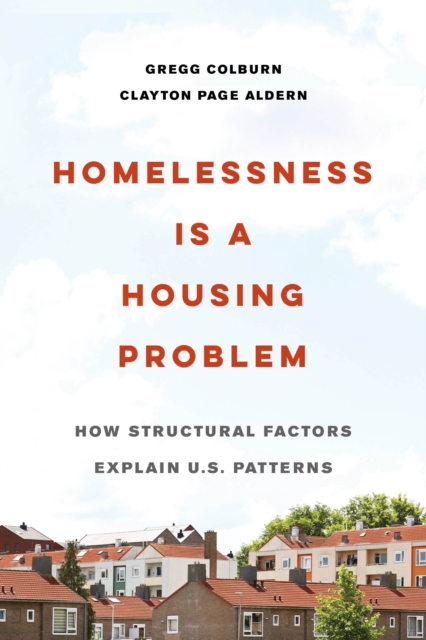
Homelessness Is a Housing Problem
In Homelessness Is a Housing Problem , Gregg Colburn and
Clayton Page Aldern seek to explain the substantial regional
variation in rates of homelessness in cities across the United
States. In a departure from many analytical approaches, Colburn and
Aldern shift their focus from the individual experiencing
homelessness to the metropolitan area. Using accessible statistical
analysis, they test a range of conventional beliefs about what
drives the prevalence of homelessness in a given city-including
mental illness, drug use, poverty, weather, generosity of public
assistance, and low-income mobility-and find that none explain the
regional variation observed across the country. Instead, housing
market conditions, such as the cost and availability of rental
housing, offer a far more convincing account. With rigor and
clarity, Homelessness Is a Housing Problem explores U.S.
cities' diverse experiences with housing precarity and offers
policy solutions for unique regional contexts.
eBook


Cooking up a revolution
On Labor Day in 1988 two hundred hungry and homeless people went to Golden Gate Park in search of a hot meal, while fifty-four activists from Food Not Bombs, surrounded by riot police, lined up to serve them food. The riot police counted twenty-five served meals, the legal number allowed by city law before breaking permit restrictions, and then began to arrest people. The arrests proceeded like an assembly line: an activist would scoop a bowl of food and hand it to a hungry person. A police officer would then handcuff and arrest that activist. Immediately, the next activist in line would take up the ladle and be promptly arrested. By the end of the day fifty-four people had been arrested for “providing food without a permit.” These arrests were not an aberration but part of a multi-year campaign by the city of San Francisco against radical homeless activists. Why would a liberal city arrest activists helping the homeless? In exploring this question, the book uses the conflict between the city and activists as a unique opportunity to examine the contested nature of urban politics, homelessness, and public space, while developing an anarchist alternative to liberal urban politics, which is rooted in mutual aid, solidarity, and anti-capitalism.
eBook

The bridge home
Four determined homeless children make a life for themselves in Chennai, India.
Book

The Archaeology of the Homed and the Unhomed
Choice Outstanding Academic Title
The first comprehensive discussion of the historical archaeology of homelessness
In a time when the idea of home has become central to living the American dream,
The Archaeology of the Homed and the Unhomed brings to the forefront the concept of homelessness. The book points out that homelessness remains underexplored in historical archaeology, a fact which may reflect societal biases and marginalization, and it provides the field’s first comprehensive discussion of the subject.
Daniel Sayers argues that the unhomed and the home have been inherently interconnected in the real world across the past several centuries. Sayers builds a conceptual model that focuses on this dynamic and uses it to generate new insights into pre ‒ Civil War communities of Maroons and Indigenous Americans, Great Depression ‒ era hobo communities, and Midwest farmsteads. In doing so, he highlights the social complexities, ambiguities, and significance of the home and the unhomed in the archaeological record. Using a variety of data sources including documentary records and material culture and drawing on extensive fieldwork, Sayers illuminates how homelessness is created, reproduced, and disparaged by the dominant culture.
The book also emphasizes the importance of applied archaeology. Through these studies, Sayers contends that activist archaeologists have a role—and responsibility—to share their knowledge to help policy makers and stakeholders understand the unhomed, homelessness, and the American experience in this area.
A volume in the series the American Experience in Archaeological Perspective, edited by Michael S. Nassaney and Krysta Ryzewski
eBook

Just under the clouds
Since her father's death, Cora, twelve, longs for a permanent home for herself, her special-needs sister, and their mother while navigating middle school and studying trees using her father's field notes.
Book

The situation of homeless individuals in earthquakes and policy recommendations: A phenomenological study
This study aims to examine in depth the situation of homeless individuals in earthquakes from the perspective of disaster experts and to present social policy recommendations within this scope. The study was planned qualitatively and phenomenology design was preferred. The study data were obtained from interviews with 10 people. In the study, four themes were formed as ‘Vulnerability and Access to Basic Needs’, ‘Information and Safety’, ‘Physical and Psychological Effects’ and ‘Empowerment and Community Integration’. In the study, it was evaluated that homeless individuals have difficulty in reaching basic needs, are socially isolated, and face more health problems than other individuals. In addition, it has been evaluated that these individuals are not adequately included in disaster plans, cannot access sufficient information, have difficulty accessing information and support services, and may experience more security problems than other individuals. As a result, in order to carry out an effective disaster management process in earthquakes, it is important to develop policies that will include homeless individuals in disaster plans. It is recommended that the special needs of these individuals be determined, support services that will prevent social exclusion be provided, programs that support their social integration be prepared and information campaigns be organized.
Journal Article

Different days
Twelve-year-old Rosie and her brother face homelessness in Honolulu when their parents, Americans of German descent, are interrogated and imprisoned as suspected spies after the bombing of Pearl Harbor. Includes historical notes.
BOOK

Righteous dopefiend
This powerful work of gonzo journalism, predating the widespread acknowledgement of the opioid epidemic as such, immerses the reader in the world of homelessness and drug and alcohol abuse in the contemporary United States. For over a decade Philippe Bourgois and Jeff Schonberg followed a social network of two dozen heroin injectors and crack smokers in the San Francisco drug scene, accompanying them as they scrambled to generate income through burglary, larceny, panhandling, recycling, and day labor. Righteous Dopefiend interweaves stunning black-and-white photography with vivid dialogue, oral biography, detailed field notes, and critical theoretical analysis to viscerally illustrate the life of a drug addict. Its gripping narrative develops a cast of characters around the themes of violence, racism and race relations, sexuality, trauma, embodied suffering, social inequality, and power relations. The result is a dispassionate chronicle of fixes and overdoses; of survival, loss, caring, and hope rooted in the drug abusers' determination to hang on for one more day, through a \"moral economy of sharing\" that precariously balances mutual solidarity and interpersonal betrayal.
eBook