
Catalogue Search | MBRL


Are you sure you want to remove the book from the shelf?

{{itemTitle}}
58,840
result(s) for
"Homeless persons"
Sort by:


Cooking up a revolution
On Labor Day in 1988 two hundred hungry and homeless people went to Golden Gate Park in search of a hot meal, while fifty-four activists from Food Not Bombs, surrounded by riot police, lined up to serve them food. The riot police counted twenty-five served meals, the legal number allowed by city law before breaking permit restrictions, and then began to arrest people. The arrests proceeded like an assembly line: an activist would scoop a bowl of food and hand it to a hungry person. A police officer would then handcuff and arrest that activist. Immediately, the next activist in line would take up the ladle and be promptly arrested. By the end of the day fifty-four people had been arrested for “providing food without a permit.” These arrests were not an aberration but part of a multi-year campaign by the city of San Francisco against radical homeless activists. Why would a liberal city arrest activists helping the homeless? In exploring this question, the book uses the conflict between the city and activists as a unique opportunity to examine the contested nature of urban politics, homelessness, and public space, while developing an anarchist alternative to liberal urban politics, which is rooted in mutual aid, solidarity, and anti-capitalism.
eBook

Of Others Inside
There is little doubt among scientists and the general public that homelessness, mental illness, and addiction are inter-related. InOf Others Inside, Darin Weinberg examines how these inter-relations have taken form in the United States. He links the establishment of these connections to the movement of mental health and addiction treatment from redemptive processes to punitive ones and back again, and explores the connection between social welfare, rehabilitation, and the criminal justice system.Seeking to offer a new sociological understanding of the relationship between social exclusion and mental disability,Of Others Insideconsiders the general social conditions of homelessness, poverty, and social marginality in the U.S. Weinberg also explores questions about American perceptions of these conditions, and examines in great detail the social reality of mental disability and drug addiction without reducing people's suffering to simple notions of biological fate or social disorder.
eBook


COVID-19 and people experiencing homelessness: challenges and mitigation strategies
Perri et al discuss the unique effects of COVID-19 on those experiencing homelessness, specific challenges to be addressed and strategies to mitigate disease spread within the homeless population, focusing on emerging trends in North America from the perspective of equity-informed action. They highlight interventions and adaptations that may lessen the adverse impact of the COVID-19 pandemic on people experiencing homelessness.
Journal Article

Still a family
Despite living in separate shelters, a little girl and her parents find time to be together, demonstrating that even in the most trying of times they are still a loving and committed family.
Book
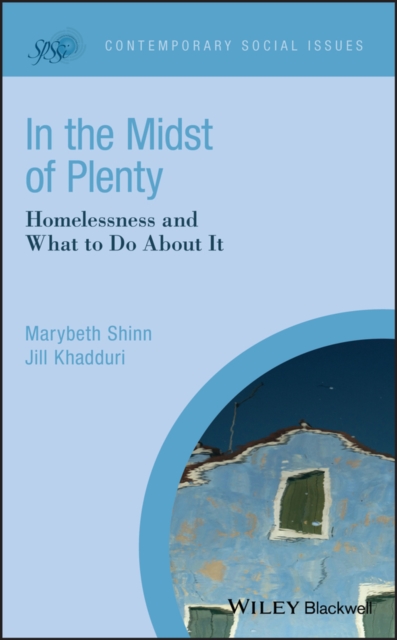
In the Midst of Plenty
Foreword by Nan Roman, President and CEO of the National Alliance to End Homelessness This book explains how to end the U.S. homelessness crisis by bringing together the best scholarship on the subject and sharing solutions that both local communities and national policy-makers can apply now. In the Midst of Plenty shifts understanding of homelessness away from individual disability to larger contexts of poverty, income inequality, housing affordability, and social exclusion. Homelessness experts Shinn and Khadduri provide guidance on how to end homelessness for people who experience it and how to prevent so many people from reaching the point where they have no alternative to sleeping on the street or in emergency shelters. The authors show that we know how to end homelessness—if we devote the necessary resources to doing so. In the Midst of Plenty: Homelessness and What to Do About It is an excellent resource for policy-makers, professionals in the homeless services system, and anyone else who wants to end homelessness. It also can serve as a text in undergraduate or masters courses in public policy, sociology, psychology, social work, urban studies, or housing policy. \"The knowledgeable and thoughtful authors of this book—two brilliant women who know as much as anyone in the country about the nature of homelessness and its solutions—have done a great service by taking us on a journey through the history of homelessness, how our responses have changed, and how we can end it.\" —Nan Roman, President and CEO National Alliance to End Homelessness. \"Shinn and Khadduri's new book is a thorough yet concise examination of what we know about the nature and causes of homelessness, and the crucial lessons learned. This critically important work provides a roadmap to restoring basic housing and income security as viable policy options, in the face of our daunting inequality divide that otherwise threatens millions with destitution and homelessness.\" —Dennis Culhane, Dana and Andrew Stone Professor of Social Policy, University of Pennsylvania \"Marybeth Shinn and Jill Khadduri have combined their significant expertise to create an essential guide about the history of modern homelessness and to offer a clear path forward to end this American tragedy. Their policy recommendations on ending homelessness are culled from the best about what we know works.\" —Barbara Poppe, Executive Director US Interagency Council on Homeless, 2009-2014
eBook

Haiku
Late one night, Michael--an addicted gambler who has lost everything, including himself--spots a woman in a white Rolls-Royce throwing something into the river. Convinced that the woman is a perfect blackmail target, he attempts to recruit a band of homeless outcasts to search for her. But news that a building is slated for demolition turns this halfhearted effort into a serious mission to find the ultimate problem-solver: money, and with it a new home for a precious collection of hardboiled paperbacks.
Book
Homelessness, Social Exclusion and Health
In a globalised world, the wealthy elite and the rough sleeper
negotiate the same streets, jostling for space in the doorways of
shops selling luxury goods, thus the winners and losers of global
capitalism meet in the same urban spaces. While the visibility of
rough sleepers has become a shorthand to frame poverty and
inequality, homelessness is not confined to the doorways of cities.
It is experienced in a multitude of different ways: as single
homeless people living in hostels, shelters and temporary supported
accommodation, as those 'sofa-surfing' and living in overcrowded
accommodation and as those who are termed 'statutory homeless',
waiting for a house from a social housing provider.
Homelessness is recognised as a multi-dimensional phenomenon.
The issue of homelessness and social exclusion has received
increasing attention in the wider arena of health and social care
policy and practice, the issue of homelessness and health has been
the focus of recent Public Health attention in Scotland. Positioned
within a health inequalities framework, homelessness is understood
to be 'both a consequence and a cause of poverty, social and health
inequality'. Homeless people experience poorer physical and mental
health than the general population and present a higher prevalence
of physical, mental and substance misuse issues.
The main aim of this book is to support readers wishing to
understand issues of homelessness, social exclusion and health at a
local level but to do so by framing these issues in a global
context. It expands notions of health by drawing on disciplines
outside the fields of housing and health to better comprehend the
ways that stigma, identity and urban geographies shape, frame and
present homelessness, especially for those who are rough
sleeping.
eBook