
Catalogue Search | MBRL


Are you sure you want to remove the book from the shelf?

{{itemTitle}}
4
result(s) for
"Homer Criticism and interpretation Congresses."
Sort by:


Written Voices, Spoken Signs
Written Voices, Spoken Signsis a stimulating introduction to new perspectives on Homer and other traditional epics. Taking advantage of recent research on language and social exchange, the nine essays in this volume focus on performance and audience reception of oral poetry.
These innovative essays by leading scholars of Homer, oral poetics, and epic invite us to rethink some key concepts for an understanding of traditional epic poetry. Egbert Bakker examines the epic performer's use of time and tense in recounting a past that is alive. Tackling the question of full-length performance of the monumentalIliad, Andrew Ford considers the extent to which the work was perceived as a coherent whole in the archaic age. John Miles Foley addresses questions about spoken signs and the process of reference in epic discourse, and Ahuvia Kahane studies rhythm as a semantic factor in the Homeric performance. Richard Martin suggests a new range of performance functions for the Homeric simile. And Gregory Nagy establishes the importance of one feature of epic language, the ellipsis. These six essays centered on Homer engage with fundamental issues that are addressed by three essays primarily concerned with medieval epic: those by Franz Bäuml on the concept of fact; by Wulf Oesterreicher on types of orality; and by Ursula Schaefer on written and spoken media. In their Introduction the editors highlight the underlying approach and viewpoints of this collaborative volume.Reviews of this book:\"Despite its wide range of topics and approaches, the volume has a clear thematic focus. All contributors seek to leave behind the more formal concerns of past generations of scholars and aim instead at an understanding of orality as that which is (conceptually or actually) close, immediate, or performed. In their joint search for the new picture, classicists, linguists, and medievalists discover a range of different 'oralities'.\"
--J. Haubold,Classical Review
eBook

Written voices, spoken signs : tradition, performance, and the epic text
Written Voices, Spoken Signs is a stimulating introduction to new perspectives on Homer and other traditional epics. Taking advantage of recent research on language and social exchange, the nine innovative essays in this volume--by leading scholars of Homer, oral poetics, and epic--focus on performance and audience reception of oral poetry.
eBook
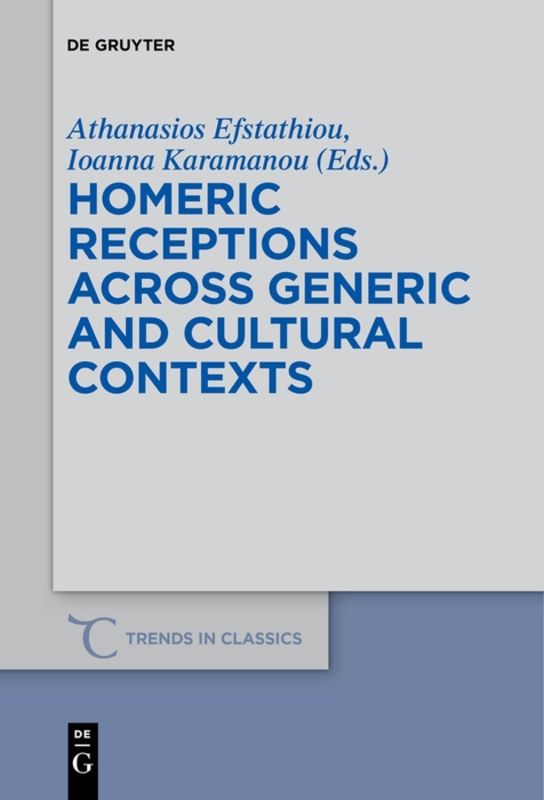
Homeric receptions across generic and cultural contexts
This collective volume provides a fresh perspective on Homeric reception through a methodologically focused, interdisciplinary investigation of the transformations of Homeric epic within varying generic and cultural contexts. It explores how various aspects of Homeric poetics appeal and can be mapped on to a diversity of contexts under different socio-historical, intellectual, literary and artistic conditions. The volume brings together internationally acclaimed scholars and acute young researchers in the fields of classics and reception studies, yielding insight into the varied strategies and ideological forces that define Homeric reception in literature, scholarship and the performing arts (theatre, film and music) and shape the 'horizon of expectations' of readers and audience. This collection also showcases that the wide-ranging 'migration' of Homeric material through time and across place holds significant cultural power, being instrumental in the construction of new cultural identities. The volume is of particular interest to scholars in the fields of classics, reception and cultural studies and the performing arts, as well as to readers fascinated by ancient literature and its cultural transformations.
eBook