
Catalogue Search | MBRL


Are you sure you want to remove the book from the shelf?

{{itemTitle}}
192
result(s) for
"Homer Criticism and interpretation."
Sort by:

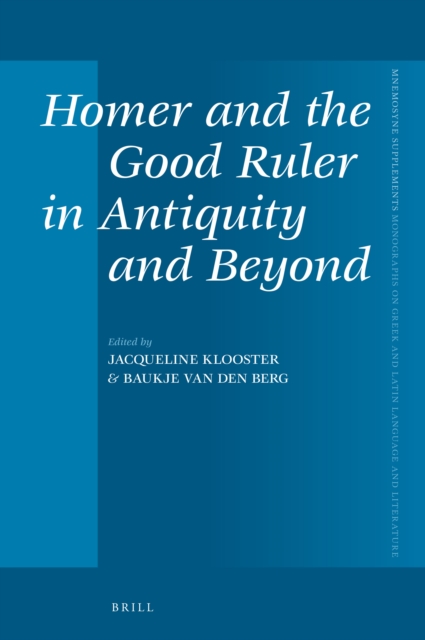
Homer and the Good Ruler in Antiquity and Beyond
Homer and the Good Ruler in Antiquity and Beyond focuses on the important question of how and why later authors employ Homeric poetry to reflect on various types and aspects of leadership. In a range of essays discussing generically diverse receptions of the epics of Homer in historically diverse contexts, this question is answered in various ways. Rather than considering Homer's works as literary products, then, this volume discusses the pedagogic dimension of the Iliad and the Odyssey as perceived by later thinkers and writers interested in the parameters of good rule, such as Plato, Philodemus, Polybius, Vergil, and Eustathios.
eBook


The Talking Greeks
When considering the question of what makes us human, the ancient Greeks provided numerous suggestions. This book argues that the defining criterion in the Hellenic world, however, was the most obvious one: speech. It explores how it was the capacity for authoritative speech which was held to separate humans from other animals, gods from humans, men from women, Greeks from non-Greeks, citizens from slaves, and the mundane from the heroic. John Heath illustrates how Homer's epics trace the development of immature young men into adults managing speech in entirely human ways and how in Aeschylus' Oresteia only human speech can disentangle man, beast, and god. Plato's Dialogues are shown to reveal the consequences of Socratically imposed silence. With its examination of the Greek focus on speech, animalization, and status, this book offers new readings of key texts and provides significant insights into the Greek approach to understanding our world.
eBook


Homer
In this accessible and concise introduction, Barbara Graziosi considers Homer's famous works and their impact on readers throughout the centuries. She shows how the Iliad and the Odyssey benefit from a tradition of reading that spans well over two millennia, from the impressive scholars at the library of Alexandria, in the third and second centuries BCE, who wrote some of the first commentaries on the Homeric epics. Summaries of these scholars' notes made their way into the margins of Byzantine manuscripts; from Byzantium the annotated manuscripts travelled to Italy; and the ancient notes finally appeared in the first printed editions of Homer, eventually influencing our interpretation of Homer's work today. Along the way, Homer's works have inspired artists, writers, philosophers, musicians, playwrights, and film-makers. Exploring the main literary, historical, cultural, and archaeological issues at the heart of Homer's works, Graziosi analyses the enduring appeal of Homer and his iconic works.
Book
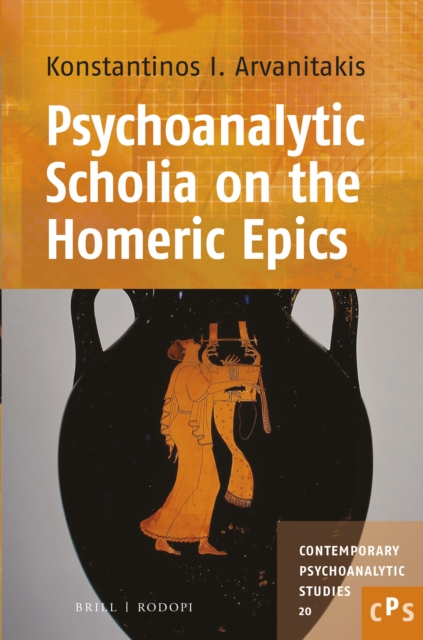
Psychoanalytic Scholia on the Homeric Epics
This work attempts a psychoanalytic listening to the 'oral' Homeric epics in an effort to extract, as it were, from the ancient text certain elements of psychoanalytic understanding that are of relevance to contemporary psychoanalysis. There is, in addition, a consideration of related philosophical and linguistic issues that are linked to the basic psychoanalytic concepts that emerge from such a listening.
eBook

Psychoanalytic scholia on the Homeric epics
\"This work attempts a psychoanalytic listening to the 'oral' Homeric epics in an effort to extract, as it were, from the ancient text certain elements of psychoanalytic understanding that are of relevance to contemporary psychoanalysis. There is, in addition, a consideration of related philosophical and linguistic issues that are linked to the basic psychoanalytic concepts that emerge from such a listening. The main themes treated rotate around the central axis of time as it is expressed in the Homeric epics. Thus, questions of transition, loss, mourning, tolerance, identity, metaphor and tragic fragmentation are addressed as they relate to the ancient text. The process of metabasis along contrasting psychic states of being is discussed as it provides the frame for the construction of the basic interval of time and of the flux of human identity. Although psychoanalysis from its early beginnings has shown - largely owing to Freud's positing the Oedipus complex as the nuclear conflict - a distinct interest in classical Antiquity, the area of the great Homeric Epics has been singularly neglected as a chosen focus of psychoanalytic attention. It is as if the Homeric Epics belonged to a prehistoric pre-Oedipal world which, for a long time, was not the dominant concern of psychoanalysis. The merit of this book lies in the fact that it fills part of this lacuna in psychoanalytic studies\". -- Provided by publisher
Book

The Hippos of Troy
This book addresses perhaps the most famous episode in Classical mythology: the Wooden Horse of Troy. Through analysis of words, images and wrecks, the author proposes a new interpretation of what Homer actually intended when he spoke of the 'hippos' used by the Greeks to conquer Troy: a particular ship type, used to pay tribute to Levantine kings.
eBook