
Catalogue Search | MBRL


Are you sure you want to remove the book from the shelf?

{{itemTitle}}
8
result(s) for
"Hong Kierkegaard Library"
Sort by:

Kierkegaard's journals and notebooks
For over a century, the Danish thinker Søren Kierkegaard (1813-55) has been at the center of a number of important discussions, concerning not only philosophy and theology, but also, more recently, fields such as social thought, psychology, and contemporary aesthetics, especially literary theory.
Despite his relatively short life, Kierkegaard was an extraordinarily prolific writer, as attested to by the 26-volume Princeton University Press edition of all of his published writings. But Kierkegaard left behind nearly as muchunpublishedwriting, most of which consists of what are called his \"journals and notebooks.\" Kierkegaard has long been recognized as one of history's great journal keepers, but only rather small portions of his journals and notebooks are what we usually understand by the term \"diaries.\" By far the greater part of Kierkegaard's journals and notebooks consists of reflections on a myriad of subjects--philosophical, religious, political, personal. Studying his journals and notebooks takes us into his workshop, where we can see his entire universe of thought. We can witness the genesis of his published works, to be sure--but we can also see whole galaxies of concepts, new insights, and fragments, large and small, of partially (or almost entirely) completed but unpublished works.Kierkegaard's Journals and Notebooksenables us to see the thinker in dialogue with his times and with himself.
Volume 4 of this 11-volume series includes the first five of Kierkegaard's well-known \"NB\" journals, which contain, in addition to a great many reflections on his own life, a wealth of thoughts on theological matters, as well as on Kierkegaard's times, including political developments and the daily press.
Kierkegaard wrote his journals in a two-column format, one for his initial entries and the second for the extensive marginal comments that he added later. This edition of the journals reproduces this format, includes several photographs of original manuscript pages, and contains extensive scholarly commentary on the various entries and on the history of the manuscripts being reproduced.
eBook

Kierkegaard's Journals and Notebooks: Volume 7, Journals NB15-NB20
For over a century, the Danish thinker Søren Kierkegaard (1813-55) has been at the center of a number of important discussions, concerning not only philosophy and theology, but also, more recently, fields such as social thought, psychology, and contemporary aesthetics, especially literary theory.
Despite his relatively short life, Kierkegaard was an extraordinarily prolific writer, as attested to by the 26-volume Princeton University Press edition of all of his published writings. But Kierkegaard left behind nearly as much unpublished writing, most of which consists of what are called his \"journals and notebooks.\" Kierkegaard has long been recognized as one of history's great journal keepers, but only rather small portions of his journals and notebooks are what we usually understand by the term \"diaries.\" By far the greater part of Kierkegaard's journals and notebooks consists of reflections on a myriad of subjects--philosophical, religious, political, personal. Studying his journals and notebooks takes us into his workshop, where we can see his entire universe of thought. We can witness the genesis of his published works, to be sure--but we can also see whole galaxies of concepts, new insights, and fragments, large and small, of partially (or almost entirely) completed but unpublished works.Kierkegaard's Journals and Notebooksenables us to see the thinker in dialogue with his times and with himself.
Volume 7 of this 11-volume series includes six of Kierkegaard's important \"NB\" journals (Journals NB15 through NB20), covering the months from early January 1850 to mid-September of that year. By this time it had become clear that popular sovereignty, ushered in by the revolution of 1848 and ratified by the Danish constitution of 1849, had come to stay, and Kierkegaard now intensified his criticism of the notion that everything, even matters involving the human soul, could be decided by \"balloting.\" He also continued to direct his barbs at the established Danish Church and its clergy (particularly Bishop J. P. Mynster and Professor H. L. Martensen), at the press, and at the attempt by modern philosophy to comprehend the incomprehensibility of faith. Kierkegaard's reading notes include entries on Augustine, the Stoics, German mystics, Luther, pietist authors, and Rousseau, while his autobiographical reflections circle around the question of which, if any, of several essays explaining his life and works he ought to publish. Perhaps unsurprisingly, Kierkegaard's more personal reflections return once again to his public feud with M. A. Goldschmidt and his broken engagement to Regine Olsen.
Kierkegaard wrote his journals in a two-column format, one for his initial entries and the second for the extensive marginal comments that he added later. This edition of the journals reproduces this format, includes several photographs of original manuscript pages, and contains extensive scholarly commentary on the various entries and on the history of the manuscripts being reproduced.
eBook
Kierkegaard's journals and notebooks
For over a century, the Danish thinker Søren Kierkegaard (1813-55) has been at the center of a number of important discussions, concerning not only philosophy and theology, but also, more recently, fields such as social thought, psychology, and contemporary aesthetics, especially literary theory.
Despite his relatively short life, Kierkegaard was an extraordinarily prolific writer, as attested to by the 26-volume Princeton University Press edition of all of his published writings. But Kierkegaard left behind nearly as much unpublished writing, most of which consists of what are called his \"journals and notebooks.\" Kierkegaard has long been recognized as one of history's great journal keepers, but only rather small portions of his journals and notebooks are what we usually understand by the term \"diaries.\" By far the greater part of Kierkegaard's journals and notebooks consists of reflections on a myriad of subjects--philosophical, religious, political, personal. Studying his journals and notebooks takes us into his workshop, where we can see his entire universe of thought. We can witness the genesis of his published works, to be sure--but we can also see whole galaxies of concepts, new insights, and fragments, large and small, of partially (or almost entirely) completed but unpublished works.Kierkegaard's Journals and Notebooksenables us to see the thinker in dialogue with his times and with himself.
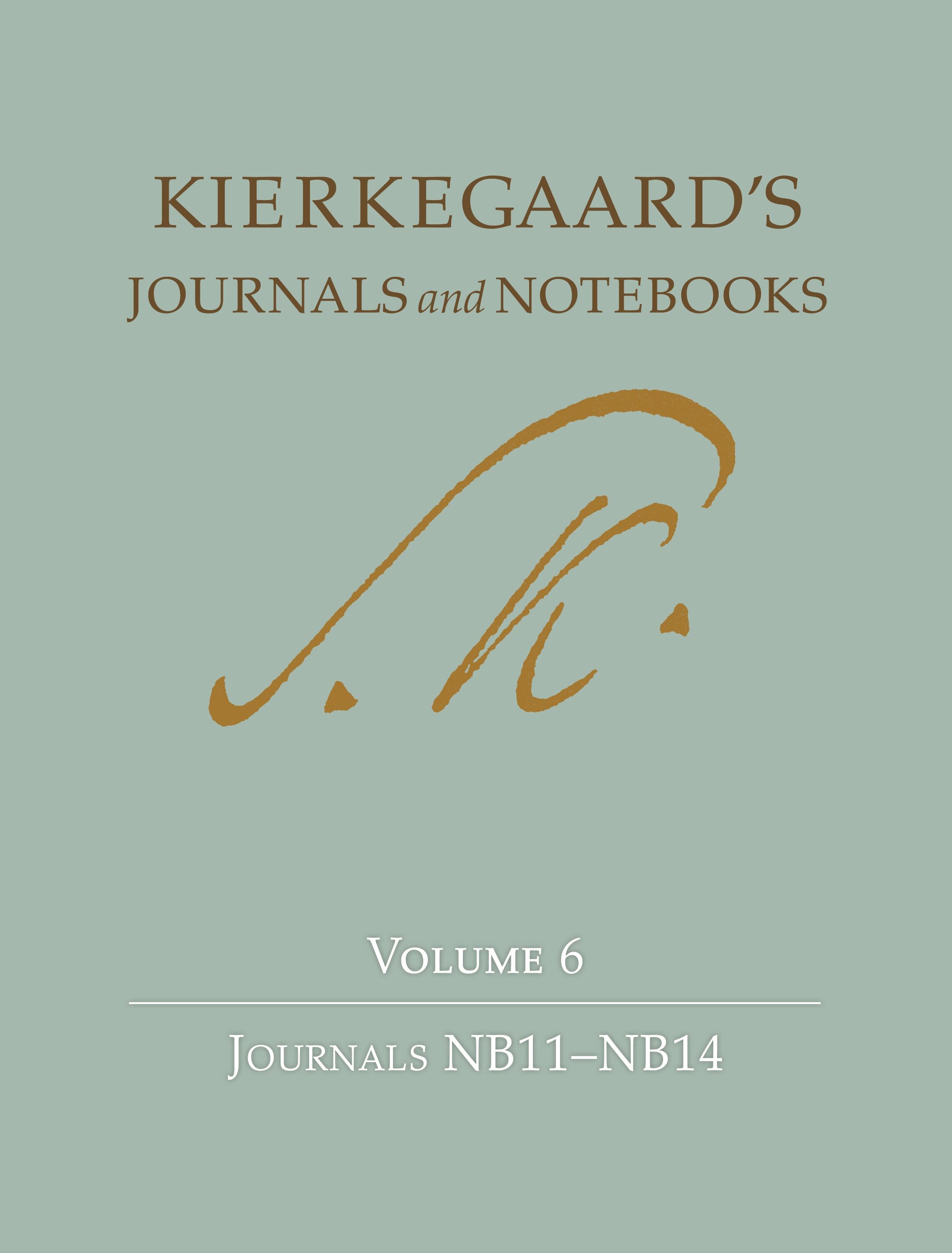
Volume 6 of this 11-volume series includes four of Kierkegaard's important \"NB\" journals (Journals NB11 through NB14), covering the months from early May 1849 to the beginning of 1850. At this time Denmark was coming to terms with the 1848 revolution that had replaced absolutism with popular sovereignty, while the war with the German states continued, and the country pondered exactly what replacing the old State Church with the Danish People's Church would mean. In these journals Kierkegaard reflects at length on political and, especially, on ecclesiastical developments. His brooding over the ongoing effects of his fight with the satirical journalCorsaircontinues, and he also examines and re-examines the broader personal and religious significance of his broken engagement with Regine Olsen. These journals also contain reflections by Kierkegaard on a number of his most important works, including the two works written under his \"new\" pseudonym Anti-Climacus (The Sickness unto DeathandPractice in Christianity) and his various attempts at autobiographical explanations of his work. And, all the while, the drumbeat of his radical critique of \"Christendom\" continues and escalates.
Kierkegaard wrote his journals in a two-column format, one for his initial entries and the second for the extensive marginal comments that he added later. This edition of the journals reproduces this format, includes several photographs of original manuscript pages, and contains extensive scholarly commentary on the various entries and on the history of the manuscripts being reproduced.
eBook

The Quotable Kierkegaard
\"Why I so much prefer autumn to spring is that in the autumn one looks at heaven--in the spring at the earth.\"--Søren Kierkegaard
The father of existentialism, Søren Kierkegaard (1813-1855) was a philosopher who could write like an angel. With only a sentence or two, he could plumb the depths of the human spirit. In this collection of some 800 quotations, the reader will find dazzling bon mots next to words of life-changing power. Drawing from the authoritative Princeton editions of Kierkegaard's writings, this book presents a broad selection of his wit and wisdom, as well as a stimulating introduction to his life and work.
Organized by topic, this volume covers notable Kierkegaardian concerns such as anxiety, despair, existence, irony, and the absurd, but also erotic love, the press, busyness, and the comic. Here readers will encounter both well-known quotations (\"Life must be understood backward. But then one forgets the other principle, that it must belived forward\") and obscure ones (\"Beware false prophets who come to you in wolves' clothing but inwardly are sheep--i.e., the phrasemongers\"). Those who spend time in these pages will discover the writer who said, \"my grief is my castle,\" but who also taught that \"the best defense against hypocrisy is love.\"
Illuminating and delightful, this engaging book also provides a substantial portrait of one of the most influential of modern thinkers.
Gathers some 800 quotations Drawn from the authoritative Princeton editions of Kierkegaard's writings Includes an introduction, a brief account and timeline of Kierkegaard's life, a guide to further reading, and an index
eBook

Kierkegaard's journals and notebooks
For over a century, the Danish thinker Søren Kierkegaard (1813-55) has been at the center of a number of important discussions, concerning not only philosophy and theology, but also, more recently, fields such as social thought, psychology, and contemporary aesthetics, especially literary theory.
Despite his relatively short life, Kierkegaard was an extraordinarily prolific writer, as attested to by the 26-volume Princeton University Press edition of all of his published writings. But Kierkegaard left behind nearly as muchunpublishedwriting, most of which consists of what are called his \"journals and notebooks.\" Kierkegaard has long been recognized as one of history's great journal keepers, but only rather small portions of his journals and notebooks are what we usually understand by the term \"diaries.\" By far the greater part of Kierkegaard's journals and notebooks consists of reflections on a myriad of subjects--philosophical, religious, political, personal. Studying his journals and notebooks takes us into his workshop, where we can see his entire universe of thought. We can witness the genesis of his published works, to be sure--but we can also see whole galaxies of concepts, new insights, and fragments, large and small, of partially (or almost entirely) completed but unpublished works.Kierkegaard's Journals and Notebooksenables us to see the thinker in dialogue with his times and with himself.
Volume 5 of this 11-volume series includes five of Kierkegaard's important \"NB\" journals (Journals NB6 through NB10), covering the months from summer 1848 through early May 1849. This was a turbulent period both in the history of Denmark--which was experiencing the immediate aftermath of revolution and the fall of absolutism, a continuing war with the German states, and the replacement of the State Church with the Danish People's Church--and for Kierkegaard personally. The journals in the present volume include Kierkegaard's reactions to the political upheaval, a retrospective account of his audiences with King Christian VIII, deliberations about publishing an autobiographical explanation of his writings, and an increasingly harsh critique of the Danish Church. These journals also reflect Kierkegaard's deep concern over his collision with the satirical journalCorsair, an experience that helped radicalize his view of \"essential Christianity\" and caused him to ponder the meaning of martyrdom.
Kierkegaard wrote his journals in a two-column format, one for his initial entries and the second for the extensive marginal comments that he added later. This edition of the journals reproduces this format, includes several photographs of original manuscript pages, and contains extensive scholarly commentary on the various entries and on the history of the manuscripts being reproduced.
eBook

What Would Kierkegaard Do?
At 94, Howard Hong knows more about Denmark's most famous philosopher than anyone alive--or at least he has known it longer. Co-founder of the Howard V. and Edna H. Hong Kierkegaard Library at St. Olaf College, the largest Kierkegaard research library in the world, Hong, over a career of more than 60 years, edited and translated with his wife, Edna, the complete works of Soren Kierkegaard (1813-55).
Journal Article

The Hong Kierkegaard Library: A Research Collection at St. Olaf College
The Kierkegaard Indices (Brill, 1970) OrdbogoverdetDanskeSprqg (Gyldendal, 1919),Nordisk Conversationslexikon (Forlagsbeauet, 1884.), Salmonsens Store Illustrerede Konversationsleksikon (Salmonsen, 1893), Dansk Litterature Historie (Politiken, 1964; Gyldendal, 1990), Dansk Biografisk Lexikon (Gyldendal, 1887), Danmarks Historie (Politiken, 1963), Forfatterlexikon omfattende Danmark, Norge og Island indtil 1814 (Aschehoug, 1924),DmDanskeFolkehojskolegennemHundrede Aar (Skandinavisk Bogforlag, 1939), and Den Danske Kirke og vor Slsgt (Skandinavisk Bogforlag, 1943)- Newer parts of the collection include a Kierkegaard newspaper clipping file, consisting mainly of Danish newspaper articles dating from the past forty years (the bulk of these acquired from a single collector) and, under development, an archive of materials documenting the history of the Kierkegaard Library and the Hongs' translation projects, and, more generally, the history of Kierkegaard studies. The Kierkegaard Library recendy acquired the personal library and papers of Julia Watkin, an accomplished Kierkegaard scholar and founder of the International Kierkegaard Newsletter, who died in 2005.23 Through the dedicated stewardship of curators, librarians, and conservators-and with the support of the St. Olaf community and the scholarly contributions of Kierkegaardians from around the worldHoward and Edna Hong's private collection has been transformed into a world-class research collection.
Journal Article
Kierkegaard in America: An Interview With Howard and Edna Hong
Upon the recommendation of its theological faculty, an honoran doctorate was bestowed upon Howard V Hong in 1992 for his lifelong dedication to spreading knowledge of Soren Kierkegaard's passionate thought in the English-speaking world. Besides their largescale and lifelong translation project, which has provided a new and solid foundation for all further Kierkegaard research in English, tiiey have been fully engaged in teaching and literary activity. First of all, Ibsen's denid: I don't read Kierkegaard; I haven't read Kierkegaard, but my wife reads Kierkegaard.
Journal Article