
Catalogue Search | MBRL


Are you sure you want to remove the book from the shelf?

{{itemTitle}}
56
result(s) for
"Horace Influence."
Sort by:


Lucretian receptions : history, the sublime, knowledge
\"Lucretius' De Rerum Natura, one of the greatest Latin poems, worked a powerful fascination on Virgil and Horace, and continued to be an important model for later poets in antiquity and after, including Milton. This innovative set of studies on the reception of Lucretius is organized round three major themes: history and time, the sublime, and knowledge. The De Rerum Natura was foundational for Augustan poets' dealings with history and time in the new age of the principate. It is also a major document in the history of the sublime; Virgil and Horace engage with the Lucretian sublime in ways that exercised a major influence on the sublime in later antique and Renaissance literature. The De Rerum Natura presents a confident account of the ultimate truths of the universe; later didactic and epic poets respond with varying degrees of certainty or uncertainty to the challenge of Lucretius' Epicurean gospel\"--Provided by publisher.
BOOK

Greek and Latin Criticism during the Roman Empire
This chapter contains sections titled:
Horace (65–8
BC
)
Longinus (First Century
AD
)
Neo‐Platonism
Book Chapter

Poetic Interplay
The lives of Catullus and Horace overlap by a dozen years in the first century BC. Yet, though they are the undisputed masters of the lyric voice in Roman poetry, Horace directly mentions his great predecessor, Catullus, only once, and this reference has often been taken as mocking. In fact, Horace's allusion, far from disparaging Catullus, pays him a discreet compliment by suggesting the challenge that his accomplishment presented to his successors, including Horace himself. In Poetic Interplay, the first book-length study of Catullus's influence on Horace, Michael Putnam shows that the earlier poet was probably the single most important source of inspiration for Horace's Odes, the later author's magnum opus. Except in some half-dozen poems, Catullus is not, technically, writing lyric because his favored meters do not fall into that category. Nonetheless, however disparate their preferred genres and their stylistic usage, Horace found in the poetry of Catullus, whatever its mode of presentation, a constant stimulus for his imagination. And, despite the differences between the two poets, Putnam's close readings reveal that many of Horace's poems echo Catullus verbally, thematically, or both. By illustrating how Horace often found his own voice even as he acknowledged Catullus's genius, Putnam guides us to a deeper appreciation of the earlier poet as well.
eBook

What Exile Ever Fled His Own Mind?
The Roman poet Horace provides an unlikely-seeming source of inspiration and consolation to a writer emerging in South Africa in the late 1980s. This account essays some history of the way one poet can work on another across cultures and millennia, noting the mediating force of W.H. Auden and the significance of form over content in brokering a stylistic affection that has lasted. The essay follows also Gilbert Highet’s premise in his Poets in a Landscape, by following the author in his tracks to Italy and the valley of Horace’s Digentia, now the Licenza river. Whether the essay is about the formation of a twenty-first century echo or the recovery of a two-thousand-year-old exemplum in outlandish circumstances is moot, and probably entangled.
This essay in creative non-fiction expresses a long affinity for the Roman poet Quintus Hotarius Flaccus (Horace), and the circumstances of that affinity with particular reference to the author’s encounter with him across South Africa and Italy, in youth and maturity. The essay makes elliptical reference to the work of the poet but does not set out any extended critical analysis; it is more gently interested in the formation of the author’s own intellectual and poetic community with the ancient Roman. In broad canvas it problematises the reception of the so-called classics in the global South, but more pronouncedly represents the formation of a writerly and philosophical outlook in a time of transformation. The essay is preoccupied also with the endurance of place, or ideologised space, in the persistence of a canonical classic, and extends its encounter with Horace’s Sabine hills and villa to the remote-but-related landscape of the (South African) mind.
Journal Article

LOOKING EDGEWAYS. PURSUING ACROSTICS IN OVID AND VIRGIL
What follows is an experiment in reading practice. I propose that we read some key passages of the Aeneid and the Metamorphoses in the active pursuit of acrostics and telestics, just as we have been accustomed to read them in the active pursuit of allusions and intertexts; and that we do so with the same willingness to make sense of what we find. The measure of success of this reading practice will be the extent to which our understanding of these familiar and well-studied texts can be usefully enriched by our interpretation of our discoveries (or rediscoveries). These will include an undiscovered authorial signature NASO in the ‘second proem’ of the Metamorphoses ; an unnoticed self-referential response to Horace with NITIDO at the centre of Ovid's epic and a similarly self-referential AVSVM at the centre of Virgil's epic; in the Aeneid we will also find glances to Aratus with LEPTE and an Aratean anagram on Aeneas’ shield; and two new acrostics connecting Dido, Ajax and Lavinia.
Journal Article

Changing Chinese Ideas into a Native English Tradition
Horace Walpole has long been known for his nationalistic repudiation of Chinese landscaping. By scrutinizing the discrepancy between his rhetoric and actions, this essay strives to cast a new light on the complex English reception and acceptance of Chinese gardening ideas in the eighteenth century.
Journal Article
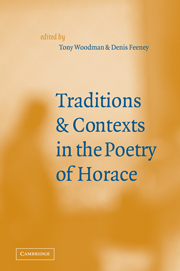
Traditions and Contexts in the Poetry of Horace
This book explores the whole range of the output of an exceptionally versatile and innovative poet, from the Epodes to the literary-critical Epistles. Distinguished scholars of diverse background and interests introduce readers to a variety of critical approaches to Horace and to Latin poetry. Close attention is paid throughout to the actual text of Horace, with many of the chapters focusing on reading a single poem. These close readings are then situated in a number of different political, philosophical and historical contexts. The book sheds light not only on Horace but on the general problems confronting Latinists in the study of Augustan poetry, and it will be of value to a wide range of upper-level Latin students and scholars.
eBook