
Catalogue Search | MBRL


Are you sure you want to remove the book from the shelf?

{{itemTitle}}
884
result(s) for
"Horkheimer, Max (1895-1973)"
Sort by:

Max Horkheimer and the foundations of the Frankfurt School
\"This book provides an intellectual biography of Max Horkheimer during the early and middle phases of his life and analyzes his model of early Critical Theory\"-- Provided by publisher.
Book

Leaving Marxism : studies in the dissolution of an ideology
This book seeks to understand the failure of Marxism by viewing it up close, in the experiences of three important Marxist intellectuals, each of whom embraced Marxism early in life and later decisively rejected it. Their experiences provide the framework for a more general account of modern ideological disenchantment.
eBook
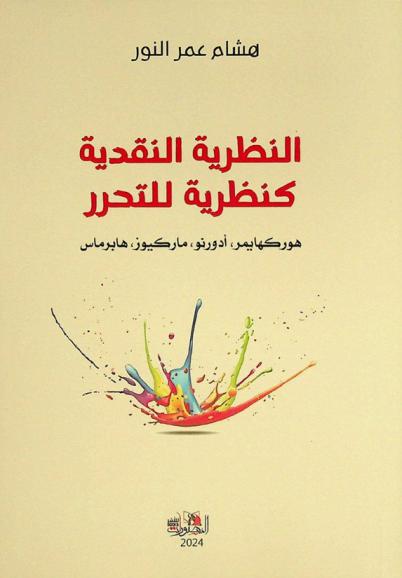
النظرية النقدية كنظرية للتحرر : هوركهايمر، أدورنو، ماركيوز، هابرماس
هذه المقالات الخمسة تمت كتابتها كلها في أوائل هذه الألفية، والرابط بينها واضح فكلها ترتبط بالنظرية النقدية عند مدرسة فرانكفورت. وهي تتناول مفكريها الأساسين في الجيل الأول : هوركهايمر، أدورنو، ماركيوز، هابرماس ممثلها الرئيس في الجيل الثاني. والمقالات كلها يربطها هم وحيد، ألا وهو مشروع التحرر الإنساني العظيم (على حد قول بولا) فبعد انهيار المشروع بانهيار الاتحاد السوفيتي والمعسكر الشرقي افتقدت حركة التحرر الأساس النظري الذي يستوعب التحولات الهائلة التي جرت في الفلسفة والمعرفة والعلم والتكنولوجيا.
Book

Otto Kirchheimer's The Policy of the Catholic Church Toward the Jews (1943): A Forgotten Chapter of the Frankfurt School's Research on Antisemitism
This article places Otto Kirchheimer's unpublished essay, The Policy of the Catholic Church Toward the Jews, within the context of the Frankfurt School's studies of antisemitism during the 1940s. It identifies the traces left by Kirchheimer's text on the Institute's subsequent research, and emphasizes the differences between Kirchheimer's approach and the future theory of antisemitism conceived by Max Horkheimer and Theodor W. Adorno, suggesting that this essay was the starting point for larger research projects on antisemitism by Horkheimer's Institute for Social Research. Kirchheimer's later writings on antisemitism are also discussed.
Journal Article

Consequences of Enlightenment
What is the relationship between contemporary intellectual culture and the European Enlightenment it claims to reject? In Consequences of Enlightenment, Anthony Cascardi revisits the arguments advanced in Horkheimer and Adorno's seminal work Dialectic of Enlightenment. Cascardi argues against the view that postmodern culture has rejected Enlightenment beliefs and explores instead the continuities contemporary theory shares with Kant's failed ambition to bring the project of Enlightenment to completion. He explores the link between aesthetics and politics in thinkers as diverse as Habermas, Derrida, Arendt, Nietzsche, Hegel, and Wittgenstein in order to reverse the tendency to see works of art simply in terms of the worldly practices among which they are situated.
eBook

Offline: Rethinking the world
[...]evidence for Germany's decision to upgrade its role in global health comes from its commitment to develop the World Health Summit into a pre-eminent policy discussion forum. A decade ago, the 2013 replenishment saw just four countries in sub-Saharan Africa contribute $38 million. In global health, I think the roles of India and China, despite their demographic strengths, have been exaggerated, while African countries are too often neglected.
Journal Article

Communicationism: Cold War Humanism
Rajagopal talks about cold war humanism. Media as a term has become so commonplace that it is easy to overlook the fact that one word designates all or virtually all technologies of communication, as if they could all be assumed to act in concert, or as if they were uniform. Max Horkheimer and Theodor Adorno noted that film, radio and the press were all projecting similar effects, they offered a critical concept, arguing that discrete media technologies and their distinct forms of expression were collapsing and merging into each other. \"Culture\" was being reduced to formulaic repetitions of social unity and uniformity, they argued, instead of providing ideas that transcended the status quo or militated against its reproduction.
Journal Article

Pragmatism, Critical Theory and Business Ethics: Converging Lines
There is a \"Pragmatist turn\" visible in the field of organization science today, resulting from a renewed interest in the work of Pragmatist philosophers like Dewey, Mead, Peirce, James and others, and in its implications for the study of organizations. Following Wicks and Freeman (1998), in the past decade Pragmatism has also entered the field of business ethics, which, however, has not been uniformly applauded in that field. Some (Critical) scholars fear that Pragmatism may enhance already existing positivist and managerialist tendencies in current business ethics, while others see more emancipatory potential in Pragmatism, arguing that it complements and supports stakeholder theory. In this paper, a comparison of the philosophical underpinnings of Pragmatist and Critical conceptions of business ethics is offered, concentrating on the Pragmatism of John Dewey and the Critical theory of the Frankfurt School, in particular of Axel Honneth. It is argued that these two developed along two converging lines. Along the first line, Dewey was far more skeptical and critical of capitalism than is often thought. Along the second line, the reactions to Pragmatism of Frankfurt School Critical theorists developed over time from generally hostile (Horkheimer, Marcuse), to partially inclusive (Habermas), to more fully integrative (Honneth). At the crossroads of these converging lines a Pragmatist Critical perspective is developed and exemplified, and its implications for business ethics are outlined.
Journal Article


The Linguistic Turn in the Early Frankfurt School: Horkheimer and Adorno
Was there a linguistic turn in Frankfurt School Critical Theory before Habermas's communications-theoretic one? Might later Wittgenstein and the early Frankfurt School have adopted similar pictures of language? I propose that both questions should be answered affirmatively, focusing on Horkheimer's Eclipse of Reason. I argue that, thanks to the picture of language that Horkheimer and Adorno share with (later) Wittgenstein, we can reconstruct their theory in a way that renders it more defensible. Insofar as the human life form and language are inseparable, language can be an inextinguishable reservoir of what Horkheimer called \"objective reason.\" Recognizing this allows us to answer Habermas's critique of Horkheimer and Adorno. Moreover, paying attention to this inseparableness can enable us to engage in disclosing social critique (for example, regarding current debates about sustainability).
Journal Article