
Catalogue Search | MBRL


Are you sure you want to remove the book from the shelf?

{{itemTitle}}
581
result(s) for
"Horses Color."
Sort by:


Introduction
Identification and definition of horse color are important for several reasons, and each of these reasons demands a different organization and presentation of the material. Reasons for accurate horse color classification include identification of individual horses for legal purposes, health records, and breed registrations. An understanding of genetics is almost essential for breeders interested in producing specific colors of foals. An overview of some principles of genetics as well as some definitions of genetic terms is a good starting point for this endeavor. A fundamental principle to understand about horse color is that color in horses is due to the presence of pigments in the hair. Two major pigments account for all colors of mammals (including horses). One of these is eumelanin (YOO mel a nin), which is responsible for black or slate blue. The other pigment is pheomelanin (FEE oh mel a nin), which produces colors ranging from reddish brown or tan to yellow.
Book Chapter
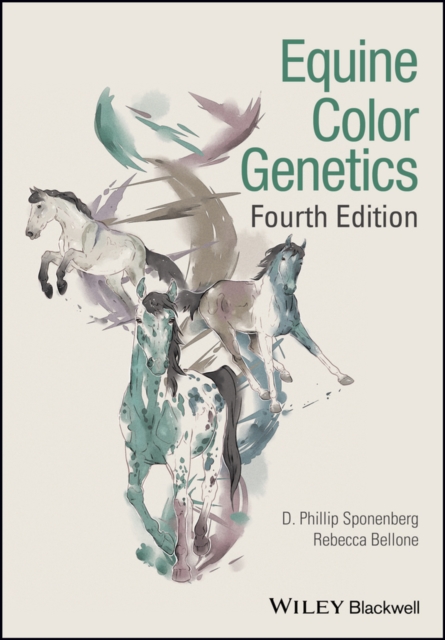
Equine Color Genetics
Equine Color Genetics, Fourth Edition presents a detailed examination of the color variation in horses and donkeys and the genetic mechanisms that produce color variations.
* Thoroughly covers the basic colors in horses, including bay, chestnut, black, and brown
* Details the genetic basis of the colors built from the basic coat color, including dilutions and white patterning
* Provides an explanation of genetic mechanisms that determine coat color
* Presents a thorough revision and update, including new advances in molecular genetics, biochemistry, molecular mechanisms, genetic loci, coat colors before domestication, and more
* Offers a new introduction describing the principles of genetics and genomics research to help outline how knowledge is discovered and to assist the reader in understanding concepts covered in the book
eBook
Horse Color and Horse Breeding
Fashions in horse color can change over the years, such that colors can fall into or out of favor with horse breeders. The end result is that appreciation of color variation is inextricably woven into many horse breeding cultures. Breeders in some regions have attempted to standardize horse colors across several breeds in the region. In England the preferred colors for many horse breeds are generally bay, chestnut, brown, black, and grey. Iceland has its own unique approach to color in the Icelandic Horse breed. The general tendency in Iceland is to ignore color altogether when selecting horses. The color variability of Icelandic horses is especially noteworthy because Icelandic Horses have been isolated from all others for about 1000 years. Among the gaited breeds of the USA rare colors are highly desired, and the silver dapple allele has a reasonably high frequency. These breeds also have the cremello, dun, and champagne alleles.
Book Chapter
Summary Tables
This chapter first tabulates horse color names. The names for main color category designations are usually used in a narrow sense for a specific color within the category, as well as for the category as a whole. The chapter then tabulates the main features of each pattern of white hairs and the results of genes affecting colors. The loci and the various alleles are outlined, with the mechanism of action if it is known. Wild‐type alleles are the original sequences for the locus. For most loci the wild type has no DNA test, but for a handful a test is available. The chapter further tabulates a list of the usual genotypes of major colors. This table assumes accurate and reasonably detailed identification of horse colors, so that brown is separated out from sooty bay, sorrel from mealy chestnut, and smoky is never misidentified as black.
Book Chapter
Basic Dark Horse Colors: Bay, Chestnut, Black, and Brown
Dark horse colors are generally the most common colors in any breed, and the most common of these are usually referred to as “dark” or “hard” colors. Most observers include bay, black, brown, and chestnut as the “hard colors”. The genetic control of the bay, chestnut, and black colors of horses is the result of interaction at two genetic loci: Agouti and extension. It is possible to build most other horse colors step by step from these three dark colors, so they are a good starting point for discussion of horse color genetics. At least two different subtypes of color occur within the larger bay classification. One of these subtypes is the more common bay in which black on the legs extends up to the knees and hocks or even above them. In the o.
Book Chapter

Coat Color Genomics
This chapter contains sections titled:
Introduction
Base Colors (Black, Chestnut, Bay, and Seal Brown)
Dilutions (Cream, Pearl, Champagne, Silver, Dun, and Lavender Foal)
White Spotting and Depigmentation Patterns (Frame, Tobiano, Sabino, Dominant White, Leopard Complex, Gray, Roan, and White face and leg markings)
References
Book Chapter

SPORTS OF THE TIMES; IT'S LADIES' DAY AT BELMONT
It is the year's most intriguing matchup so far, and there is a tactical aspect that adds even more spice. Personal Ensign's handlers have entered a pace-setter, the outstanding sprinter Cadillacing, as a ''rabbit'' to keep Winning Colors from getting an easy, early lead going a mile. The last time someone went head-and-head with Winning Colors, it was Forty Niner in the Preakness, and their early duel cost both of them the race. It also prompted a silly but furious controversy over whether Forty Niner's interests had been unsportsmanlike for having the temerity to challenge the filly early. Eugene V. Klein, Winning Colors's owner, called Woody Stephens, Forty Niner's trainer ''despicable'' for sending his colt to the front in the Preakness. Will he say the same of Shug McGaughey if Cadillacing runs Winning Colors into the ground today? A correspondent for an English racing publication, quoting unnamed sources, wrote this week that Personal Ensign also was for sale and that she would be auctioned later this fall if no private deal could be made first. Put away your checkbook. ''Absolutely not,'' Ogden Mills Phipps said yesterday. He and his father, Ogden Phipps, bred Personal Ensign and she runs in his father's name.
Newspaper Article

A genome-wide scan for diversifying selection signatures in selected horse breeds
The genetic differentiation of the current horse population was evolutionarily created by natural or artificial selection which shaped the genomes of individual breeds in several unique ways. The availability of high throughput genotyping methods created the opportunity to study this genetic variation on a genome-wide level allowing detection of genome regions divergently selected between separate breeds as well as among different horse types sharing similar phenotypic features. In this study, we used the population differentiation index (FST) that is generally used for measuring locus-specific allele frequencies variation between populations, to detect selection signatures among six horse breeds maintained in Poland. These breeds can be classified into three major categories, including light, draft and primitive horses, selected mainly in terms of type (utility), exterior, performance, size, coat color and appearance. The analysis of the most pronounced selection signals found in this study allowed us to detect several genomic regions and genes connected with processes potentially important for breed phenotypic differentiation and associated with energy homeostasis during physical effort, heart functioning, fertility, disease resistance and motor coordination. Our results also confirmed previously described association of loci on ECA3 (spanning LCORL and NCAPG genes) and ECA11 (spanning LASP1 gene) with the regulation of body size in our draft and primitive (small size) horses. The efficiency of the applied FST-based approach was also confirmed by the identification of a robust selection signal in the blue dun colored Polish Konik horses at the locus of TBX3 gene, which was previously shown to be responsible for dun coat color dilution in other horse breeds. FST-based method showed to be efficient in detection of diversifying selection signatures in the analyzed horse breeds. Especially pronounced signals were observed at the loci responsible for fixed breed-specific features. Several candidate genes under selection were proposed in this study for traits selected in separate breeds and horse types, however, further functional and comparative studies are needed to confirm and explain their effect on the observed genetic diversity of the horse breeds.
Journal Article
HORSE RACING; Risen Star Outruns Filly in Preakness
''We were eight or nine lengths off the inside fence and we were bumping continuously'' said Gary Stevens, Winning Colors's rider. ''[Pat Day] wasn't concerned about anybody getting through or maybe even winning the race.'' ''I don't blame Pat, I blame one man,'' he said, clearly referring to Forty Niner's trainer. ''Jealousy's a powerful thing and it cost that man a lot more than it cost us.'' ''He'd be a lot better if he had someone else training him,'' [Roussel] said after the race, ''so you know he's a real top horse.''
Newspaper Article