
Catalogue Search | MBRL


Are you sure you want to remove the book from the shelf?

{{itemTitle}}
233,992
result(s) for
"Hospitality industry"
Sort by:

Hospitality business development
\"Hospitality Business Development analyses and evaluates the different aspects of business growth routes and development processes in the international hospitality industry. It considers the essential features of the strategic business context, in which any hospitality organization operates. Since the first edition, the hospitality industry has evolved significantly with the emergence of new entrants, new technologies and evolved global market structures. This new edition has been updated to reflect these developments in the field and includes: New contemporary topics such as social enterprises, business models, social capital, value proposition, co-creation and the sharing economy. Examples and case studies on hospitality organisations from across the world to demonstrate the globalisation of the hospitality business. A new up-to-date standard for explaining the hospitality business development concept, scope and process. This book equips students and aspiring hospitality managers with the necessary knowledge, expertise and skills in business development. It is a must-read for anyone studying or working in the hospitality industry\"-- Provided by publisher.
Book

A systematic review of the servant leadership literature in management and hospitality
Purpose
The purpose of this study is two-fold. First, it systematically reviews and synthesizes research on servant leadership in management and hospitality management literature. Second, by reviewing and comparing the characteristics of the hospitality industry and servant leadership attributes, this study provides insights concerning the conceptualizations and theorization of servant leadership in hospitality management and discusses future research directions.
Design/methodology/approach
The current study reviewed 106 articles published during the period of 1970 to 2018 in hospitality management and broader management literature.
Findings
The characteristics of the hospitality industry and servant leadership attributes were found to be mutually inclusive, both consisting qualities such as trust, integrity, honesty, care, servant behavior, listening and community focus.
Practical implications
Scholars should concentrate on exploring what makes servant leaders unique in the hospitality industry.
Originality/value
The study reviews the hospitality characteristics, and servant leadership attributes offer new research avenues.
Journal Article


Social media in travel, tourism and hospitality
Social media is fundamentally changing the way travellers and tourists search, find, read and trust, as well as collaboratively produce information about tourism suppliers and tourism destinations. Presenting cutting-edge theory, research and case studies investigating Web 2.0 applications and tools that transform the role and behaviour of the new generation of travellers, this book also examines the ways in which tourism organisations reengineer and implement their business models and operations, such as new service development, marketing, networking and knowledge management. Written by an international group of researchers widely known for their expertise in the field of the Internet and tourism, chapters include applications and case studies in various travel, tourism and leisure sectors.
eBook

Optimizing digital solutions for hyper-personalization in tourism and hospitality
\"This book contributes in an objective way for leveraging digital solutions to optimize the concept of hyper personalization in the tourist experience, emphasizing the importance of hyperpersonalization models, processes, strategies and issues within tourism and hospitality fields with a particular focus on digital IT solutions\"-- Provided by publisher.
BOOK

Robots, Artificial Intelligence, and Service Automation in Travel, Tourism and Hospitality
Using a combination of theoretical discussion and real-world case studies, this book focuses on current and future use of RAISA technologies in the tourism economy, including examples from the hotel, restaurant, travel agency, museum, and events industries.
eBook

Future tourism in a robonomic world
\"This book envisions the future of tourism in an economy that is largely automated. An economic system that relies on robots, AI and automation technologies for the production of goods and delivery of services instead of human labour is known as 'robonomics'. The volume explores the challenges of transitioning to a robonomic tourism ecosystem\"-- Provided by publisher.
BOOK

What Happens When Evaluation Goes Online? Exploring Apparatuses of Valuation in the Travel Sector
Our research focuses on the fast-changing landscape of contemporary social media where user-generated content is increasingly being used to evaluate a wide range of products and services. The move to online valuations is raising important questions about how valuations change when they are produced online by consumers and what outcomes they generate for the organizations being evaluated. To address these questions, we investigate two prominent hotel valuation schemes currently at work in the hospitality industry, and we identify significant differences in their valuation practices and outcomes. We develop a practice-based lens for examining the materiality of valuations, providing a way of understanding the differences we observed in terms of performativity. This lens explains both how valuations are actively produced in ongoing practice and how their production is significantly reconfiguring everyday practices of the organizations being evaluated. We conclude by considering the implications of our findings for research on valuation and organizations.
Journal Article

Advances in hospitality and leisure. Volume 15
\"Advances in Hospitality and Leisure (AHL), a peer-reviewed research journal, has been published annually since 2004. AHL is indexed in Scopus and included in the Australian Business Deans Council (ABDC) journal quality list. International in focus, the series attempts to divulge innovative methods of inquiry so as to inspire new research topics that are vital and have been in large neglected in the context of hospitality, tourism, and leisure. It strives to address the needs of the populace willing to disseminate seminal ideas, concepts, and theories derived from scholarly inquiries. This fifteenth annual volume includes eight full papers and three research notes. Most articles deploy either a quantitative or qualitative approach to data collection while two present conceptual models. The scholarly works covered in the volume are contributed by reputable researchers from five nations. The authors of this publication come from America, Europe, Asia, Pacific, and Africa. Potential readers may retrieve useful articles to outline new research agendas, suggest viable topics for a dissertation work, and augment the knowledge of the new subjects of learning.\"--Back cover.
BOOK
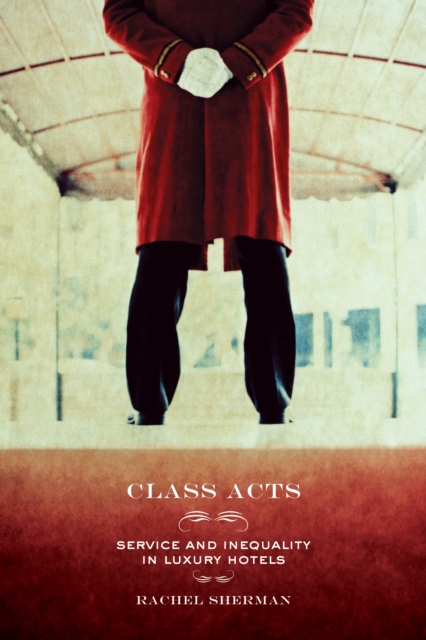
Class Acts
In this lively study, Rachel Sherman goes behind the scenes in two urban luxury hotels to give a nuanced picture of the workers who care for and cater to wealthy guests by providing seemingly unlimited personal attention. Drawing on in-depth interviews and extended ethnographic research in a range of hotel jobs, including concierge, bellperson, and housekeeper, Sherman gives an insightful analysis of what exactly luxury service consists of, how managers organize its production, and how workers and guests negotiate the inequality between them. She finds that workers employ a variety of practices to assert a powerful sense of self, including playing games, comparing themselves to other workers and guests, and forming meaningful and reciprocal relations with guests. Through their contact with hotel staff, guests learn how to behave in the luxury environment and come to see themselves as deserving of luxury consumption. These practices, Sherman argues, help make class inequality seem normal, something to be taken for granted. Throughout, Class Acts sheds new light on the complex relationship between class and service work, an increasingly relevant topic in light of the growing economic inequality in the United States that underlies luxury consumption.
eBook