
Catalogue Search | MBRL


Are you sure you want to remove the book from the shelf?

{{itemTitle}}
10
result(s) for
"Household employees South Africa History."
Sort by:

Like family : domestic workers in South African history and literature
More than a million black South African women are domestic workers. These nannies, housekeepers and chars occupy a central place in South African society. but it is an ambivalent position. Precariously situated between urban and rural areas, rich and poor, white and black, these women are at once intimately connected to and at a distant remove from the families they serve. \"Like family\" they may be, but they and their employers know they can never be real family. The author shows that slavery at the Cape shaped South African domestic worker relations, establishing social hierarchies and patterns of behavior and interaction that persist in the predicament of black female domestic workers today. The author examines the representation of domestic workers in a diversity of texts in English and Afrikaans. Authors include Andrâe Brink, JM Coetzee, Nadine Gordimer, Elsa Joubert, Antjie Krog, Sindiwe Magona, Es'kia Mphahlele, Sisonke Msimang, Zukiswa Wanner and Zoèe Wicomb. She uncovers wry and subversive insights into the \"madam/maid\" nexus, capturing paradoxes relating to shifting power relationships.
Book
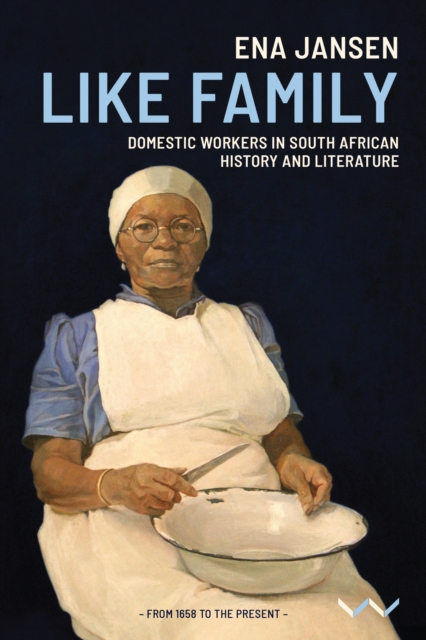
Like Family
An analytic and historical perspective of literary texts to understand the position of domestic workers in South Africa More than a million black South African women are domestic workers. Precariously situated between urban and rural areas, rich and poor, white and black, these women are at once intimately connected and at a distant remove from the families they serve. Ena Jansen shows that domestic worker relations in South Africa were shaped by the institution of slavery, establishing social hierarchies and patterns of behavior that persist today. To support her argument, Jansen examines the representation of domestic workers in a diverse range of texts in English and Afrikaans. Authors include André Brink, JM Coetzee, Imraan Coovadia, Nadine Gordimer, Elsa Joubert, Antjie Krog, Sindiwe Magona, Kopano Matlwa, Es'kia Mphahlele, Sisonke Msimang, Zukiswa Wanner and Zoë Wicomb. Like Family is an updated version of the award-winning Soos familie (2015) and the highly-acclaimed 2016 Dutch translation, Bijna familie.
eBook

At Home with Apartheid
Despite their peaceful, bucolic appearance, the tree-lined streets of South African suburbia were no refuge from the racial tensions and indignities of apartheid's most repressive years. InAt Home with Apartheid,Rebecca Ginsburg provides an intimate examination of the cultural landscapes of Johannesburg's middle- and upper-middle-class neighborhoods during the height of apartheid (c. 1960-1975) and incorporates recent scholarship on gender, the home, and family.
More subtly but no less significantly than factory floors, squatter camps, prisons, and courtrooms, the homes of white South Africans were sites of important contests between white privilege and black aspiration. Subtle negotiations within the domestic sphere between white, mostly female, householders and their black domestic workers, also primarily women, played out over and around this space. These seemingly mundane, private conflicts were part of larger contemporary struggles between whites and blacks over territory and power.
Ginsburg gives special attention to the distinct social and racial geographies produced by the workers' detached living quarters, designed by builders and architects as landscape complements to the main houses. Ranch houses, Italianate villas, modernist cubes, and Victorian bungalows filled Johannesburg's suburbs. What distinguished these neighborhoods from their precedents in the United States or the United Kingdom was the presence of the ubiquitous back rooms and of the African women who inhabited them in these otherwise exclusively white areas.
The author conducted more than seventy-five personal interviews for this book, an approach that sets it apart from other architectural histories. In addition to these oral accounts, Ginsburg draws from plans, drawings, and onsite analysis of the physical properties themselves. While the issues addressed span the disciplines of South African and architectural history, feminist studies, material culture studies, and psychology, the book's strong narrative, powerful oral histories, and compelling subject matter bring the neighborhoods and residents it examines vividly to life.
eBook

From Servants to Workers
In the past decade, hundreds of thousands of women from poorer countries have braved treacherous journeys to richer countries to work as poorly paid domestic workers. Scholars and activists denounce compromised forms of citizenship that expose these women to at times shocking exploitation and abuse.
InFrom Servants to Workers, Shireen Ally asks whether the low wages and poor working conditions so characteristic of migrant domestic work can truly be resolved by means of the extension of citizenship rights. Following South Africa's \"miraculous\" transition to democracy, more than a million poor black women who had endured a despotic organization of paid domestic work under apartheid became the beneficiaries of one of the world's most impressive and extensive efforts to formalize and modernize paid domestic work through state regulation. Instead of undergoing a dramatic transformation, servitude relations stubbornly resisted change. Ally locates an explanation for this in the tension between the forms of power deployed by the state in its efforts to protect workers, on the one hand, and the forms of power workers recover through the intimate nature of their work, on the other.
Listening attentively to workers' own narrations of their entry into democratic citizenship-rights, Ally explores the political implications of paid domestic work as an intimate form of labor.From Servants to Workersintegrates sociological insights with the often-heartbreaking life histories of female domestic workers in South Africa and provides rich detail of the streets, homes, and churches of Johannesburg where these women work, live, and socialize.
eBook

Fathers’ Employment and Sons’ Stature: The Long-Run Effects of a Positive Regional Employment Shock in South Africa’s Mining Industry
I exploit the unexpected increase in employment in 1975, 1976, and 1977 in the South African homelands to compare the long-term adult outcomes of children whose fathers benefited from the employment increase to those who did not. Using a standard difference-in-difference approach, I find that the shock affected males who were either newborn or in utero at the time, providing support to the fetal-origins hypothesis and showing the importance of mother’s nutrition. The income increases did not raise household income above the poverty datum line, explaining why older individuals were not affected. This study provides previously unmeasured individual-level information on the quality of life in the homelands during apartheid, an era when African living standards were neglected but unmeasured because of a lack of data collection.
Journal Article

Liberation and Redistribution: Social Grants, Commercial Insurance, and Religious Riches in South Africa
South Africa's liberation, marked by the first democratic elections of 1994, ushered in an unprecedented expansion of large-scale redistributive arrangements. In the post-apartheid period, the collection of money into a central fund administered anonymously and bureaucratically has gained social and political importance, particularly for poor and lower-middle-class Africans. This is most evident in a rapid expansion of government social assistance—from 1997 to 2006 the number of beneficiaries of social grants increased from three to almost eleven million, and today at least a quarter of South African households receive welfare payments. Social assistance “has been the fastest-growing category of government expenditure since 2001, and now amounts to R70 billion [almost US$7 billion in 2006] a year, about 3.4 percent of gross domestic product.” The centrality of redistribution is clear in current debates over the establishment of a Basic Income Grant (BIG) for all South Africans. Political liberation has also brought an increase in redistribution through development projects such as the National Reconstruction and Development Programme (RDP) and Black Economic Empowerment (BEE) grants.
Journal Article