
Catalogue Search | MBRL


Are you sure you want to remove the book from the shelf?

{{itemTitle}}
13,779
result(s) for
"Households Economic aspects."
Sort by:


The Ties That Buy
In 1770, tavernkeeper Abigail Stoneman called in her debts by flourishing a handful of playing cards before the Rhode Island Court of Common Pleas. Scrawled on the cards were the IOUs of drinkers whose links to Stoneman testified to women's paradoxical place in the urban economy of the late eighteenth and early nineteenth centuries. Stoneman did traditional women's work-boarding, feeding, cleaning, and selling alcohol-but her customers, like her creditors, underscore her connections to an expansive commercial society. These connections are central toThe Ties That Buy. Historian Ellen Hartigan-O'Connor traces the lives of urban women in early America to reveal how they used the ties of residence, work, credit, and money to shape consumer culture at a time when the politics of the marketplace was gaining national significance. Covering the period 1750-1820, the book analyzes how women such as Stoneman used and were used by shifting forms of credit and cash in an economy transitioning between neighborly exchanges and investment-oriented transactions. In this world, commerce reached into every part of life. At the hearths of multifamily homes, renters, lodgers, and recent acquaintances lived together and struck financial deals for survival. Landladies, enslaved washerwomen, shopkeepers, and hucksters sustained themselves by serving the mobile population. A new economic practice in America-shopping-mobilized hierarchical and friendly relationships into wide-ranging consumer networks that depended on these same market connections. Rhetoric emerging after the Revolution downplayed the significance of expanding female economic life in the interest of stabilizing the political order. But women were quintessential market participants, with fluid occupational identities, cross-class social and economic connections, and a firm investment in cash and commercial goods for power and meaning.
eBook

Households as corporate firms : an analysis of household finance using integrated household surveys and corporate financial accounting
\"This investigation proposes a conceptual framework for measurement necessary for an analysis of household finance and economic development. The authors build on and, where appropriate, modify corporate financial accounts to create balance sheets, income statements, and statements of cash flows for households in developing countries, using an integrated household survey. The authors also illustrate how to apply the accounts to an analysis of household finance that includes productivity of household enterprises, capital structure, liquidity, financing, and portfolio management. The conceptualization of this analysis has important implications for measurement, questionnaire design, the modeling of household decisions, and the analysis of panel data\"--Provided by publisher.
Book

Oikos and Market
Self-sufficiency of the house is practiced in many parts of the world but ignored in economic theory, just as socialist collectivization is assumed to have brought household self-sufficiency to an end. The ideals of self-sufficiency, however, continue to shape economic activity in a wide range of postsocialist settings. This volume’s six comparative studies of postsocialist villages in Eastern Europe and Asia illuminate the enduring importance of the house economy, which is based not on the market but on the order of the house. These formations show that economies depend not only on the macro institutions of markets and states but also on the micro institutions of families, communities, and house economies, often in an uneasy relationship.
eBook

Economics of the family
\"The family is a complex decision unit in which partners with potentially different objectives make consumption, work, and fertility decisions. Couples marry and divorce partly based on their ability to coordinate these activities, which in turn depends on how well they are matched. This book provides a comprehensive, modern, and self-contained account of the research in the growing area of family economics. The first half of the book develops several alternative models of family decision making. Particular attention is paid to the collective model and its testable implications. The second half discusses household formation and dissolution and who marries whom. Matching models with and without frictions are analyzed and the important role of within-family transfers is explained. The implications for marriage, divorce, and fertility are discussed. The book is intended for graduate students in economics and for researchers in other fields interested in the economic approach to the family\"-- Provided by publisher.
Book

Dignifying Argentina
During the mid-twentieth century, Latin American countries witnessed unprecedented struggles over the terms of national sovereignty, civic participation, and social justice. Nowhere was this more visible than in Peronist Argentina (1946-1955), where Juan and Eva Perón led the region's largest populist movement in pursuit of new political hopes and material desires. Eduardo Elena considers this transformative moment from a fresh perspective by exploring the intersection of populism and mass consumption. He argues that Peronist actors redefined national citizenship around expansive promises of a vida digna (dignified life), which encompassed not only the satisfaction of basic wants, but also the integration of working Argentines into a modern consumer society. From the mid-1940s onward, the state moved to boost purchasing power and impose discipline on the marketplace, all while broadcasting images of a contented populace.Drawing on documents such as the correspondence between Peronist sympathizers and authorities, Elena sheds light on the contest over the dignified life. He shows how the consumer aspirations of citizens overlapped with Peronist paradigms of state-led development, but not without generating great friction among allies and opposition from diverse sectors of society. Consumer practices encouraged intense public scrutiny of class and gender comportment, and everyday objects became freighted with new cultural meaning. By providing important insights on why Peronism struck such a powerful chord,Dignifying Argentinasituates Latin America within the broader history of citizenship and consumption at mid-century, and provides innovative ways to understand the politics of redistribution in the region today.
eBook


Economic mobility and the rise of the Latin American middle class
After decades of stagnation, the size of Latin America's middle class recently expanded to the point where, for the first time ever, the number of people in poverty is equal to the size of the middle class. This volume investigates the nature, determinants and possible consequences of this remarkable process of social transformation. We propose an original definition of the middle class, tailor-made for Latin America, centered on the concept of economic security and thus a low probability of falling into poverty. Given our definition of the middle class, there are four, not three, classes in Latin America. Sandwiched between the poor and the middle class there lies a large group of people who appear to make ends meet well enough, but do not enjoy the economic security that would be required for membership of the middle class. We call this group the 'vulnerable'. In an almost mechanical sense, these transformations in Latin America reflect both economic growth and declining inequality in over the period. We adopt a measure of mobility that decomposes the 'gainers' and 'losers' in society by social class of each household. The continent has experienced a large amount of churning over the last 15 years, at least 43% of all Latin Americans changed social classes between the mid 1990s and the end of the 2000s. Despite the upward mobility trend, intergenerational mobility, a better proxy for inequality of opportunity, remains stagnant. Educational achievement and attainment remain to be strongly dependent upon parental education levels. Despite the recent growth in pro-poor programs, the middle class has benefited disproportionally from social security transfers and are increasingly opting out from government services. Central to the region's prospects of continued progress will be its ability to harness the new middle class into a new, more inclusive
social contract, where the better-off pay their fair share of taxes, and demand improved public services.
eBook

Household divisions of labour : teamwork, gender and time
\"This book investigates the extent of gender inequality in the division of labor in the modern household. Through comparisons of the time allocations of single couple families without children, couple families with children and lone parents, a comprehensive account of the evolution of gender inequality over a typical lifecourse is presented\"--Provided by publisher.
Book
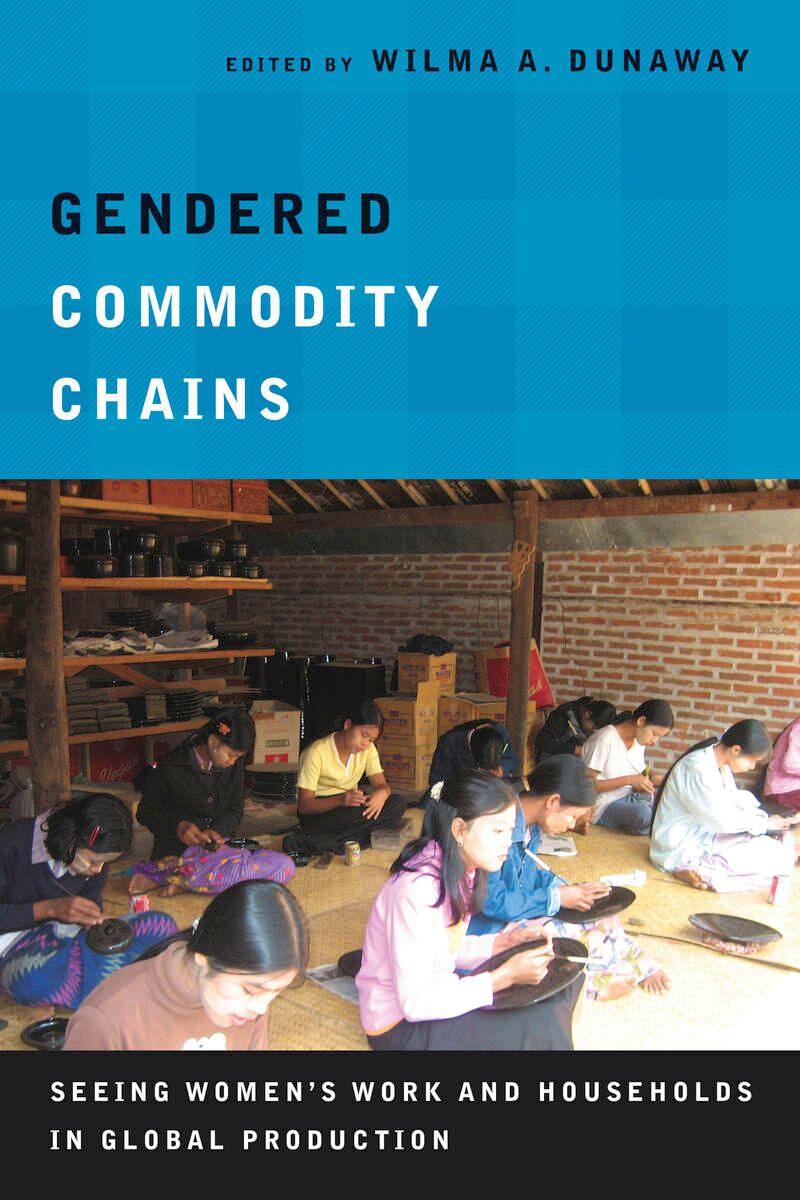
Gendered commodity chains : seeing women's work and households in global production
Gendered Commodity Chains is the first book to consider the fundamental role of gender in global commodity chains. It challenges long-held assumptions of global economic systems by identifying the crucial role social reproduction plays in production and by declaring the household as an important site of production. In affirming the importance of women's work in global production, this cutting-edge volume fills an important gender gap in the field of global commodity and value chain analysis.
With thirteen chapters by an international group of scholars from sociology, anthropology, economics, women's studies, and geography, this volume begins with an eye-opening feminist critique of existing commodity chain literature. Throughout its remaining five parts, Gendered Commodity Chains addresses ways women's work can be integrated into commodity chain research, the forms women's labor takes, threats to social reproduction, the impact of indigenous and peasant households on commodity chains, the rapidly expanding arenas of global carework and sex trafficking, and finally, opportunities for worker resistance. This broadly interdisciplinary volume provides conceptual and methodological guides for academics, graduate students, researchers, and activists interested in the gendered nature of commodity chains.
eBook