
Catalogue Search | MBRL


Are you sure you want to remove the book from the shelf?

{{itemTitle}}
1,101
result(s) for
"Hugo Black"
Sort by:
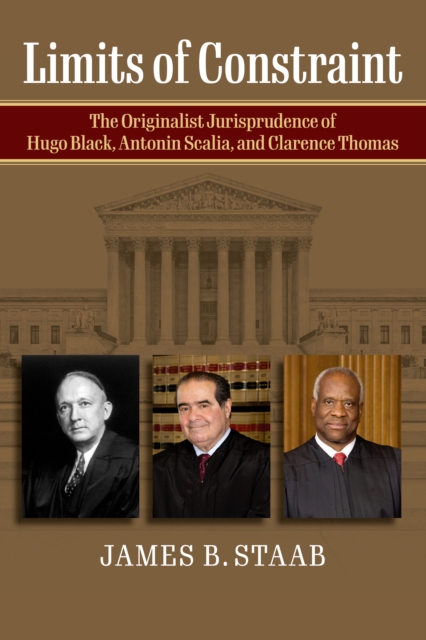
Limits of Constraint
Adherents of originalism often present it as a theory that
constrains legal decision-making in a clear and objective manner
that is based on the text and original meaning of the Constitution,
in contrast to the supposedly subjective and \"activist\"
jurisprudence of those who promote a living Constitution. But
originalists have not had the same views on constitutional issues,
calling into question the theory of originalism. Limits of
Constraint examines the originalist jurisprudence of Hugo
Black, Antonin Scalia, and Clarence Thomas, showing that three of
the Court's originalists have arrived at different conclusions in
many constitutional areas. While the starkest contrast is between
Justice Black and Justices Scalia and Thomas, even the latter two
justices have disagreed on several key issues, including executive
power and the administrative state. James Staab shows that
originalism in actual practice does not deliver on its promise of
an objective jurisprudence free of personal philosophy and
discretion. Rather than rehash theoretical debates about the merits
of originalism, Limits of Constraint examines originalism
in operation by focusing on the judicial opinions of three
prominent Supreme Court originalists: Hugo Black, Antonin Scalia,
and Clarence Thomas. If the analysis of this book is correct-that
is, the results reached by Justices Black, Scalia, and Thomas are
divergent across a wide array of constitutional areas-then
originalism promises more than it can deliver. One of the
fundamental claims made by originalists is that their theory of
constitutional interpretation limits judicial discretion, but
originalism does not constrain judicial behavior as much as its
defenders claim.
eBook

THE POLITICAL THEOLOGY OF JUSTICE HUGO BLACK
Associate Justice Hugo Black is often considered one of the giants of twentieth-century American religion clause jurisprudence. Especially regarding the Establishment Clause, Black sought to leave his mark on precedent. Previous biographers and legal scholars have noted the influence of his own religious convictions on his legal reasoning. I extend this line of inquiry but argue that Black's decisions enshrine a more concrete, substantive view of religion and political life than has previously been acknowledged. By drawing primarily on archival research regarding Justice Black's reading, correspondence, and religious membership, I argue that we can best understand his religious thought as a species of political theology, one I term syncretic civic moralism. In brief, Justice Black viewed the ideal religion as one free of doctrinal claims and primarily supporting prosocial behavior and civic loyalty. After outlining the impact of his theology on his landmark opinions, I conclude by suggesting some of the consequences of Black's theo-political jurisprudence for contemporary American establishment debates.
Journal Article

New Deal Mass Surveillance: The “Black Inquisition Committee,” 1935–1936
At the behest of the Roosevelt administration in 1935, the U.S. Senate established a special committee to investigate lobbying activities by opponents of the “death sentence” of the Public Utility Holding Company Bill. Chaired by Hugo L. Black (D-Ala.), the “Black Committee” expanded its mission into a more general probe of anti–New Deal organizations and individuals. The committee used highly intrusive methods, notably catch-all dragnet subpoenas, to secure evidence. It worked closely with the IRS for access to tax returns and with the FCC to obtain copies of millions of telegrams. When the telegram search became public information, there was a major backlash from the press, Congress, and the courts. Court rulings in 1936, resulting from suits by William Randolph Hearst and others, not only limited the committee’s powers but provided important checks for future investigators, including Senator Joseph McCarthy.
Journal Article
Free Church, Free State, Free Conscience: Baptist Ecclesiology and Church-State Attitudes in the Mid-Twentieth-Century United States
This article explores the connection between the ecclesiology and the beliefs on church-state relations of Baptists in the mid-twentieth-century United States. The author analyzes white Baptists’ reactions to the US Supreme Court rulings in Everson v. Board of Education (1947) and McCollum v. Board of Education (1948), both of which inaugurated the modern era of strict separationist Establishment Clause jurisprudence. The author also traces the development of Baptist beliefs on how the institutional church relates to individual salvation—beliefs that distinguished Baptists from both Catholics and most other Protestants—and statements from US Baptist leadership supporting church-state separation. The author demonstrates that Baptists’ beliefs on the internal, individualistic, and non-sacramental nature of salvation induced them to see any government-sponsored religious activity as likely corrupting of a person’s genuine choice of salvation. Furthermore, Baptists’ origins as a persecuted minority in Europe and the United States reinforced their idea that government-sponsored religion would lead to the suppression of true Christianity. For both reasons, then, state-sponsored religion was not God’s design. Beginning with Everson and McCollum and continuing with later cases through the 1960s, Baptist’s strict separationism became the binding interpretation of the First Amendment’s Establishment Clause through Justice Hugo Black, who authored both the Everson and McCollum majority opinions. Although no longer a Baptist when the rulings were issued, Black retained his Baptist influence on church-state issues and enshrined strict separationism into American case law for decades, leading to a Baptist triumph that many Baptists themselves would later regret and attempt to reverse.
Journal Article

Before Black Lives Matter: The Notorious Shooting of Bonita Carter
Rather, to understand the full tragedy of Bonita Carter, one must ask difficult questions about the culture and attitudes of police officers, including grappling with the fact that whatever role race played in the shooting, the incident proved more nuanced than the racist-whitecop-kills-Black-person framework into which most Americans today sort such horrific episodes. Since the beginning of the twentieth century, Birmingham law enforcers had often resorted to the third degree and lethal force to maintain law and order and the color line. Between the late 1940s and early 1970s, Birmingham police officers killed 213 suspects-all but thirteen of whom were Black-and continued to rely on vague, centuries-old common-law standards that authorized the use of deadly force against fleeing felons. Black leaders clamored for an end to police brutality, for criminal justice reform, including more Black judges, lawyers in the district attorney's office, street cops, and for a citizen police review board with subpoena power.
Journal Article
Incorporation
In this Homework Help narrative, learn about the constitutional principle of incorporation and its historic context. Has incorporating the Bill of Rights to apply to the states created greater liberty for Americans?
Streaming Video

The Unconstitutionality of Justice Black
[...]Levitt 's challenge was probably meritorious, and Hugo Black's appointment unconstitutional. [...]the Court's standing analysis was probably wrong-though there might have been other reasons to deny the challenge. [...]it is with Ex parte Levitt,1 a one-paragraph per curiam opinion that is now a chestnut of modern standing doctrine. During the early Burger Court, it specifically \"recognized the continued vitality of Levitt,\"3 and invoked it to deny standing for various constitutional claims, such as a claim in Schlesinger v. Reservists Committee to Stop the War4 that members of Congress could not hold a commission in the Armed Forces Reserve,5 or a claim in United States v. Richardson6 that the CIA's expenditures must be published.7 In these cases, the Court invoked Levitt \"in holding that standing to sue may not be predicated upon an interest of the kind alleged here which is held in common by all members of the public, because of the necessarily abstract nature of the injury all citizens share,\"8 and noting that \"whatever Levitt's injury, it was one he shared with 'all members of the public. Patrick Henry Kelley was a member of the Supreme Court bar21 who had litigated two previous cases in the Supreme Court.22 Albert Levitt was a lawyer and troublemaker (his obituary called him a \"crusading professor\") who had variously worked as a lawyer, law professor, judge, and political candidate.23 Earlier in 1937, he had finished his third stint as a special assistant to the U.S. Attorney General.24 He too was a member of the Supreme Court bar.25 A week later, the Court rejected their claims.
Journal Article


Questioning Strict Separationism in Unsettled Times: Rethinking the Strict Separation of Church and State in United States Constitutional Law
Contemporary case law in the United States surrounding the establishment clause of the federal Constitution has entered a period of remarkable uncertainty. Now is an appropriate time to revisit the legal foundations of the Supreme Court’s seminal cases of Everson v. Board of Education (1947) and McCollum v. Board of Education (1948). These cases initiated the Court’s strict separationist construction of the establishment clause. In response to critics who see these cases as without judicial warrant, I argue that the holdings rest on a particular form of substantive due process. Further, I defend the methodology the Court deploys in these cases. Recognizing the legal foundations of Everson and McCollum and the tenability of the method the Court deploys in these cases improves our understanding of important Supreme Court case law. However, it also highlights new lines of critique of the Court’s strict separationist jurisprudence—a conclusion especially relevant today, given the Court’s willingness to revise long-standing precedents.
Journal Article

Governed Vs. Governors
In his opinion concurring that The New York Times and The Washington Post had the right to defy the Nixon administration by publishing the leaked \"Pentagon papers,\" U.S. Supreme Court Justice Hugo Black declared that \"[t]he press was to serve the governed, not the governors.\" Last week, the former team doctor for USA Gymnastics was sentenced to spend the rest of his miserable life in prison for molesting more than 150 young girls entrusted to his care. Sunday marked the 10th anniversary of one of the biggest news stories of my career: the disappearance of John Glasgow, the chief financial officer of CDI Contractors of Little Rock.
Journal Article