
Catalogue Search | MBRL


Are you sure you want to remove the book from the shelf?

{{itemTitle}}
585
result(s) for
"Hugo Grotius"
Sort by:

The Cambridge companion to Hugo Grotius
\"It remains a mystery why there has not been a Cambridge Companion to Hugo Grotius to this point. As a format, The Cambridge Companions have a strong tradition in intellectual history, covering numerous political and theological thinkers from - in particular - Europe's past. It was Stephen Neff (Edinburgh University) who first drew attention to the anomaly that Hugo Grotius, one of the most prolific, versatile and influential voices from Europe's intellectual history was still awaiting his 'Cambridge Companion'. He suggested that we, as members of the Grotiana foundation, would take up the task of coordinating this. It was during a nice afternoon at the National Archives at The Hague, that we made the first design for the book. Our proposal, worked out in numerous subsequent conversations, was enthusiastically met by Finola O'Sullivan, law editor at Cambridge University Press, who agreed that Grotius' lasting fame in international law earned him a place in the law list. Nevertheless, the plan to cover the life, thought and work of Grotius in all its breadth, transcending the borderlines of modern discipline, also met with strong approval at the Press. Our special thanks goes to Finola and her dedicated team, among other Marianne Nield, ...\"-- Provided by publisher.
Book

Grotius Contra Carneades: Natural Law and the Problem of Self-Interest
In the Prolegomena to De Jure Belli ac Pacis , Hugo Grotius expounds his theory of natural law by way of reply to a skeptical challenge from the Greek Academic Carneades. Though this dialectical context is undeniably important for understanding Grotian natural law, commentators disagree about the substance of Carneades’s challenge. This paper aims to give a definitive reading of Carneades’s skeptical argument, and, by reconstructing Grotius’s reply, to settle some longstanding debates about Grotius’s conception of natural law. I argue that Grotius held a Stoic view of natural law, endorsing both the doctrine of eudaimonism and the claim that moral obligations are natural, not grounded in divine command. Consequently, Grotius’s view of natural law has more continuity with premodern, indeed ancient, morality than is usually supposed. However, I argue that we can still understand Grotius as a founder of modern moral philosophy.
Journal Article

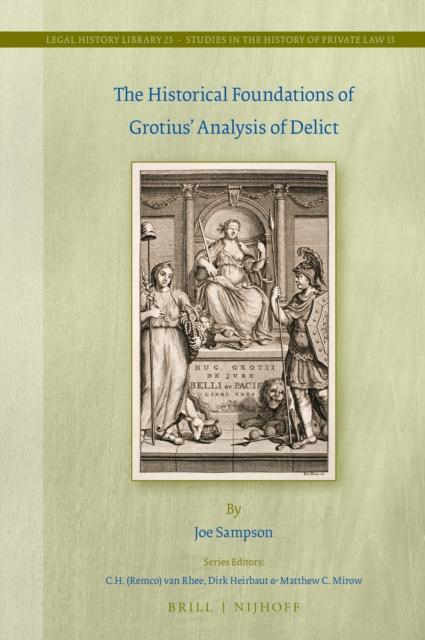
The Historical Foundations of Grotius' Analysis of Delict
The Historical Foundations of Grotius' Analysis of Delict explores the origins of the generalised model of liability for wrongdoing presented in the writings of Grotius, analysing the extent to which earlier civilian and theological doctrines shaped his views.
eBook

Moses Mendelssohn and the Jewish Questions of Modern Natural Law
In the late eighteenth century, Johann David Michaelis criticized Moses Mendelssohn for bringing what Michaelis termed his native Jewish tradition into his thinking on universal matters. Yet leaning on Jewish sources had been a key feature of European natural law thinking from the onset of modernity. In this article, the author reads Mendelssohn’s natural law theory as conversant with early modern legal thought that was scrutinized in the enlightenment, shedding new light on Mendelssohn’s innovations and on what Mendelssohn was up against when he offered natural law foundations for toleration. The author finds that arguments for and against toleration of the Jews from the seventeenth century to the nineteenth were tied to the question of whether Judaism contained universal laws or laws particular to the Jews, and suggests that Mendelssohn’s approach, while rejected from the eighteenth to the twentieth century, may be newly relevant today.
Journal Article

The State Theory of Grotius
Abstract
This article argues that Grotius has a modern theory of the state that can take its place alongside Bodin and Hobbes as one of the ways in which early modern civil philosophy sought to solve the problem of the authority and validity of political order. This is interesting because Grotius’s account of the state draws a picture of the relationship between political and legal ordering, and history, in which the interrelationship of the political and the legal allows a range of adaptive and adaptable state-forms. State authority is made possible and accountable under a system of natural legal right, even as its constitution is a historical achievement that should not readily be disturbed and in which a large range of freedom and unfreedom is lawful and should be accepted. I argue that, understood in this way, the State Theory of Grotius is not only modern, but provides in its methods and insights, a potential answer to one of the key conceptual dead ends of modern theories of sovereignty: the idea that sovereign power must be perpetually concentrated in one organ or entity if it is to retain what makes it sovereign. Along the way, I highlight the significance of state theory for contemporary discussions of international, transnational and global law.
Journal Article

HUGO GROTIUS AND THE CONCEPT OF GROTIAN MOMENTS IN INTERNATIONAL LAW
The seventeenth-century academic and statesman, Hugo Grotius, had a profound influence on the development of International Law. This article explains why Grotius is often called \"the father of international law,\" the role played by his great work, The Law of War and Peace in transforming the international legal system, and why it is appropriate to characterize fundamental changes to the international system and the rapid formation of customary international law that result therefrom in modern times as \"Grotian Moments.\"
Journal Article
Grotius on Natural Law and Supererogation
This article provides a novel interpretation of Grotius’s conception of natural law. Prior interpretations have overlooked Grotius’s doctrine of supererogation and have hence misrepresented, in varying ways, the content of his law of nature and its relation to justice and individual rights. Grotius, I contend, created logical space for supererogation by making natural obligation rather than natural morality determinative of natural law. Natural law regulates only those actions that are obligatory or illicit by their nature (i.e. without human or divine command). Acting in accordance with virtues other than justice is intrinsically morally good but not usually morally required. However, circumstances may fall out such that otherwise supererogatory actions cannot be omitted without committing a moral wrong: natural law is then rendering their performance mandatory.
Journal Article

Vengeance clipping the Eagle’s wings: Jan Vos’s Aran en Titus (1641), Hugo Grotius’s De Republica Emendanda (c. 1600) and the political implications of private, public and divine revenge
The present article explores how private, public and divine vengeance relate to each other in Jan Vos’s blockbusting revenge tragedy Aran en Titus, of Wraak en Weerwraak (Aran and Titus, or Revenge and Counter-revenge, 1641), and investigates what are considered to be their respective political implications. Vos’s play is a demonstration of how people can be blinded by their adherence to private revenge. This results in a tremendously cruel chain reaction of massacres, which ushers in the end of the play’s political status quo. As such, Aran en Titus not only shows the destructive character of vengeance to physical bodies (of self and others) but also to the body politic. The relationship between revenge and politics proved to be a complex issue which was topical in the early modern period. To indicate this, Aran en Titus will be read alongside Hugo Grotius’s De Republica Emendanda (On the Emendation of the Dutch Polity, c. 1600). Both Aran en Titus and Grotius’s tract affirm that divine providence (and thus: divine vengeance) should overrule human authority (and thus: private revenge). However, whereas Grotius propagates faith in divine providence in an attempt to eradicate private revenge, Vos stages a protagonist whose frustrated belief in divine providence only leads him to pursue personal (counter-)revenge. The third mode of revenge at play in the texts (a public revenge entrusted to the rightful ruler by God) is shown to be prone to political manipulation. Whereas Grotius regards public revenge as a necessary evil to guarantee civil order, the public revenge committed in Vos’s play only disperses the body politic and is one of the direct causes for the Empire’s disintegration.
Journal Article

The End of Freedom of the Seas?
\"6 To understand why this document, which was intended to provide support for a legal argument in a dispute, had such a significant impact on modern law of the sea, it is important to outline the background of Grotius, and examine the purpose and historical context of his work, Mare Liberum. Born in the Netherlands in 1583, Grotius commenced university at age eleven, travelled to France as part of a diplomatic delegation at age fifteen, and received a doctor of laws at age sixteen.11 He worked as a practicing lawyer in the Netherlands, was involved in politics, and became the attorney-general of the Netherlands at age twenty-four.12 From this impressive background, Grotius wrote extensively about various topics, including the publication of sixty books.13 In his writing, he considered the concept of a law of nations or an international society, most notably within his influential work On the Law of War and Peace;14 and the influence of his work is still being considered by international law academics today.15 It is important to consider the background, influences, and purpose of Grotius-and how these factors shaped his perspective and overall argument-when discussing and analyzing Grotian concepts. Grotius was not a philosopher that considered international relations, laws, and governing principles from the perspective of an outsider, analyzing the system purely in the realm of thought.16 Grotius was firmly rooted in the realm of realism: his background in politics, law, and international relations meant that his analysis and arguments were driven and influenced by a pragmatic perspective.17 B.Mare Liberum Given the extensive publishing history of Grotius, it is important to understand the context of the specific work referenced, Mare Liberum. Grotius was retained by the Dutch East India Company after one of its ships captured a Portuguese galleon in 1602.19 At the heart of this dispute was the claim by Portugal of ownership or control of the Indian Ocean and Atlantic Ocean south of Morocco, and the assertion of
Journal Article