
Catalogue Search | MBRL


Are you sure you want to remove the book from the shelf?

{{itemTitle}}
5,270
result(s) for
"Human capital United States."
Sort by:


The Education Myth
The Education Myth questions the idea that education represents the best, if not the only, way for Americans to access economic opportunity. As Jon Shelton shows, linking education to economic well-being was not politically inevitable. In the eighteenth and nineteenth centuries, for instance, public education was championed as a way to help citizens learn how to participate in a democracy. By the 1930s, public education, along with union rights and social security, formed an important component of a broad-based fight for social democracy. Shelton demonstrates that beginning in the 1960s, the political power of the education myth choked off powerful social democratic alternatives like A. Philip Randolph and Bayard Rustin's Freedom Budget. The nation's political center was bereft of any realistic ideas to guarantee economic security and social dignity for the majority of Americans, particularly those without college degrees. Embraced first by Democrats like Lyndon Johnson, Jimmy Carter, and Bill Clinton, Republicans like George W. Bush also pushed the education myth. The result, over the past four decades, has been the emergence of a deeply inequitable economy and a drastically divided political system.
eBook


Strategic Management of Human Capital in Education
Strategic Management of Human Capital in Education offers a comprehensive and strategic approach to address what has become labeled as \"talent and human capital.\" Grounded in extensive research and examples of leading edge districts, this book shows how the entire human resource system in schools—from recruitment, to selection/placement, induction, professional development, performance management and evaluation, compensation, and career progression—can be reformed and restructured to boost teacher and principal effectiveness in ways that dramatically improve instructional practice and student learning. Strategic Management of Human Capital in Education guides educators towards putting more effective teachers, teacher leaders, and principals in the country’s schools—especially in poverty-impacted urban and rural communities—equipping those teacher and principals with instructional and leadership expertise, and rewarding and retaining those who are successful in attaining these objectives. Drawing from cases, experiences, and deliberations from a national task force, this book outlines a comprehensive framework for how to transform current human resource management practices into authentic, strategic talent management systems in order to improve student achievement.
1. Strategic Management of Human Capital in Education: A Framework
2. A Powerful Education Improvement Strategy
3. Staffing and Recruiting Top Talent
4. Performance Management in Education
5. Measuring Teacher Performance for Strategic Human Capital Management, Anthony Milanowski
6. Induction and Professional Development
7. New Policies for Licensure, Tenure, Evaluation and Dismissal
8. The Compensation Side of Strategic Talent Management
9. Strategic Talent Management for Principals, Steven Kimball
10. Organizing to Implement Strategic Talent Management in Education, Allan Odden, Anthony Milanowski, and Steven Kimball
11. The State Role in Strategic Management of Education Talent
12. The Policy and Political Environment for Change, James A. Kelly
\"Rooted in improving student achievement, the book shows how strategy for developing people overlays with strategy for developing rigorous college ready curricula.\" —Teachers College Record
\"This important new book clearly and comprehensively addresses the new work in school reform that is changing the face of human resources in school systems.\"
-- From the Foreword by Carl A. Cohn, Professor and Co-Director, Urban Leadership Program, Claremont Graduate University
\"All the reorganization and restructuring in the world cannot compensate for poorly selected and developed personnel. Allan R. Odden provides future education leaders a comprehensive foundation for ensuring that school systems recruit, select, retain, and develop educators capable of meeting the challenges of high-stakes schooling.\"
-- Daniel L. Duke, Professor of Educational Leadership, University of Virginia
Allan R. Odden is Professor of Educational Leadership and Policy Analysis at University of Wisconsin-Madison, Director of Strategic Management of Human Capital, and Co-Director of the Consortium for Policy Research in Education in the Wisconsin Center for Education Research.
eBook

Accounting for slavery : masters and management
Accounting for Slavery offers a history of business and management practices on slave plantations in the British West Indies and the American South, covering the century from approximately 1780-1880. Far from lagging behind Northern manufacturers, the most sophisticated Southern planters used complex management techniques, measuring and monitoring their human capital with precision. More broadly, the book explores the complex relationship between slavery and capitalism in American history. The traditional story of modern management focuses on the factories of England and New England, largely ignoring plantation economies. Drawing on extensive archival research into plantation accounting practices, the author argues that the harsh realities of slavery were compatible with a highly quantitative, calculating style of management. Planters allocated and reallocated slaves' labor from task to task, precisely monitored their productivity, and depreciated their \"human capital\" decades before depreciation became a common accounting technique.-- Provided by publisher
Book

Addressing the Human Capital Crisis in the Federal Government
President Bush's number-one management initiative for the federal government is the Strategic Management of Human Capital. According to Knowledgeworkers.com, human capital is the accumulated value of an individual's intellect, knowledge, and experience. In the U.S. federal government, a human capital crisis exists. The factors contributing to a human capital dilemma include a knowledge bleed due to retirement eligibility, changing perspectives on work, and escalating knowledge loss. According to a Joint Hearing on the Federal Human Capital, by 2005, more than half of the 1.8 million non-postal civilian employees will be eligible for early or regular retirement. An even greater percentage of the Senior Executive Service, the government's core managers, will be eligible to leave. All government agencies are required to develop a human capital strategy by 2005. Many of these agencies have scored a \"red\" (lowest rating) on the Government Scorecard in the way they are approaching their strategic management of human capital. This book is an executive briefing on developing a successful human capital strategy based on lessons learned from analyzing existing strategies at government agencies such as NASA. Using a knowledge management perspective, Liebowitz identifies four pillars of an effective strategy and gives examples of these in practice.
Chapter 1: A Broad View of Human Capital Chapter 2: The Human Capital Crisis in the Federal Government Chapter 3: Developing a Human Capital Strategy Chapter 4: The Four Pillars of Human Capital Chapter 5: Knowledge Management: The Key Pillar in a Human Capital Strategy Chapter 6: Pillar Two: Performance Management through a Knowledge Management Lens Chapter 7: Competency Management: A Necessary Pillar in a Human Capital Strategy Chapter 8: Change Management: The Forgotten Pillar Chapter 9: Establishing Strategic Partnerships for Human Capital Chapter 10: Strategic Management of Human Capital: The Future Case Study: An Operational Study of Knowledge Management GAO Report: Human Capital: Practices That Empowered and Involved Employees
\"Liebowitz offers a leading resource for government executives struggling with very real human capital issues. Jay has made an important and timely contribution to the government and to the Knowledge Management field.\" -- Alex Bennet, Co-Founder, Mountain Quest Institute; Former Chief Knowledge Officer for the U.S. Department of Navy
eBook

From Homemakers to Breadwinners to Community Leaders
In From Homemakers to Breadwinners to Community Leaders , Norma Fuentes-Mayorga compares the immigration and integration experiences of Dominican and Mexican women in New York City, a traditional destination for Dominicans but a relatively new one for Mexicans. Her book documents the significance of women-led migration within an increasingly racialized context and underscores the contributions women make to their communities of origin and of settlement. Fuentes-Mayorga’s research is timely, especially against the backdrop of policy debates about the future of family reunification laws and the unprecedented immigration of women and minors from Latin America, many of whom seek human rights protection or to reunite with families in the US. From Homemakers to Breadwinners to Community Leaders provides a compelling look at the suffering of migrant mothers and the mourning of family separation, but also at the agency and contributions that women make with their imported human capital and remittances to the receiving and sending community. Ultimately the book contributes further understanding to the heterogeneity of Latin American immigration and highlights the social mobility of Afro-Caribbean and indigenous migrant women in New York.
eBook
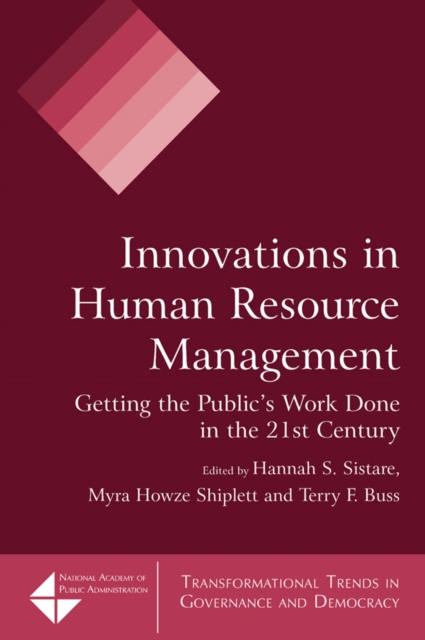
Innovations in Human Resource Management
This volume brings together expert insights on the dramatic new direction on human resource management in the public sector. While it focuses on federal government policies and practices, the principles, conclusions, and recommendations translate readily to state and local government, and the private sector.
eBook

Capitol investments
What would you do if, the very day you were hired, you knew you could be unemployed in as little as two years? You'd seek opportunities in your current job to develop a portfolio of skills and contacts in order to make yourself more attractive to future employers. Representatives and senators think about their jobs in Congress in precisely this way, according to Glenn R. Parker. While in office, members of Congress plan not merely for the next election but for the next stage of their careers. By networking, serving on committees, and championing particular legislation, they deliberately accumulate human capital—expertise, networks, and reputation—which later gives them advantages on the job market. Parker's study of the postelective careers of more than 200 former members of Congress who left office during the last half century shows that, in most cases, the human capital these politicians amassed while in office increased their occupational mobility and earning power.
eBook

Addressing the Human Capital Crisis in the Federal Government
President Bush's number-one management initiative for the federal government is the Strategic Management of Human Capital. According to Knowledgeworkers.com, human capital is the accumulated value of an individual's intellect, knowledge, and experience. In the U.S. federal government, a human capital crisis exists. The factors contributing to a human capital dilemma include a knowledge bleed due to retirement eligibility, changing perspectives on work, and escalating knowledge loss. According to a Joint Hearing on the Federal Human Capital, by 2005, more than half of the 1.8 million non-postal civilian employees will be eligible for early or regular retirement. An even greater percentage of the Senior Executive Service, the government's core managers, will be eligible to leave.All government agencies are required to develop a human capital strategy by 2005. Many of these agencies have scored a \"red\" (lowest rating) on the Government Scorecard in the way they are approaching their strategic management of human capital. This book is an executive briefing on developing a successful human capital strategy based on lessons learned from analyzing existing strategies at government agencies such as NASA.Using a knowledge management perspective, Liebowitz identifies four pillars of an effective strategy and gives examples of these in practice.
eBook