
Catalogue Search | MBRL


Are you sure you want to remove the book from the shelf?

{{itemTitle}}
273
result(s) for
"Human ecology -- Cross-cultural studies"
Sort by:


A Companion to Global Environmental History
The Companion to Global Environmental History offers multiple points of entry into the history and historiography of this dynamic and fast-growing field, to provide an essential road map to past developments, current controversies, and future developments for specialists and newcomers alike.
* Combines temporal, geographic, thematic and contextual approaches from prehistory to the present day
* Explores environmental thought and action around the world, to give readers a cultural, intellectual and political context for engagement with the environment in modern times
* Brings together environmental historians from around the world, including scholars from South Africa, Brazil, Germany, and China
eBook


Culture and the changing environment
Today human ecology has split into many different sub-disciplines such as historical ecology, political ecology or the New Ecological Anthropology. The latter in particular has criticised the predominance of the Western view on different ecosystems, arguing that culture-specific world views and human-environment interactions have been largely neglected. However, these different perspectives only tackle specific facets of a local and global hyper-complex reality. In bringing together a variety of views and theoretical approaches , these especially commissioned essays prove that an interdisciplinary collaboration and understanding of the extreme complexity of the human-environment interface(s) is possible.
eBook

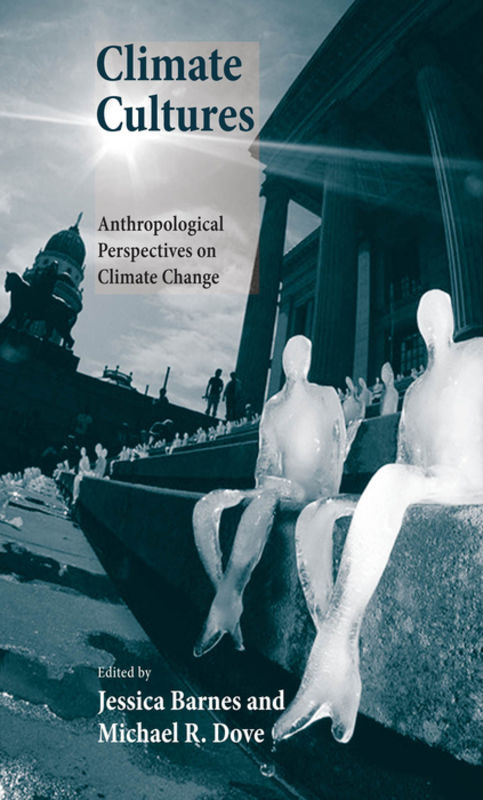
Climate cultures : anthropological perspectives on climate change
Climate change is one of the most pressing issues of our times, yet also seemingly intractable. This book offers novel insights on this contemporary challenge, drawing together the state-of-the-art thinking in anthropology. Approaching climate change as a nexus of nature, culture, science, politics, and belief, the book reveals nuanced ways of understanding the relationships between society and climate, science and the state, certainty and uncertainty, global and local that are manifested in climate change debates. The contributors address three major areas of inquiry: how climate change issues have been framed in previous times compared to the present; how knowledge about climate change and its impacts is produced and interpreted by different groups; and how imagination plays a role in shaping conceptions of climate change. Jessica Barnes is assistant professor, Department of Geography and Environment and Sustainability Program, University of South Carolina. She lives in Columbia, SC. Michael Dove is Margaret K. Musser Professor of Social Ecology and Professor of Anthropology at Yale University. He lives in Killingworth, CT.
eBook


Shadows in the Sun
Ranging from the British Columbian wilderness to the jungles of the Amazon and the polar ice of the Arctic Circle, Shadows in the Sun is a testament to a world where spirits still stalk the land and seize the human heart. Its essays and stories, though distilled from travels in widely separated parts of the world, are fundamentally about landscape and character, the wisdom of lives drawn directly from the land, the hunger of those who seek to rediscover such understanding, and the consequences of failure.
eBook
People and places of nature and culture
Using the rich and vital Australian Aboriginal understanding of country as a model, People and Places of Nature and Culture affirms the importance of a sustainable relationship between nature and culture. This book demonstrates the problems inherent in the notion that humans have a mastery over the Earth and projects what needs to change.
eBook
Bush Base: Forest Farm
Taking a unique anthropological apprach, Bush Base: Forest Farm explores the management of resources in third would development programmes. The contributors, all distinguished anthropologists with practical experience of development projects, focus on the role of human cultural imagination in the use of environmental resources. They challenge the traditional sharp distinction between human settlement and natual environment (farm or camp, forest or bush), and argue that development programmes should place at their centre an appreciation of people's cosmologies and cultural understandings.
eBook