
Catalogue Search | MBRL


Are you sure you want to remove the book from the shelf?

{{itemTitle}}
2,632
result(s) for
"Human ecology Canada."
Sort by:


Coasts under stress
Rosemary Ommer and her project team combine formal scientific (natural and social) and humanist analysis with an examination of the lived experience of coastal people. They analyze community erosion created by economic decline and the ecosystem damage caused by unrelenting industrial pressure on natural resources and look at the history of coastal communities, their resource bases, their economies, and the way the lives of people are embedded in their environments.
eBook


Every Grain of Sand
Universal in scope, yet focusing on recognizable Canadian places, this collection of essays connects individuals' love of nature to larger social issues, to cultural activities, and to sustainable technology. Subjects include activism in Cape Breton, eco-feminism, Native perspectives on the history of humans' relationship with the natural world, the inconsistency of humankind's affinity with nature alongside its capacity to destroy, and scientific and traditional accounts of evolution and how they can come together for the welfare of Earth's ecology. These essays encourage us to break down the power-based divisions of centre versus marginal politics, to talk with our perceived enemies in environmental wars, to consider activism as a personal commitment, and to resist the construction of a \"post-natural\" world.
Using a combination of personal memoirs and formal essays, Every Grain of Sand seeks to involve readers in the extraordinary places they inhabit—and usually take for granted—and will appeal to both the general reader and to students in humanities, social sciences, and environmental studies. It is unique for its presentation of entirely Canadian perspectives on ecology and environmental issues.
eBook

The reluctant land : society, space, and environment in Canada before Confederation
Describes the evolving pattern of settlement and the changing relationships of people and land in Canada from the end of the 15th century to the late 1860s and early 1870s.
Book

Inhabited : wildness and the vitality of the land
Through an ethnographic exploration of Canada's ten UNESCO Natural World Heritage sites, Inhabited reflects on the meanings of wildness, wilderness, and natural heritage. Presenting perspectives of local inhabitants, the authors ask us to reflect on the colonial and dualist assumptions behind the received meaning of wild.
eBook

Canadians and the natural environment to the twenty-first century
\"Canadians and the Natural Environment to the Twenty-First Century provides an ideal foundation for undergraduates and general readers on the history of Canada's complex environmental issues. Through clear, easy-to-understand case studies, Neil Forkey integrates the ongoing interplay of humans and the natural world into national, continental, and global contexts. Forkey's engaging survey addresses significant episodes from across the country over the past four hundred years: the classification of Canada's environments by its earliest inhabitants, the relationship between science and sentiment in the Victorian era, the shift towards conservation and preservation of resources in the early twentieth century, and the rise of environmentalism and issues involving First Nations at the end of the century. Canadians and the Natural Environment to the Twenty-First Century provides an accessible synthesis of the most important recent work in the field, making it a truly state-of-the-art contribution to Canadian environmental history.\"--publisher's website.
Book

Ice Blink
Northern Canada's distinctive landscapes, its complex social relations and the contested place of the North in contemporary political, military, scientific and economic affairs have fueled recent scholarly discussion. At the same time, both the media and the wider public have shown increasing interest in the region. This timely volume extends our understanding of the environmental history of northern Canada - clarifying both its practice and promise, and providing critical perspectives on current public debates. Ice Blink provides opportunities to consider critical issues in other disciplines and geographic contexts. Contributors also examine whether distinctive approaches to environmental history are required when studying the Canadian North, and consider a range of broader questions. What, if anything, sets the study of environmental history in particular regions apart from its study elsewhere? Do environmental historians require regionally-specific research practices? How can the study of environmental history take into consideration the relations between Indigenous peoples, the environment, and the state? How can the history of regions be placed most effectively within transnational and circumpolar contexts? How relevant are historical approaches to contemporary environmental issues? Scholars from universities in Canada, the United States and Britain contribute to this examination of the relevance of historical study for contemporary arctic and sub-arctic issues, especially environmental challenges, security and sovereignty, indigenous politics and the place of science in northern affairs. By asking such questions, the volume offers lessons about the general practice of environmental history and engages an international body of scholarship that addresses the value of regional and interdisciplinary approaches. Crucially, however, it makes a distinctive contribution to the field of Canadian environmental history by identifying new areas of research and exploring how international scholarly developments might play out in the Canadian context.
eBook

Working on earth : class and environmental justice
\"Working on Earth: Class and Environmental Justice is a collection of scholarly essays that examine the relationship between the exploitation of the working-class and environment injustices in the US and Canada. These scholars, from the fields of environmental humanities and environmental social sciences, seek to assess the current unprecedented rates of environmental degradation, expanding economic inequality, and wide-spread social injustice. Without dividing worker from wilderness, or labor from landscape, they present solutions to the global climate crisis. Ultimately, this book advances the idea of a working-class ecology that must be an integral part of achieving just and sustainable human development\"-- Provided by publisher.
Book
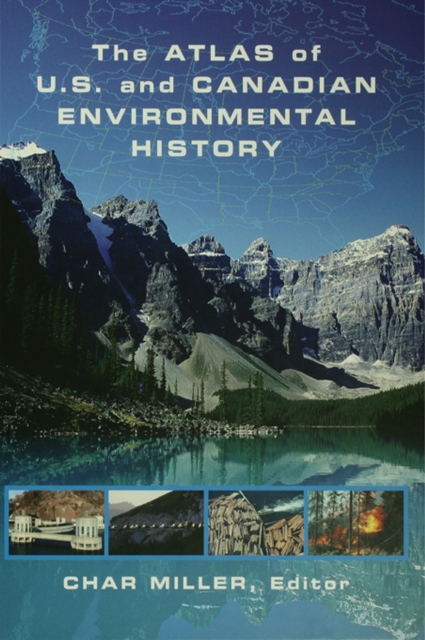
The atlas of U.S. and Canadian environmental history
This visually dynamic historical atlas chronologically covers American environmental history through the use of four-color maps, photos, and diagrams, and in written entries from well known scholars.Organized into seven categories, each chapter covers: agriculture * wildlife and forestry * land use and management * technology and industry * pollution and human heath * human habitats * and ideology and politics.With valuable reference aids--including bibliographies, sources for further research, an extensive index, and newly designed maps--this is an indispensable tool for students and educators alike.For a detailed contents, a generous selection of sample articles, and more, visit the website Atlas of USand Canadian Environmental Historywebsite.Also includes 46 color maps.
eBook