
Catalogue Search | MBRL


Are you sure you want to remove the book from the shelf?

{{itemTitle}}
5,967
result(s) for
"Human ecology in literature"
Sort by:


world in which we occur
American philosopher John Dewey considered all human endeavors to be one with the natural world. In his writings, particularly Art as Experience (1934), Dewey insists on the primacy of the environment in aesthetic experience. Dewey’s conception of environment includes both the natural and the man-made. The World in Which We Occur highlights this notion in order to define “pragmatist ecology,” a practice rooted in the interface of the cultural and the natural. Neil Browne finds this to be a significant feature of some of the most important ecological writing of the last century. To fully understand human involvement in the natural world, Browne argues that disciplinary boundaries must be opened, with profound implications for the practice of democracy. The degradation of the physical environment and democratic decay, for Browne, are rooted in the same problem: our persistent belief that humans are somehow separate from their physical environment. Browne probes the work of a number of major American writers through the lens of Dewey’s philosophy. Among other texts examined are John Muir’s My First Summer in the Sierra (1911); Sea of Cortez (1941) by John Steinbeck and Edward Ricketts; Rachel Carson’s three books about the sea, Under the Sea-Wind (1941), The Sea Around Us (1951), and The Edge of the Sea (1955); John Haines’s The Stars, the Snow, the Fire (1989); Barry Lopez’s Arctic Dreams (1986); and Terry Tempest Williams’s Refuge (1991). Together, these texts—with their combinations of scientific observation and personal meditation—challenge the dichotomies that we have become accustomed and affirm the principles of a pragmatist ecology, one in which ecological and democratic values go hand in hand.
eBook

Contesting environmental imaginaries : nature and counternature in a time of global change
\"Contesting Environmental Imaginaries foregrounds a question central to humanistic environmental studies: How is nature to be perceived and understood in a time of global environmental crisis? A challenge was issued to imagine counter natures, past or present, casting nature as a normative concept into productive relief. One ambition was to highlight shifting perspectives on nature and the environment that may help account for the rise of the environmental humanities; another was to invite challenges to orthodoxies, including those that animate this burgeoning field. Contributions emerged from the study areas of Environmental History, Ecocriticism, Cultural Studies, American Studies, Caribbean Studies, Scandinavian Studies, Media Studies, and the History of Ideas. This volume draws together the fruits of this thought experiment\"--Provided by publisher.
Book
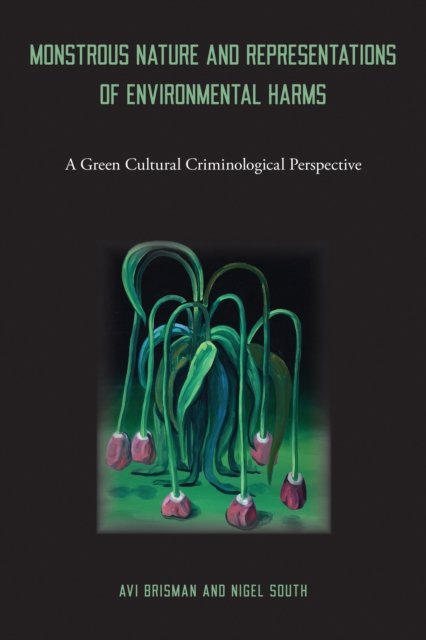
Monstrous Nature and Representations of Environmental Harms
How does culture influence human relationships with the environment?In Monstrous Nature and Representations of Environmental Harms , green cultural criminologists Avi Brisman and Nigel South examine stories of monsters and disasters to address how the ways we depict and think about harms to the environment dissuade us from taking care of our.
eBook


Ecocriticism on the Edge
The twenty-first century has seen an increased awareness of the forms of environmental destruction that cannot immediately be seen, localised or, by some, even acknowledged. Ecocriticism on the Edge explores the possibility of a new mode of critical practice, one fully engaged with the destructive force of the planetary environmental crisis. Timothy Clark argues that, in literary and cultural criticism, the \"Anthropocene\", which names the epoch in which human impacts on the planet's ecological systems reach a dangerous limit, also represents a threshold at which modes of interpretation that once seemed sufficient or progressive become, in this new counterintuitive context, inadequate or even latently destructive. The book includes analyses of literary works, including texts by Paule Marshall, Gary Snyder, Ben Okri, Henry Lawson, Lorrie Moore and Raymond Carver.
eBook


Environment, Society, and the Compleat Angler
No detailed description available for \"Environment, Society, and The Compleat Angler\".
eBook


Organic Supplements
From the hair of a famous dead poet to botanical ornaments and
meat pies, the subjects of this book are dynamic, organic
artifacts. A cross-disciplinary collection of essays, Organic
Supplements examines the interlaced relationships between
natural things and human beings in early modern and
eighteenth-century Europe. The material qualities of things as
living organisms-and things that originate from living organisms-
enabled a range of critical actions and experiences to take place
for the people who wore, used, consumed, or perceived them.
eBook