
Catalogue Search | MBRL


Are you sure you want to remove the book from the shelf?

{{itemTitle}}
73,969
result(s) for
"Human evolution."
Sort by:

Future humans : inside the science of our continuing evolution
\"Evolutionary biologist Scott Solomon draws on the explosion of discoveries in recent years to examine the future evolution of our species. Combining knowledge of our past with current trends, Solomon offers convincing evidence that evolutionary forces still affect us today. But how will modernization--including longer lifespans, changing diets, global travel, and widespread use of medicine and contraceptives--affect our evolutionary future?\" --publisher description.
Book
Humanity's Rise to Superdominance, the Global Ecological Crisis, and the Way Forward for Education
This book pinpoints the evolutionary connection between the global ecological crisis and transgenerational learning and education. As Julian Huxley (1887-1975) described, the cumulative passing down of knowledge, skills, and ideas by one generation to the next over eons of time, which has been afforded by the advent of complex languages in the evolutionary past, is chiefly responsible for humanity's planetary superdominance. However, given that the drive of the human species to increase its control over the natural world has, today, run up against ecological limits, there is an evolutionary-existential choice to be made in relation to the ultimate purposes of formal education. Should humanity \"double down\" on the anthropocentric humanist project of superdominance, including the goals of unlimited economic growth, development, and scientific and technological progress? Alternatively, should a biocentric anti-humanist and/or postmodernist deconstruction of formal education take place? Or should a holistic organicist orientation, emphasizing biological wisdom, help to shape its future? As this book shows, the answers to these philosophical questions on the parts of educators, prospective teachers, and learners will, going forward, play a key role in deciding the evolutionary trajectories of all life-forms on the planet.
eBook

When we became humans : our incredible evolutionary journey
\"Step back in time to discover how a clever ape climbed down from the trees and changed the world like no other animal has done before. Explore the story of our origins and meet some of the key species in our history.\"--Page 4 of cover.
Book

Major transitions in human evolution
Evolutionary problems are often considered in terms of ‘origins', and research in human evolution seen as a search for human origins. However, evolution, including human evolution, is a process of transitions from one state to another, and so questions are best put in terms of understanding the nature of those transitions. This paper discusses how the contributions to the themed issue ‘Major transitions in human evolution’ throw light on the pattern of change in hominin evolution. Four questions are addressed: (1) Is there a major divide between early (australopithecine) and later (Homo) evolution? (2) Does the pattern of change fit a model of short transformations, or gradual evolution? (3) Why is the role of Africa so prominent? (4) How are different aspects of adaptation—genes, phenotypes and behaviour—integrated across the transitions? The importance of developing technologies and approaches and the enduring role of fieldwork are emphasized.
This article is part of the themed issue ‘Major transitions in human evolution’.
Journal Article

Human evolutionary biology
\"Wide-ranging and inclusive, this text provides an invaluable review of an expansive selection of topics in human evolution, variation and adaptability for professionals and students in biological anthropology, evolutionary biology, medical sciences and psychology. The chapters are organized around four broad themes, with sections devoted to phenotypic and genetic variation within and between human populations, reproductive physiology and behavior, growth and development, and human health from evolutionary and ecological perspectives. An introductory section provides readers with the historical, theoretical and methodological foundations needed to understand the more complex ideas presented later. Two hundred discussion questions provide starting points for class debate and assignments to test student understanding\"-- Provided by publisher.
Book

The Role of Ontogeny in the Evolution of Human Cooperation
To explain the evolutionary emergence of uniquely human skills and motivations for cooperation, Tomasello et al. (
2012
, in
Current Anthropology
53(6):673–92) proposed the interdependence hypothesis. The key adaptive context in this account was the obligate collaborative foraging of early human adults. Hawkes (
2014
, in
Human Nature
25(1):28–48), following Hrdy (
Mothers and Others
, Harvard University Press, 2009), provided an alternative account for the emergence of uniquely human cooperative skills in which the key was early human infants’ attempts to solicit care and attention from adults in a cooperative breeding context. Here we attempt to reconcile these two accounts. Our composite account accepts Hrdy’s and Hawkes’s contention that the extremely early emergence of human infants’ cooperative skills suggests an important role for cooperative breeding as adaptive context, perhaps in early
Homo
. But our account also insists that human cooperation goes well beyond these nascent skills to include such things as the communicative and cultural conventions, norms, and institutions created by later
Homo
and early modern humans to deal with adult problems of social coordination. As part of this account we hypothesize how each of the main stages of human ontogeny (infancy, childhood, adolescence) was transformed during evolution both by infants’ cooperative skills “migrating up” in age and by adults’ cooperative skills “migrating down” in age.
Journal Article


Grandma plays favourites: X-chromosome relatedness and sex-specific childhood mortality
Biologists use genetic relatedness between family members to explain the evolution of many behavioural and developmental traits in humans, including altruism, kin investment and longevity. Women's post-menopausal longevity in particular is linked to genetic relatedness between family members. According to the 'grandmother hypothesis', post-menopausal women can increase their genetic contribution to future generations by increasing the survivorship of their grandchildren. While some demographic studies have found evidence for this, others have found little support for it. Here, we re-model the predictions of the grandmother hypothesis by examining the genetic relatedness between grandmothers and grandchildren. We use this new model to re-evaluate the grandmother effect in seven previously studied human populations. Boys and girls differ in the per cent of genes they share with maternal versus paternal grandmothers because of differences in X-chromosome inheritance. Here, we demonstrate a relationship between X-chromosome inheritance and grandchild mortality in the presence of a grandmother. With this sex-specific and X-chromosome approach to interpreting mortality rates, we provide a new perspective on the prevailing theory for the evolution of human female longevity. This approach yields more consistent support for the grandmother hypothesis, and has implications for the study of human evolution.
Journal Article

The philosophy of human evolution
\"This book provides a unique discussion of human evolution from a philosophical viewpoint, looking at the facts and interpretations since Charles Darwin's The Descent of Man. Michael Ruse explores such topics as the nature of scientific theories, the relationships between culture and biology, the problem of progress and the extent to which evolutionary issues pose problems for religious beliefs. He identifies these issues, highlighting the problems for morality in a world governed by natural selection. By taking a philosophical viewpoint, the full ethical and moral dimensions of human evolution are examined. This book engages the reader in a thorough discussion of the issues, appealing to students in philosophy, biology and anthropology\"-- Provided by publisher.
Book
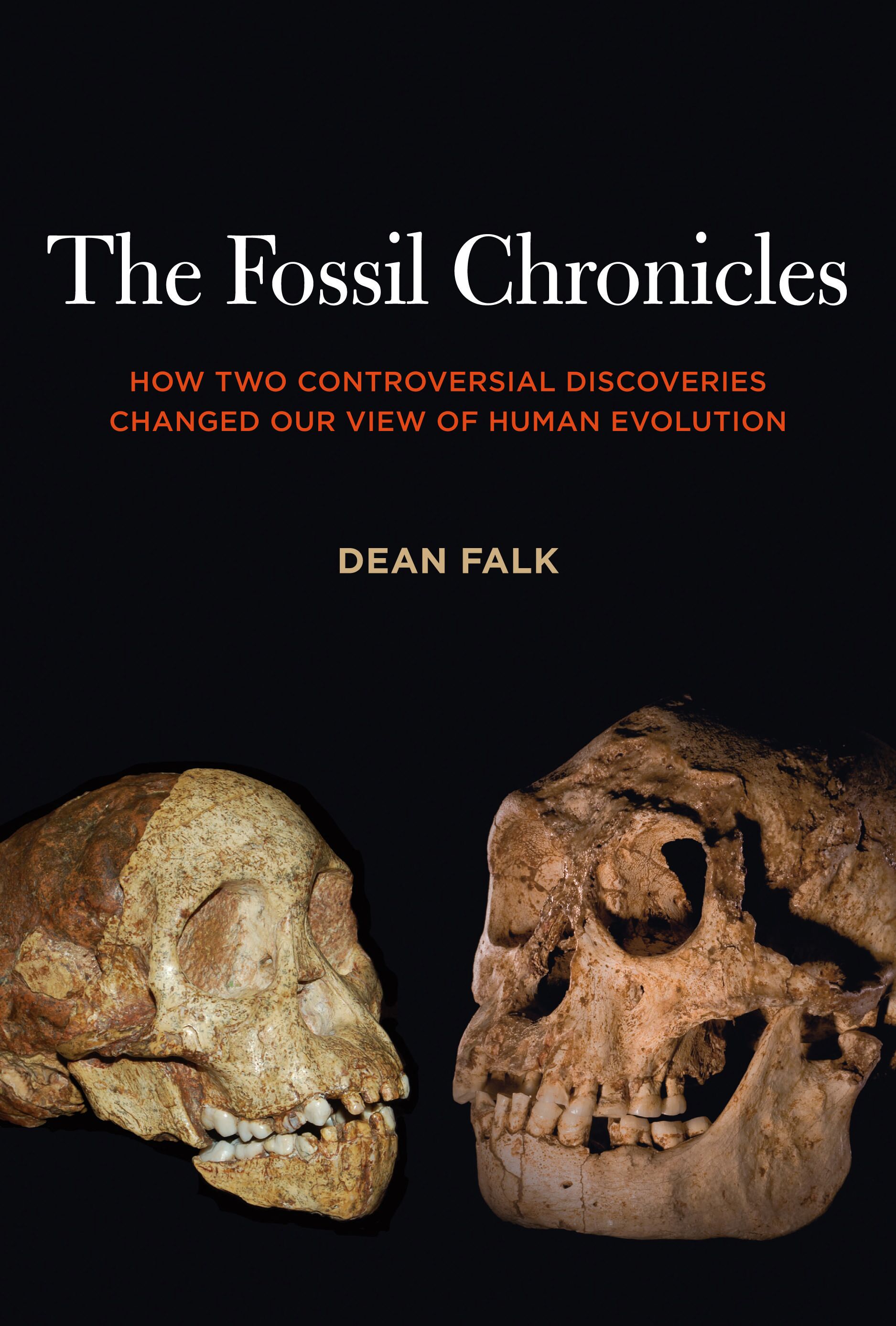
The fossil chronicles
Two discoveries of early human relatives, one in 1924 and one in 2003, radically changed scientific thinking about our origins. Dean Falk, a pioneer in the field of human brain evolution, offers this fast-paced insider's account of these discoveries, the behind-the-scenes politics embroiling the scientists who found and analyzed them, and the academic and religious controversies they generated. The first is the Taung child, a two-million-year-old skull from South Africa that led anatomist Raymond Dart to argue that this creature had walked upright and that Africa held the key to the fossil ancestry of our species. The second find consisted of the partial skeleton of a three-and-a-half-foot-tall woman, nicknamed Hobbit, from Flores Island, Indonesia. She is thought by scientists to belong to a new, recently extinct species of human, but her story is still unfolding. Falk, who has studied the brain casts of both Taung and Hobbit, reveals new evidence crucial to interpreting both discoveries and proposes surprising connections between this pair of extraordinary specimens.
eBook