
Catalogue Search | MBRL


Are you sure you want to remove the book from the shelf?

{{itemTitle}}
5,193
result(s) for
"Human influence on nature."
Sort by:

Eaarth : making a life on a tough new planet
Argues that a large-scale shift in Earth's climate is unavoidable and explains how humans should live if they are going to sustain themselves on the new planet that their mistakes have created.
Book
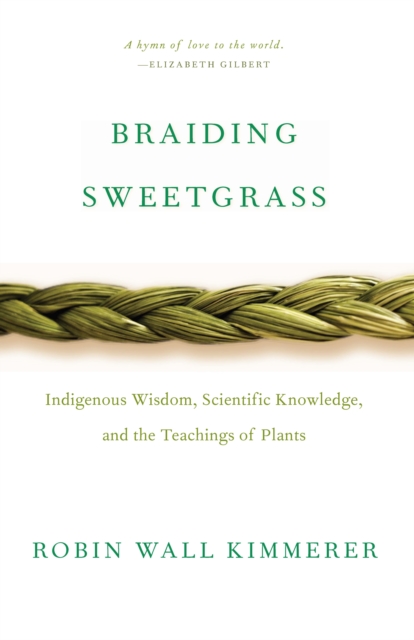
Braiding Sweetgrass
A New York Times BestsellerA Washington Post BestsellerNamed a \"Best Essay Collection of the Decade\" by Literary HubAs a botanist, Robin Wall Kimmerer has been trained to ask questions of nature with the tools of science. As a member of the Citizen Potawatomi Nation, she embraces the notion that plants and animals are our oldest teachers. In Braiding Sweetgrass, Kimmerer brings these two lenses of knowledge together to take us on \"a journey that is every bit as mythic as it is scientific, as sacred as it is historical, as clever as it is wise\" (Elizabeth Gilbert).Drawing on her life as an indigenous scientist, and as a woman, Kimmerer shows how other living beings-asters and goldenrod, strawberries and squash, salamanders, algae, and sweetgrass-offer us gifts and lessons, even if we've forgotten how to hear their voices. In reflections that range from the creation of Turtle Island to the forces that threaten its flourishing today, she circles toward a central argument: that the awakening of ecological consciousness requires the acknowledgment and celebration of our reciprocal relationship with the rest of the living world. For only when we can hear the languages of other beings will we be capable of understanding the generosity of the earth, and learn to give our own gifts in return.
eBook

Over the seawall : tsunamis, cyclones, drought, and the delusion of controlling nature
\"As extreme weather becomes more common, the urge to outwit nature can be irresistible. But when our expensive technosolutions backfire, are we worse off than before? How should we adapt to a changing climate? Miller reveals the unintended consequences of bad adaptations or as academics call it, maladaptations--fixes that do more harm than good. From seawalls in coastal Japan, to the reengineered waters in the Ganges River Delta, to the artificial ribbon of water supporting both farms and urban centers in parched Arizona, the author traces the histories of engineering marvels that were once deemed too smart and too big to fail. In each he takes us into the land and culture, seeking out locals and experts to better understand how complicated, grandiose schemes led instead to failure, and to find answers to the technologic holes we've dug ourselves into. Miller urges us to take a hard look at the fortifications we build and how they've fared in the past. He embraces humanity's penchant for problem-solving, but argues that if we are to adapt successfully to climate change, we must recognize that working with nature is not surrender but the only way to assure a secure future.\"--From publisher's description.
Book
American West at risk
The American West at Risk summarizes the dominant human-generated environmental challenges facing the 11 contiguous arid western United States. The importance of this story is that protecting lands and soil also protects air and water quality, and water supplies, which are critical support for our lives and our health.
eBook

Save the people! : halting human extinction
\"A book for middle-school-aged children about previous extinctions and possible threats to humans, from volcanoes, to asteroids, to pollution and diseases\"-- Provided by publisher.
Book

Reconfiguring Modernity
Julia Adeney Thomas turns the concept of nature into a powerful analytical lens through which to view Japanese modernity, bringing the study of both Japanese history and political modernity to a new level of clarity. She shows that nature necessarily functions as a political concept and that changing ideas of nature's political authority were central during Japan's transformation from a semifeudal world to an industrializing colonial empire. In political documents from the nineteenth to the early twentieth century, nature was redefined, moving from the universal, spatial concept of the Tokugawa period, through temporal, social Darwinian ideas of inevitable progress and competitive struggle, to a celebration of Japan as a nation uniquely in harmony with nature. The so-called traditional \"Japanese love of nature\" masks modern state power. Thomas's theoretically sophisticated study rejects the supposition that modernity is the ideological antithesis of nature, overcoming the determinism of the physical environment through technology and liberating denatured subjects from the chains of biology and tradition. In making \"nature\" available as a critical term for political analysis, this book yields new insights into prewar Japan's failure to achieve liberal democracy, as well as an alternative means of understanding modernity and the position of non-Western nations within it.
eBook

Back to Earth : what life in space taught me about our home planet--and our mission to protect it
\"When NASA Astronaut Nicole Stott first saw the Earth from space, she was filled with awe. Our shared home was a brilliant blue marble, with a razor thin atmosphere protecting billions of people, including everyone she loved. She realized that we are all bound together on this fragile planet. When she came back to earth, she knew she had to share this vision to help protect it. Stott knows the scale of the daunting task at hand-and yet, she believes we can set aside our differences and work together to tackle the most challenging planetary problems humanity has ever faced. She knows this, because she's seen it happen, on the International Space Station. Throughout her book, Stott imparts hard-won lessons in high-stakes problem solving, survival, and responding to crisis in space. On a space station, astronauts can't wait for someone else to handle a rescue; and when it comes to our earthbound problems, Stott learned that everyone should live like a crewmember, not like a passenger. In space, where everyone survives in a closed system, everything is local-and Stott discovered that in a profound way, the same is true back at home. Back to Earth distills these lessons and more into seven principles that can be practiced by each and every one of us to make much-needed change. In addition to sharing stories from her own spaceflight, Stott offers eye-opening insights from scientists and changemakers already sparking meaningful change in their communities and around the globe. She explores the complexities and splendor of the earth's biodiversity, and what it takes to preserve it, with both pioneering scientists on earth and engineers working to enable life in space. She meets with activists who use their time in space to advocate for clean water, and with executives who quit their corporate positions and use their global reach to become environmental leaders. Through her stirring call to action, Nicole Stott reveals how we each have the power to respect the Earth and one another-and to change our own lives in the process. And, while we're at it, we might just save humanity.\"-- Provided by publisher.
BOOK

Global Warming: Looking Beyond Kyoto
Comprehensive examination of the economic, social, and political context of climate policy in industrialized and developing nations. Calls for a multilateral approach that goes beyond the mitigation-focused Kyoto policies and stresses the importance of generating policies that work within a time frame commensurate with that of climate change itself.
eBook

Climate change and biodiversity
\"Anthology of diverse perspectives that explore the controversies surrounded climate change and biodiversity today\"-- Provided by publisher.
BOOK
Environment and History
The influence of human economies and cultures on ecosystems is particularly striking in the new worlds into which Europeans have expanded over the past five hundred years. Using a comparative and multidisciplinary approach, Beinart and Coates examine this neglected aspect of the history of settler incursion and dominance in two frontier nations, the USA and South Africa. They also seek to explain change in indigenous ideas and practices towards the environment, and discuss the rise of popular environmentalism up to the present day.
William Beinart is Reader and Peter Coates Lecturer in the Department of Historical Studies at the University of Bristol. William Beinart is the author of Hidden Struggles in Rural South Africa (1987), and Twentieth-Century South Africa (1994). He is the co-editor of Segregation and Apartheid in Twentieth-Century South Africa (1995). Peter Coates is the author of In Nature's Defence (1993).
eBook