
Catalogue Search | MBRL


Are you sure you want to remove the book from the shelf?

{{itemTitle}}
5,574
result(s) for
"Human robot interaction"
Sort by:


Progress and prospects of the human–robot collaboration
Recent technological advances in hardware design of the robotic platforms enabled the implementation of various control modalities for improved interactions with humans and unstructured environments. An important application area for the integration of robots with such advanced interaction capabilities is human–robot collaboration. This aspect represents high socio-economic impacts and maintains the sense of purpose of the involved people, as the robots do not completely replace the humans from the work process. The research community’s recent surge of interest in this area has been devoted to the implementation of various methodologies to achieve intuitive and seamless human–robot-environment interactions by incorporating the collaborative partners’ superior capabilities, e.g. human’s cognitive and robot’s physical power generation capacity. In fact, the main purpose of this paper is to review the state-of-the-art on intermediate human–robot interfaces (bi-directional), robot control modalities, system stability, benchmarking and relevant use cases, and to extend views on the required future developments in the realm of human–robot collaboration.
Journal Article

Human-robot interaction : safety, standardization, and benchmarking
\"This book provides a comprehensive introduction to human robot interaction, with a focus on safety, standardization, and benchmarking. Featuring contributions from leading experts, the book presents state-of-the-art research and includes real-world applications and use cases. It explores industrial robotics, service robotics, and medical robotics, and features chapters on safety approaches for human robot interaction including physical interactions, collaboration in tasks, work space sharing, human aware motion planning, and existing standards and guidelines\"-- Provided by publisher.
Book

A Taxonomy of Factors Influencing Perceived Safety in Human–Robot Interaction
Safety is a fundamental prerequisite that must be addressed before any interaction of robots with humans. Safety has been generally understood and studied as the physical safety of robots in human–robot interaction, whereas how humans perceive these robots has received less attention. Physical safety is a necessary condition for safe human–robot interaction. However, it is not a sufficient condition. A robot that is safe by hardware and software design can still be perceived as unsafe. This article focuses on perceived safety in human–robot interaction. We identified six factors that are closely related to perceived safety based on the literature and the insights obtained from our user studies. The identified factors are the context of robot use, comfort, experience and familiarity with robots, trust, the sense of control over the interaction, and transparent and predictable robot actions. We then made a literature review to identify the robot-related factors that influence perceived safety. Based the literature, we propose a taxonomy which includes human-related and robot-related factors. These factors can help researchers to quantify perceived safety of humans during their interactions with robots. The quantification of perceived safety can yield computational models that would allow mitigating psychological harm.
Journal Article

Social robots : a fictional dualism model
\"Social robots are an increasingly integral part of society, already appearing as customer service assistants, care-home helpers, teaching assistants and personal companions. This book argues that the wider inclusion of social robots in our society is having a revolutionary impact on some of our key intuitions regarding ethics, metaphysics and epistemology and, as such, will put pressure on many of our best theories. Social robots elicit an emotional and social response in humans that some have taken to be evidence that robots deserve moral consideration. Others have argued that, as robots are only machines, we should avoid designing robots that encourage emotional engagement. The fictional dualism model provides a new way for us to view social robots and a new route for our continued relationship with them. When we engage with a social robot, we create a fictional overlay that has wants, needs and desires. Our emotional attachment to social robots is a natural continuation of our relationship to fiction: a life-enhancing and important connection, but not one that prompts moral consideration for the fictional entity. In this book, Paula Sweeney shows how the fictional dualism model of social robots differs from other popular models. In addition to providing a distinctive and ethically appropriate framework for emotional engagement without moral consideration, the model provides conditions for trusting social robots and, uniquely, allows us to individuate social robots as distinct persons, even in contexts in which they share a collective mind\"-- Page 4 of cover.
BOOK

Recent advancements in multimodal human–robot interaction
Robotics have advanced significantly over the years, and human–robot interaction (HRI) is now playing an important role in delivering the best user experience, cutting down on laborious tasks, and raising public acceptance of robots. New HRI approaches are necessary to promote the evolution of robots, with a more natural and flexible interaction manner clearly the most crucial. As a newly emerging approach to HRI, multimodal HRI is a method for individuals to communicate with a robot using various modalities, including voice, image, text, eye movement, and touch, as well as bio-signals like EEG and ECG. It is a broad field closely related to cognitive science, ergonomics, multimedia technology, and virtual reality, with numerous applications springing up each year. However, little research has been done to summarize the current development and future trend of HRI. To this end, this paper systematically reviews the state of the art of multimodal HRI on its applications by summing up the latest research articles relevant to this field. Moreover, the research development in terms of the input signal and the output signal is also covered in this manuscript.
Journal Article


More-than-human-aging : animals, robots, and care in later life
What does later life look like when it is lived in the companionship of other species?Similarly, how do other species age (or not) with humans, and what sort of (a)symmetries, if any, are brought to light around how we understand and think about aging?So far, aging has been investigated in the social sciences in purely human terms.
eBook

Robo sapiens japanicus : robots, gender, family, and the Japanese nation
\"Japan is arguably the first postindustrial society to embrace the prospect of human-robot coexistence. Over the past decade, Japanese humanoid robots designed for use in homes, hospitals, offices, and schools have become celebrated in the mass media and social media throughout the world. In Robo sapiens japanicus, Jennifer Robertson casts a critical eye on press releases and public relations videos that misrepresent actual robots as being as versatile and agile as their science fiction counterparts. An ethnography and sociocultural history of governmental and academic discourses of human-robot relations in Japan, this book explores how actual robots--humanoids, androids, animaloids--are \"imagineered\" in ways that reinforce the conventional sex/gender system and political-economic status quo. In addition, Robertson interrogates the notion of human exceptionalism as she considers whether \"civil rights\" should be granted to robots. Similarly, she juxtaposes how robots and robotic exoskeletons reinforce a conception of the \"normal\" body with a deconstruction of the much-invoked Theory of the Uncanny Valley\"--Provided by publisher.
Book
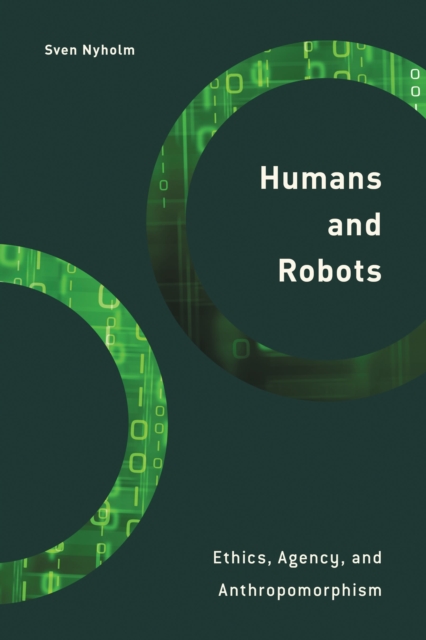
Humans and robots : ethics, agency, and anthropomorphism
Can robots perform actions, make decisions, collaborate with humans, be our friends, perhaps fall in love, or potentially harm us? Even before these things truly happen, ethical and philosophical questions already arise. The reason is that we humans have a tendency to spontaneously attribute minds and \"agency\" to anything even remotely humanlike. Moreover, some people already say that robots should be our companions and have rights. Others say that robots should be slaves. This book tackles emerging ethical issues about human beings, robots, and agency head on. It explores the ethics of creating robots that are, or appear to be, decision-making agents. From military robots to self-driving cars to care robots or even sex robots equipped with artificial intelligence: how should we interpret the apparent agency of such robots? This book argues that we need to explore how human beings can best coordinate and collaborate with robots in responsible ways. It investigates ethically important differences between human agency and robot agency to work towards an ethics of responsible human-robot interaction.
eBook