
Catalogue Search | MBRL


Are you sure you want to remove the book from the shelf?

{{itemTitle}}
1,683
result(s) for
"Human security India."
Sort by:


Human security
Human security is a new paradigm for security, development and justice. Since it was first proposed in the 1990s, there has been an endless debate between its proponents and critics, and even among its advocates, over the meaning and utility of the concept. What is important now is to move the concept beyond the realm of theory and explore its practical applications, considering possible policy perspectives and implications. This book suggests new practical applications of the human security concept, such as human security mapping, the human security governance index and human security impact assessment. Using Northeast India and Orissa as case studies, the methodology introduced in this path-breaking book can be applied to conflict zones worldwide. By designating the individual rather than the state as the referent object of security, human security is emerging as a framework that can serve as a means to evaluate threats, foresee crises, analyze causes of discord and propose solutions entailing a redistribution of responsibilities.
eBook

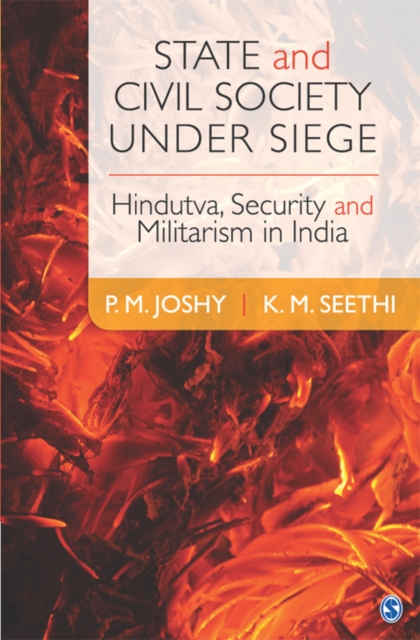
State and Civil Society under Siege
A comprehensive analysis on the rise, assertion and dominance of the New Hindu Right forces in civil society From its forgettable electoral performance of 1984 to its historical victory in 2014, the Bharatiya Janata Party's (BJP) story has been fodder for many political and academic debates. In this book, the authors show how the Hindu Right uses security, both external and internal, as a strategy for political mobilisation and eventual electoral success. It further explains the organisational and ideological penetration of the Sangh Parivar into the civil domain through strategies of securitisation. Deriving data from original sources, writings of leaders and their autobiographies, speeches, government documents, reports, pamphlets and manifestos of various Hindutva organisations, the work follows the growth of the Hindu Right forces and its trajectory over the years, taking a close look into its philosophical settings and political strategies. The book assumes significance in light of the massive electoral success of BJP in the 2014 elections.
eBook

In pursuit of the good life
Once celebrated as a model development for its progressive social indicators, the southern Indian state of Kerala has earned the new distinction as the nation's suicide capital, with suicide rates soaring to triple the national average since 1990. Rather than an aberration on the path to development and modernity, Keralites understand this crisis to be the bitter fruit borne of these historical struggles and the aspirational dilemmas they have produced in everyday life. Suicide, therefore, offers a powerful lens onto the experiential and affective dimensions of development and global change in the postcolonial world. In the long shadow of fear and uncertainty that suicide casts in Kerala, living acquires new meaning and contours. In this powerful ethnography, Jocelyn Chua draws on years of fieldwork to broaden the field of vision beyond suicide as the termination of life, considering how suicide generates new ways of living in these anxious times.
eBook

Border walls
Two decades after the fall of the Berlin Wall, why are the notable democracies of the United States, India, and Israel building massive walls and fences on their borders? Despite predictions of a borderless world through globalization, these three countries alone have built security barriers totaling an astonishing 5,700 kilometers in length. In this groundbreaking work, Reece Jones analyzes how these controversial walls were justified, their impact on those living behind them, and the long-term effects of the hardening of political boundaries. Border Walls is a bold, important intervention that demonstrates that the exclusion and violence necessary to secure the borders of the modern state often undermine the very ideals of freedom and democracy the barriers are meant to protect.
eBook

Beyond Partition
Communal violence, ethnonationalist insurgencies, terrorism, and
state violence have marred the Indian natio- state since its
inception. These phenomena frequently intersect with prevailing
forms of gendered violence complicated by caste, religion, regional
identity, and class within communities.
Deepti Misri shows how Partition began a history of politicized
animosity associated with the differing ideas of \"\"India\"\" held by
communities and in regions on one hand, and by the
political-military Indian state on the other. She moves beyond that
formative national event, however, in order to examine other forms
of gendered violence in the postcolonial life of the nation,
including custodial rape, public stripping, deturbanning, and
enforced disappearances. Assembling literary, historiographic,
performative, and visual representations of gendered violence
against women and men, Misri establishes that cultural expressions
do not just follow violence but determine its very contours, and
interrogates the gendered scripts underwriting the violence
originating in the contested visions of what \"\"India\"\" means.
Ambitious and ranging across disciplines, Beyond
Partition offers both an overview of and nuanced new
perspectives on the ways caste, identity, and class complicate
representations of violence, and how such representations shape our
understandings of both violence and India.
eBook

Dancing with the river : people and life on the Chars of South Asia
An intimate glimpse into the microcosmic world of \"hybrid landscapes\" and their inhabitants. With this book, Kuntala Lahiri-Dutt and Gopa Samanta offer an intimate glimpse into the microcosmic world of \"hybrid environments.\" Focusing on chars -- the part-land, part-water, low-lying sandy masses that exist within the riverbeds in the floodplains of lower Bengal -- the authors show how, both as real-life examples and as metaphors, chars straddle the conventional categories of land and water, and how people who live on them fluctuate between legitimacy and illegitimacy. The result, a study of human habitation in the nebulous space between land and water, charts a new way of thinking about land, people, and people's ways of life. Kuntala Lahiri-Dutt is a senior fellow in resource management in the Asia-Pacific Program at the College of Asia and the Pacific at the Australian National University. She lives in Canberra. Gopa Samanta is an associate professor in geography at the University of Burdwan. She lives in Golapbag, Burdwan, India.
eBook

Towards sustainable society: the sustainable livelihood security (SLS) approach for prioritizing development and understanding sustainability: an insight from West Bengal, India
A region's sustainability must be enhanced to achieve sustainable development goals. Therefore, the sustainability assessment in terms of social, economic, and environmental aspects substantially impacts achieving the livelihood security of any region. This study assesses the sustainable livelihood security index (SLSI) for the Eastern Indian state (West Bengal) by identifying 20 parameters and situating them within sustainable development's ecological security, economic efficiency, and social equity domains. The present study identified each selected indicator's relationship with the United Nations SDGs and adopted the notion of the Human Development Index of the UN Development Programme to construct an exclusive district-level SLS index. Three dimensions of sustainability, viz. ecological security, economic efficiency, and social equity, were adopted to measure the final SLSI. The study finds that the majority of the districts were performing substandard (SLSI value < 0.60) in terms of sustainable livelihood security (SLS), and a larger inter-district variation exists concerning economic and social domains. The SLS index may influence the design and execution of targeted interventions and policies aimed at boosting livelihoods and developing resilience by assessing the strengths and weaknesses of people's livelihoods.
Graphic abstract
Journal Article

Impact of Fireworks Industry Safety Measures and Prevention Management System on Human Error Mitigation Using a Machine Learning Approach
In the fireworks industry (FI), many accidents and explosions frequently happen due to human error (HE). Human factors (HFs) always play a dynamic role in the incidence of accidents in workplace environments. Preventing HE is a main challenge for safety and precautions in the FI. Clarifying the relationship between HFs can help in identifying the correlation between unsafe behaviors and influential factors in hazardous chemical warehouse accidents. This paper aims to investigate the impact of HFs that contribute to HE, which has caused FI disasters, explosions, and incidents in the past. This paper investigates why and how HEs contribute to the most severe accidents that occur while storing and using hazardous chemicals. The impact of fireworks and match industry disasters has motivated the planning of mitigation in this proposal. This analysis used machine learning (ML) and recommends an expert system (ES). There were many significant correlations between individual behaviors and the chance of HE to occur. This paper proposes an ML-based prediction model for fireworks and match work industries in Sivakasi, Tamil Nadu. For this study analysis, the questionnaire responses are reviewed for accuracy and coded from 500 participants from the fireworks and match industries in Tamil Nadu who were chosen to fill out a questionnaire. The Chief Inspectorate of Factories in Chennai and the Training Centre for Industrial Safety and Health in Sivakasi, Tamil Nadu, India, significantly contributed to the collection of accident datasets for the FI in Tamil Nadu, India. The data are analyzed and presented in the following categories based on this study’s objectives: the effect of physical, psychological, and organizational factors. The output implemented by comparing ML models, support vector machine (SVM), random forest (RF), and Naïve Bayes (NB) accuracy is 86.45%, 91.6%, and 92.1%, respectively. Extreme Gradient Boosting (XGBoost) has the optimal classification accuracy of 94.41% of ML models. This research aims to create a new ES to mitigate HE risks in the fireworks and match work industries. The proposed ES reduces HE risk and improves workplace safety in unsafe, uncertain workplaces. Proper safety management systems (SMS) can prevent deaths and injuries such as fires and explosions.
Journal Article