
Catalogue Search | MBRL


Are you sure you want to remove the book from the shelf?

{{itemTitle}}
225
result(s) for
"Human-animal relationships Philosophy."
Sort by:


Being Together in Place
Being Together in Placeexplores the landscapes that convene Native and non-Native people into sustained and difficult negotiations over their radically different interests and concerns. Grounded in three sites-the Cheslatta-Carrier traditional territory in British Columbia; the Wakarusa Wetlands in northeastern Kansas; and the Waitangi Treaty Grounds in Aotearoa/New Zealand-this book highlights the challenging, tentative, and provisional work of coexistence around such contested spaces as wetlands, treaty grounds, fishing spots, recreation areas, cemeteries, heritage trails, and traditional village sites. At these sites, activists learn how to articulate and defend their intrinsic and life-supportive ways of being, particularly to those who are intent on damaging or destroying these places.
Using ethnographic research and a geographic perspective, Soren C. Larsen and Jay T. Johnson show how the communities in these regions challenge the power relations that structure the ongoing (post)colonial encounter in liberal democratic settler-states. Emerging from their conversations with activists was a distinctive sense that the places for which they cared had agency, a \"call\" that pulled them into dialogue, relationships, and action with human and nonhuman others. This being-together-in-place, they find, speaks in a powerful way to the vitalities of coexistence: where humans and nonhumans are working to decolonize their relationships; where reciprocal guardianship is being stitched back together in new and unanticipated ways; and where a new kind of \"place thinking\" is emerging on the borders of colonial power.
eBook
Considering Animals
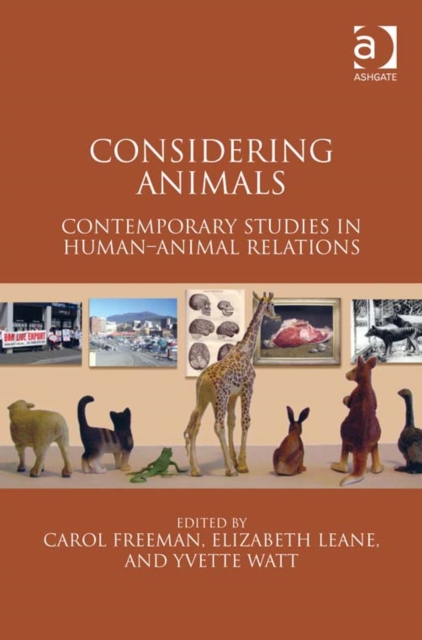
Considering Animals draws on the expertise of scholars trained in the biological sciences, humanities, and social sciences to investigate the complex and contradictory relationships humans have with nonhuman animals. Taking their cue from the specific 'animal moments' that punctuate these interactions, the essays engage with contemporary issues and debates central to human-animal studies: the representation of animals, the practical and ethical issues inseparable from human interactions with other species, and, perhaps most challengingly, the compelling evidence that animals are themselves considering beings. Case studies focus on issues such as animal emotion and human 'sentimentality'; the representation of animals in contemporary art and in recent films such as March of the Penguins, Happy Feet, and Grizzly Man; animals' experiences in catastrophic events such as Hurricane Katrina and the SARS outbreak; and the danger of overvaluing the role humans play in the earth's ecosystems. From Marc Bekoff's moving preface through to the last essay, Considering Animals foregrounds the frequent, sometimes uncanny, exchanges with other species that disturb our self-contained existences and bring into focus our troubled relationships with them. Written in an accessible and jargon-free style, this collection demonstrates that, in the face of species extinction and environmental destruction, the roles and fates of animals are too important to be left to any one academic discipline.
Contents: Foreword, Marc Bekoff; Introduction, Carol Freeman and Elizabeth Leane; Part 1 Image: Contemporary art and animal rights, Steve Baker; Marching on thin ice: the politics of penguin films, Elizabeth Leane and Stephanie Pfennigwerth; The traumatic effort to understand; Werner Herzog's Grizzly Man, Undine Sellbach; Naming and the unspeakable: representations of animal deaths in some recent South African print media, Wendy Woodward; Possum magic, possum menace: wildlife control and the demonisation of cuteness, Kay Milton. Part 2 Ethics: Pleasure's moral worth, Jonathan Balcombe; The nature of the experimental animal: evolution, vivisection and the Victorian environment, Jed Mayer; 'Room on the ark?': the symbolic nature of US pet evacuation statutes for nonhuman animals, Marsha L. Baum; Making animals matter: why the art world needs to rethink the representation of animals, Yvette Watt. Part 3 Agency: The speech of dumb beasts, Helen Tiffin; Extinction, representation, agency: the case of the dodo, Carol Freeman; Cetaceans and sentiment, Philip Armstrong; Zones of contagion: the Singapore body politic and the body of the street-cat, Lucy Davis; When is nature not?, Tim Low; Bibliography; Index.
Carol Freeman is a Research Associate in the School of Geography and Environmental Studies at the University of Tasmania.
Elizabeth Leane is a Senior Lecturer in the School of English, Journalism and European Languages at the University of Tasmania.
Yvette Watt is an Associate Lecturer in Fine Arts at the University of Tasmania.
eBook


Learning love from a tiger
Learning Love from a Tiger explores the vibrancy and variety of humans' sacred encounters with the natural world, gathering a range of stories culled from Christian, Muslim, Hindu, Mayan, Himalayan, Buddhist, and Chinese shamanic traditions. Readers will delight in tales of house cats who teach monks how to meditate, shamans who shape-shift into jaguars, crickets who perform Catholic mass, rivers that grant salvation, and many others. In addition to being a collection of wonderful stories, this book introduces important concepts and approaches that underlie much recent work in environmental ethics, religion, and ecology. Daniel Capper's light touch prompts readers to engage their own views of humanity's place in the natural world and question longstanding assumptions of human superiority.
eBook


The Human-Animal Boundary
Throughout the centuries philosophers and poets alike have defended an essential difference--rather than a porous transition--between the human and animal.Attempts to assign essential properties to humans (e.g., language, reason, or morality) often reflected ulterior aims to defend a privileged position for humans..This book shifts.
eBook

