
Catalogue Search | MBRL


Are you sure you want to remove the book from the shelf?

{{itemTitle}}
17
result(s) for
"Humanae vitae"
Sort by:

Humanae vitae, a generation later
Janet E. Smith presents a comprehensive review of this issue from a philosophical and theological perspective. Tracing the emergence of the debate from the mid-1960s and reviewing the documents from the Special Papl Commission established to advise Pope Paul VI, Smith also examines the Catholic Church's position on marriage, which provides context for its condemnation of contraception.
eBook

“Tormented by Difficulties of Every Kind”: Catholic Teaching on Contraception in Social Context
The Catholic Church notably condemns all forms of artificial birth control and advocates natural family planning as the only morally licit means of spacing births. This teaching is presented as the quintessential pathway to the fullness of human sexuality, but many Catholics struggle with it, and the magisterium itself recognizes that this path is not an easy one to follow. This article uses recent developments in Catholic moral theology around the notion of structural sin to examine the structural constraints complicating ordinary Catholics’ pursuit of their tradition’s vision for marital sexuality, demonstrating that larger structural forces can considerably affect the perceived viability of Catholic teaching on contraception. As a result, the article highlights the importance of linking Catholic sexual ethics and social ethics to provide a more credible vision for a more compassionate approach to married life.
Journal Article
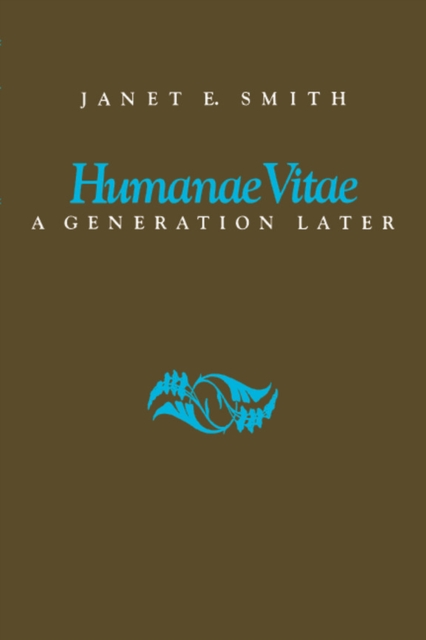
Humanae vitae, a generation later
Janet E. Smith presents a comprehensive review of this issue from a philosophical and theological perspective. Tracing the emergence of the debate from the mid-1960s and reviewing the documents from the Special Papl Commission established to advise Pope Paul VI, Smith also examines the Catholic Church's position on marriage, which provides context for its condemnation of contraception.
eBook

‘Too Many Children?’ Family Planning and Humanae Vitae in Dublin, 1960–72
In July 1968, the papal encyclical Humanae Vitae reaffirmed the ban on artificial contraception for Catholics. Utilising Dublin as a case study, this article explores how the Irish medical and social work community, their patients and the Catholic hierarchy responded to Humanae Vitae. Drawing on a range of medical and diocesan sources, as well as diverse material from the news media, this article illuminates the change in private behaviour that took place with regard to birth control between 1960 and 1972, and contrasts this behaviour with the public rhetoric and actions of many Catholics in positions of power. Furthermore, it highlights class inequality regarding access to and education on birth control; the health and welfare of working-class women often suffered greatly as a result of multiple births. It is demonstrated that while many exhibited a more liberal shift in their views on the issue of artificial birth control, this was not a straightforward change. A strong, patriarchal network of authority, made up of the Irish Catholic hierarchy and an obeisant section of the medical profession, sought to reaffirm control over Catholic women’s bodies in the wake of Humanae Vitae.
Journal Article

Reframing Catholic Ethics: Is the Person an Integral and Adequate Starting Point?
Joseph Selling rightly defines human intentions and motivations as part of human nature and an important determinant of the morality of personal actions. The thesis of this paper is that Selling’s view of agency, as focused on the individual, must be expanded to include social relationships and the social constitution of selves and communities. This requires cross-cultural dialogue about human nature, the goods for persons and societies, and social ethics.
Journal Article

Postmodern Belief
How can intense religious beliefs coexist with pluralism in America today? Examining the role of the religious imagination in contemporary religious practice and in some of the best-known works of American literature from the past fifty years, Postmodern Belief shows how belief for its own sake--a belief absent of doctrine--has become an answer to pluralism in a secular age. Amy Hungerford reveals how imaginative literature and religious practices together allow novelists, poets, and critics to express the formal elements of language in transcendent terms, conferring upon words a religious value independent of meaning. Hungerford explores the work of major American writers, including Allen Ginsberg, Don DeLillo, Cormac McCarthy, Toni Morrison, and Marilynne Robinson, and links their unique visions to the religious worlds they touch. She illustrates how Ginsberg's chant-infused 1960s poetry echoes the tongue-speaking of Charismatic Christians, how DeLillo reimagines the novel and the Latin Mass, why McCarthy's prose imitates the Bible, and why Morrison's fiction needs the supernatural. Uncovering how literature and religion conceive of a world where religious belief can escape confrontations with other worldviews, Hungerford corrects recent efforts to discard the importance of belief in understanding religious life, and argues that belief in belief itself can transform secular reading and writing into a religious act. Honoring the ways in which people talk about and practice religion, Postmodern Belief highlights the claims of the religious imagination in twentieth-century American culture.
eBook

Josef Fuchs' Revised Natural Law: Possibilities for Social Ethics
In the second half of the twentieth century Josef Fuchs put forward a major re-visioning of the natural law, but this re-visioning did not include a robust social ethic. In this paper the author first undertakes an explication of the development, context, and major features of Fuchs' theory. Next, in order to locate it within other twentieth century developments in natural law theory, Fuchs' theory is related to Jacques Maritain's re-visioning of natural law, with its clear social-ethical implications. Finally, the author draws out some of the potential implications and applications of Fuchs' revised natural law for social ethics.
Journal Article

'Humanae vitae' I: Pope Paul VI in pastoral mode
Long after its publication in 1968, Pope Paul VI's encyclical letter on birth control Humanae Vitae continues to provoke great interest among Catholic bishops, clergy and faithful alike. At the time of its promulgation and in the years since, many Catholic couples struggled with the teaching contained in the document. Some couples apparently managed to adapt seamlessly to the continuing prohibition on contraception, but others encountered and continue to encounter major difficulties in receiving and living the teaching. Birth control may no longer be an issue for that first generation of couples, yet many of them still view Humanae Vitae as a watershed in their journey in Catholic faith.
Journal Article
Humanae vitae II: Conscience, contraception and holy communion
Having taken all reasonable steps to make the best decision they can in conscience, a Catholic couple believe they have no real alternative but to use contraception for the time being. Can this couple continue to receive Holy Communion?
Journal Article

Humanae vitae, ideología de género y futuro biotecnológico
Este artículo tiene como finalidad hacer un comentario breve alusivo a la influencia de la Humanae vitae, cincuenta años después de haber sido publicada. En este contexto se comentan algunos aspectos alusivos a la influencia positiva que confiere esta encíclica al entorno afectivo de la sexualidad, tanto en la edad adulta como en edades temprana de la juventud, ante la influencia de la ideología LGTBI. La visión antropológica de la sexualidad confiere un entorno de respeto por la dignidad de la persona, ante las desviaciones que pueden llegar a presentarse debidas a la influencia de la ideología de género. Finalmente, se citan algunos artículos científicos de índole internacional, que ilustran positivamente la posibilidad de compatibilizar la ciencia con el carácter unitivo y procreativo de la Humanae vitae, en un entorno globalizado.
Journal Article