
Catalogue Search | MBRL


Are you sure you want to remove the book from the shelf?

{{itemTitle}}
7,411
result(s) for
"Humanities Research Methodology."
Sort by:

Hermeneutica : computer-assisted interpretation in the humanities
\"With increasing interest being shown in participatory research models, whether it be Wikipedia, World of Warcraft, participatory writing (like Montfort et al's 10 Print or Laurel et al's Design Research) or the more traditional communal research cultures of the arts collective or engineering lab, the Humanities is increasingly relying on computational tools to do the 'heavy lifting' necessary to process all of this information. Hermeneuti.ca, as its name implies, is about hermeneutical things--the computing tools of research that are usually hidden--how to use them, and how they are interpretative objects to be understood. Hermeneuti.ca is both a book and also a web site (http://hermeneuti.ca) that shows the interactive text analysis tools woven into the book. Essentially, Hermeneuti.ca is both a text about computer-assisted methods and a collection of analytical tools called Voyant (http://voyant-tools.org) that instantiate the authors ideas. While there is a definitely an emphasis on classic Digital Humanities work (corpus analysis, information retrieval, etc.), there is also a focus on the development of software as part of a project of knowledge that encompasses the idea of software as an active part of knowledge production that brings this book into the Software Studies series\"--Provided by publisher.
Book

Research methods for reading digital data in the digital humanities
The first volume centred on the navigation and interpretation of digital material as research methods in the Humanities.
eBook

Critical Digital Humanities : The Search for a Methodology
\"Can established humanities methods coexist with computational thinking? It is one of the major questions in humanities research today, as scholars increasingly adopt sophisticated data science for their work. James E. Dobson explores the opportunities and complications faced by humanists in this new era. Though the study and interpretation of texts alongside sophisticated computational tools can serve scholarship, these methods cannot replace existing frameworks. As Dobson shows, ideas of scientific validity cannot easily nor should be adapted for humanities research because digital humanities, unlike science, lack a leading-edge horizon charting the frontiers of inquiry. Instead, the methods of digital humanities require a constant rereading. At the same time, suspicious and critical readings of digital methodologies make it unwise for scholars to defer to computational methods. Humanists must examine the tools--including the assumptions that went into the codes and algorithms--and questions surrounding their own use of digital technology in research. Insightful and forward thinking, this book lays out a new path of humanistic inquiry that merges critical theory and computational science\"-- Provided by publisher.
Book
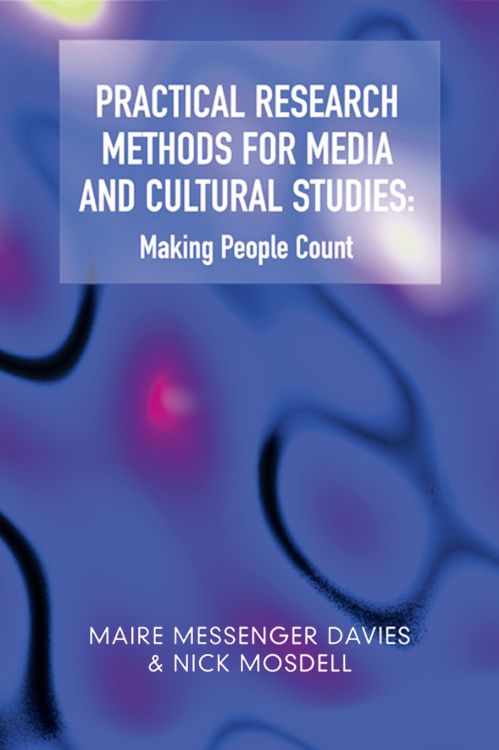
Practical research methods for media and cultural studies
Many very intelligent people don't like dealing with numbers. Similarly, many gifted scientists are not especially interested in studying people and their cultural behaviour. In this book, we argue that being interested in people and their cultures, and helping students and others to use numbers to pursue these interests, are not mutually exclusive. Research methods are becoming an increasingly important requirement for students of all kinds. But many students, particularly those in the humanities, struggle with concepts drawn from the social sciences and find quantitative and statistical information inaccessible and daunting. Nonetheless, such concepts are found in nearly all areas of society, from market research and opinion polls to psychological studies of human behaviour. This book aims to provide a simple guide to the process of conducting research in the humanities, with special reference to media and culture, from the planning stage, through the data gathering, to the analysis and interpretation of results: 'planning it', 'doing it' and 'understanding it'.
The book aims to show how students' own choice of research topic can be refined into a manageable research question and how the most appropriate methodologies can be applied. Each section draws on actual examples from research that the authors and their students have conducted. Topics covered include: choosing a research question and method; instrument design and pilot data; practical procedures; research with children; looking at statistics; and interpretation of results.
Key Features:
Based on the authors' practical experience as researchers and teachers and is thus accessible, practical and 'how to'.Includes students' own work as examples.Bridges the 'divide' between social science and humanities research methods and will therefore appeal to a broad range of students and teachers.
eBook


Research methods for creating and curating data in the digital humanities
The first volume to introduce the techniques and methods of reading digital material for researchDigital Humanities has become one of the new domains of academe at the interface of technological development, epistemological change, and methodological concerns. This volume explores how digital material might be read or utilized in research, whether that material is digitally born as fanfiction, for example, mostly is, or transposed from other sources. The volume asks questions such as what happens when text is transformed from printed into digital matter, and how that impacts on the methods we bring to bear on exploring that technologized matter, for example in the case of digital editions. Issues such as how to analyse visual material in digital archives or Twitter feeds, how to engage in data mining, what it means to undertake crowd-sourcing, big data, and what digital network analyses can tell us about online interactions are dealt with. This will give Humanities researchers ideas for doing digitally based research and also suggest ways of engaging with new digital research methods.Key featuresFirst volume centred on the navigation and interpretation of digital material as research methods in the HumanitiesUp-to-date analyses of issues and methods including big data, crowdsourcing, digital network analysis, working with digital additionsBased on actual research projects such as para-textual work with fanfiction, reading twitter, different kinds of distant and close readings
eBook


Doing Academic Research
Doing Academic Research is a concise, accessible, and tightly organized overview of the research process in the humanities, social sciences, and business. Conducting effective scholarly research can seem like a frustrating, confusing, and unpleasant experience. Early researchers often have inconsistent knowledge and experience, and can become overwhelmed - reducing their ability to produce high quality work.
Rather than a book about research, this is a practical guide to doing research. It guides budding researchers along the process of developing an effective workflow, where to go for help, and how to actually complete the project. The book addresses diversity in abilities, interest, discipline, and ways of knowing by focusing not just on the process of conducting any one method in detail, but also on the ways in which someone might choose a research method and conduct it successfully. Finally, it emphasizes accessibility and approachability through real-world examples, key insights, tips, and tricks from active researchers.
This book is a highly useful addition to both content area courses and research methods courses, as well as a practical guide for graduate students and independent scholars interested in publishing their research.
eBook

Mapping landscapes in transformation : multidisciplinary methods for historical analysis
\"The development of historical geographical information systems (HGIS) and other methods from the digital humanities have revolutionised historical research on cultural landscapes. One of today's major challenges, however, concerns the concepts and tools to be deployed for mapping processes of transformation - that is, interpreting and imagining the relational complexity of urban and rural landscapes, both in space and in time, at micro- and macro-scale. The opening up of increasingly diverse collections of source material, often incomplete and difficult to interpret, has led to methodologically innovative experiments. 'Mapping Landscapes in Transformation' gathers experts from different disciplines, active in the fields of historical geography, urban and landscape history, and heritage conservation. They are specialised in a wide variety of space-time contexts, including regions within Europe, Asia, and the Americas, and periods from antiquity to the 21st century\"--Page 4 of cover.
Book

Routledge International Handbook of Research Methods in Digital Humanities
This book draws on both traditional and emerging fields of study to consider what a grounded definition of quantitative and qualitative research in the Digital Humanities (DH) might mean; which areas DH can fruitfully draw on in order to foster and develop that understanding; where we can see those methods applied; and what the future directions of research methods in Digital Humanities might look like.
Schuster and Dunn map a wide-ranging DH research methodology by drawing on both 'traditional' fields of DH study such as text, historical sources, museums and manuscripts, and innovative areas in research production, such as knowledge and technology, digital culture and society and history of network technologies. Featuring global contributions from scholars in the United Kingdom, the United States, Europe and Australia, this book draws together a range of disciplinary perspectives to explore the exciting developments offered by this fast-evolving field.
Routledge International Handbook of Research Methods in Digital Humanities is essential reading for anyone who teaches, researches or studies Digital Humanities or related subjects.
eBook