
Catalogue Search | MBRL


Are you sure you want to remove the book from the shelf?

{{itemTitle}}
3,521
result(s) for
"Humboldt"
Sort by:


Humboldt and the reinvention of nature
1. Alexander von Humboldt is a key figure in the history of ecology and biogeography who contributed to shape what is today ecology, as well as the environmentalist movement. His observation that the world's vegetation varies systematically with climate was one of his many contributions to science. 2. Here, we question to what extent Humboldt's view biased our vision of nature. The current emphasis on the role of climate and soils in ecological and evolutionary studies, and the emphasis on forests as the potential and most important vegetation, suggests that we still view nature through the eyes of Humboldt. 3. Over the last 20 years, diverse studies have shown that many open non-forested ecosystems (savannas, grasslands, and shrublands) cannot be predicted by climate and are ancient and diverse systems maintained by fire and/or vertebrate herbivory. Paleoecological and phylogenetic studies have shown the key role of these plant consumers at geological time scales. This has major implications for how we understand and manage our ecosystems. 4. Synthesis. We need to consciously probe the long-standing idea that climate and soils are the only major factors shaping broad-scale patterns in nature. We propose to move beyond the legacy of Humboldt by embracing fire and large mammal herbivory as additional key factors in explaining the ecology and evolution of world vegetation.
Journal Article


Alexander von Humboldt
Alexander von Humboldt: Perceiving the World provides an interdisciplinary exploration into Humboldt’s approach to seeing and describing the many subjects he pursued. Though remembered primarily as an environmental thinker, Humboldt’s interests were vast and documented not just in his published works, but also in his extensive correspondence with scientists, artists, poets, and philosophers internationally. Perceiving the World covers Humboldt’s perceptions during intercontinental travels and scientific discoveries, as well as how he visualized nature, geography, environments, and diverse cultures, including Indigenous Peoples.
This collection draws heavily on the English translations of Humboldt’s work housed in the Purdue University Archives, which were collected by John Purdue. The book is divided into three parts: Humboldt’s contributions to science since the nineteenth century; his work on nature, climates, environments, and the cosmos; and his lasting cultural impact, including his imaging techniques, modes of visual presentation, and contributions to the arts. Humboldt’s intricate approach to perception still resonates today, as his nuanced and unique way of seeing the world was just as important as what he wrote.
eBook

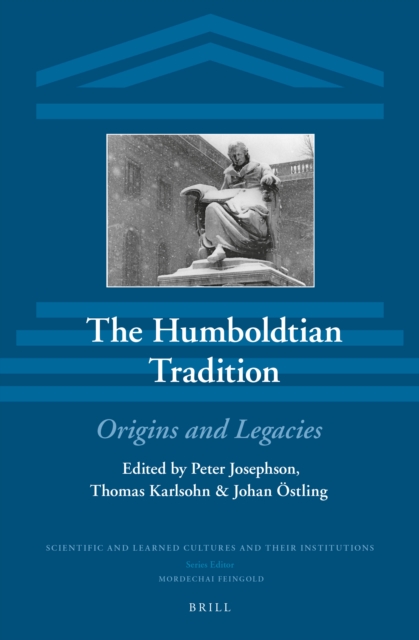
The Humboldtian Tradition
In The Humboldtian Tradition, eleven scholars analyse Wilhelm von Humboldt as a historical phenomenon and a contemporary symbol. They put Humboldt's basic academic principles into context and discuss their significance for the current debate about the university.
eBook


Leaping eels electrify threats, supporting Humboldt’s account of a battle with horses
In March 1800, Alexander von Humboldt observed the extraordinary spectacle of native fisherman collecting electric eels (Electrophorus electricus) by “fishing with horses” [von Humboldt A (1807) Ann Phys 25:34–43]. The strategy was to herd horses into a pool containing electric eels, provoking the eels to attack by pressing themselves against the horses while discharging. Once the eels were exhausted, they could be safely collected. This legendary tale of South American adventures helped propel Humboldt to fame and has been recounted and illustrated in many publications, but subsequent investigators have been skeptical, and no similar eel behavior has been reported in more than 200 years. Here I report a defensive eel behavior that supports Humboldt’s account. The behavior consists of an approach and leap out of the water during which the eel presses its chin against a threatening conductor while discharging high-voltage volleys. The effect is to short-circuit the electric organ through the threat, with increasing power diverted to the threat as the eel attains greater height during the leap. Measurement of voltages and current during the behavior, and assessment of the equivalent circuit, reveal the effectiveness of the behavior and the basis for its natural selection.
Journal Article