
Catalogue Search | MBRL


Are you sure you want to remove the book from the shelf?

{{itemTitle}}
4,320
result(s) for
"Hume, David, 1711-1776"
Sort by:


Historical dictionary of Hume's philosophy
The philosopher David Hume was born in Edinburgh, Scotland on April 26, 1711. Known for his re-thinking of causation, morality, and religion, Hume has left a lasting mark on history. James Madison, the \"father\" of the U.S. Constitution, drew heavily on Hume's writing, especially his \"Idea of Perfect Commonwealth,\" which combated the belief at the time that a large country could not sustain a republican form of government. Hume's writing also influenced Adam Smith's Wealth of Nations and the philosophy of Immanuel Kant. This edition attempts a broader picture of Hume's philosophy including more detail on the elements of his psychology, aesthetics, social and political philosophy as well as his legacy in contemporary topics of race, feminism, animal ethics, and environmental issues.
This second edition of Historical Dictionary of Hume's Philosophy contains a chronology, an introduction, and an extensive bibliography. The dictionary section has over 100 cross-referenced entries covering key terms, as well as brief discussions of Hume's major works and of some of his most important predecessors, contemporaries, and successors. This book is an excellent resource for students, researchers, and anyone wanting to know more about David Hume.
eBook


Hume's Enlightenment Tract
This book studies David Hume's Enquiry concerning Human Understanding. The Enquiry has, contrary to its author's expressed wishes, long lived in the shadow of its predecessor, A Treatise of Human Nature. This book presents the Enquiry in a fresh light, and aims to raise it to its rightful position in Hume's work and in the history of philosophy. It argues that the Enquiry is not, as so often assumed, a mere collection of watered-down extracts from the earlier work. It is, rather, a coherent work with a unified argument; and, when this argument is grasped as a whole, the Enquiry shows itself to be the best introduction to the lineaments of its author's general philosophy. This book offers a careful guide through the argument and structure of the work. It shows how the central sections of the Enquiry offer a critique of the dogmatic empiricisms of the ancient world (Stoicism, Epicureanism, and Aristotelianism), and set in place an alternative conception of human powers based on the sceptical principles of habit and probability. These principles are then put to work, to rule out philosophy's metaphysical ambitions and their consequences: religious systems and their attendant conception of human beings as semi-divine rational animals. Hume's scepticism, experimentalism, and naturalism are thus shown to be different aspects of the one unified philosophy — a sceptical version of the Enlightenment vision.
eBook


David Hume
This volume provides a new and nuanced appreciation of David Hume, the historian. Gone for good are the days when one can off-handedly assert, as R. G. Collingwood once did, that Hume “deserted philosophical studies in favour of historical” ones. History and philosophy are commensurate in Hume’s thought and works from the beginning to the end. Only by recognizing this can we begin to make sense of Hume’s canon as a whole. Only then are we able to see clearly his many contributions to fields we now recognize as the distinct disciplines of history, philosophy, political science, economics, literature, religious studies and much else besides. Casting their individual beams of light on various nooks and crannies of Hume’s historical thought and writing, the book’s contributors illuminate the whole in a way that would not be possible from the perspective of a single-authored study. Aside from the editor, the contributors are David Allan, M. A. Box, Timothy M. Costelloe, Roger L. Emerson, Jennifer Herdt, Philip Hicks, Douglas Long, Claudia M. Schmidt, Michael Silverthorne, Jeffrey M. Suderman, Mark R. M. Towsey, and F. L. Van Holthoon.
eBook
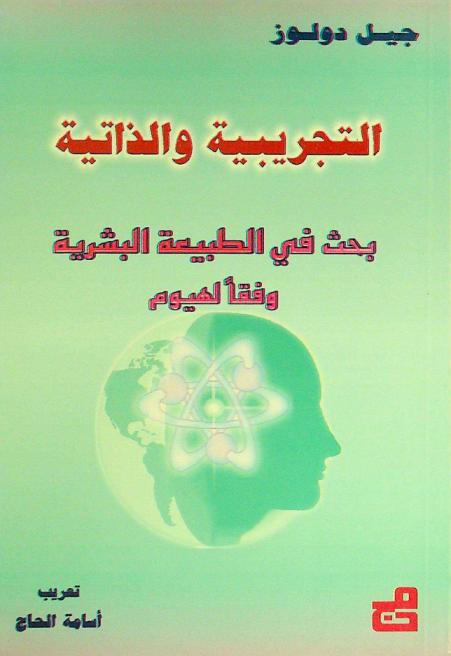
التجريبية والذاتية : بحث في الطبيعة البشرية وفقا لهيوم
يقدم دولوز في هذا الكتاب نظرية جديدة للإدراك والتجربة، حيث يقول إن التجربة ليست مجرد تسجيل للحواس، بل هي تفسير نشط للحواس. ومن خلال هذا التفسير، يصبح المستقبل مفتوحا للاختيارات المختلفة، بدلا من أن يكون محددا مسبقا. كما يتطرق دولوز في كتابه إلى مفهوم الذاتية، حيث يعني بذلك قدرة الإنسان على تحديد هويته وتحديد مكانته في العالم. ويقول دولوز إن الذاتية ليست شيئا ثابتا، بل هي تتغير باستمرار، وتتأثر بالظروف الخارجية والتجارب الداخلية.
BOOK

Toward a Humean true religion : genuine theism, moderate hope, and practical morality
David Hume is traditionally seen as a devastating critic of religion. He is widely read as an infidel, a critic of the Christian faith, and an attacker of popular forms of worship. His reputation as irreligious is well forged among his readers, and his argument against miracles sits at the heart of the narrative overview of his work that perennially indoctrinates thousands of first-year philosophy students. In Toward a Humean True Religion, Andre Willis succeeds in complicating Hume's split approach to religion, showing that Hume was not, in fact, dogmatically against religion in all times and places. Hume occupied a \"watershed moment,\" Willis contends, when old ideas of religion were being replaced by the modern idea of religion as a set of epistemically true but speculative claims. Thus, Willis repositions the relative weight of Hume's antireligious sentiment, giving significance to the role of both historical and discursive forces instead of simply relying on Hume's personal animus as its driving force. Willis muses about what a Humean \"true religion\" might look like and suggests that we think of this as a third way between the classical and modern notions of religion. He argues that the cumulative achievements of Hume's mild philosophic theism, the aim of his moral rationalism, and the conclusion of his project on the passions provide the best content for this \"true religion.\"
eBook


David Hume's Political Theory
David Hume's Political Theorybrings together Hume's diverse writings on law and government, collected and examined with a view to revealing the philosopher's coherent and persuasive theory of politics.
eBook