
Catalogue Search | MBRL


Are you sure you want to remove the book from the shelf?

{{itemTitle}}
1,151
result(s) for
"IMPORT PROCEDURES"
Sort by:

Ukraine's trade policy : a strategy for integration into global trade
Ukraine's Trade Policy identifies the key drivers of Ukraine's recent trade performance, assesses current trade policies, and proposes recommendations to strengthen the Ukraines trade integration strategy. It also identifies core bottlenecks in the ongoing integration processes, including global and regional integration. The study concludes that the main obstacles to furthering Ukraines trade integration are domestic, and relate to deficiencies in the business environment. Problems in customs administration, standardization, and administrative barriers for new entry require immediate attention. The report highlights specific policy issues that hamper WTO accession, such as trade legislation, protection of intellectual property rights, government support for specific industries, and export restrictions. It also recommends improvements in the structure of Ukraines import tariffs, reform of both the regime of free economic zones and mechanism of VAT refund, and investment in a major upgrade of government capacity for investment and export promotion. The report also draws attention to the importance of the post-WTO accession agenda for Ukraine. To take advantage of WTO membership, the Government will need to undertake significant institutional reforms to implement WTO regulatory rules in ways that facilitate integration into the world economy and provide benefits to private sector participants.
eBook

Assessing World Bank support for trade, 1987-2004 : an IEG evaluation
An independent evaluation of the World Bank??s extensive support to developing countries on trade issues between 1987 and 2004. The study assesses the development effectiveness of World Bank trade-related advocacy, capacity-building, lending and research. It examines the extent to which the Bank??s policies and assistance have met its stated objectives in the area of trade and makes recommendations to strengthen the effectiveness of future Bank trade assistance.
eBook


Why Adjudicate?
The World Trade Organization (WTO) oversees the negotiation and enforcement of formal rules governing international trade. Why do countries choose to adjudicate their trade disputes in the WTO rather than settling their differences on their own? InWhy Adjudicate?,Christina Davis investigates the domestic politics behind the filing of WTO complaints and reveals why formal dispute settlement creates better outcomes for governments and their citizens.
Davis demonstrates that industry lobbying, legislative demands, and international politics influence which countries and cases appear before the WTO. Democratic checks and balances bias the trade policy process toward public lawsuits and away from informal settlements. Trade officials use legal complaints to manage domestic politics and defend trade interests. WTO dispute settlement enables states and domestic groups to signal resolve more effectively, thereby enhancing the information available to policymakers and reducing the risk of a trade war. Davis establishes her argument with data on trade disputes and landmark cases, including the Boeing-Airbus controversy over aircraft subsidies, disagreement over Chinese intellectual property rights, and Japan's repeated challenges of U.S. steel industry protection. In her analysis of foreign trade barriers against U.S. exports, Davis explains why the United States gains better outcomes for cases taken to formal dispute settlement than for those negotiated. Case studies of Peru and Vietnam show that legal action can also benefit developing countries.
eBook

Responding to the environmental effects of remittances and trade liberalization in net-importing economies: the role of renewable energy in Sub-Saharan Africa
Little is currently known about how policy choices that seek to bridge the gap between low production capacity and growing consumption demands in developing economies impact the environment. To address this research gap, a quantile-based model is used to examine the impact of three policy-relevant variables on carbon dioxide (CO
2
) emissions: international remittance inflows, trade liberalization, and renewable energy consumption. Territorial-based CO
2
emissions are used to explain the environmental effects of the variables when emissions are calculated solely on the basis of domestic production capacity. To consider if trade-induced consumption demands provide a better measure for assessing the environmental effects of the variable, consumption-based CO
2
emissions are used. The study focused on Sub-Saharan African countries with zero or net positive CO
2
emissions from trade. The results show, among other things, that remittances and trade liberalization increase CO
2
emissions irrespective of the accounting method. Trade, in particular, has a stronger effect through import-induced consumption activities. However, the effect is statistically insignificant for the lower quantile countries and statistically significant for the middle and upper quantile countries. Harnessing the potential of renewable energy to reduce CO
2
emissions should thus be a priority for policymakers in net-importing developing economies if production and consumption activities are to be created in less carbon-intensive ways.
Journal Article

Supply portfolio selection for lead-time sensitive manufacturers under operational and disruption risks
PurposeThis paper proposes a two-level supply chain including suppliers and manufacturers. The purpose of this paper is to design a resilient fuzzy risk-averse supply portfolio selection approach with lead-time sensitive manufacturers under partial and complete supply facility disruption in addition to the operational risk of imprecise demand to minimize the mean-risk costs. This problem is analyzed for a risk-averse decision maker, and the authors use the conditional value-at-risk (CVaR) as a risk measure, which has particular applications in financial engineering.Design/methodology/approachThe methodology of the current research includes two phases of conceptual model and mathematical model. In the conceptual model phase, a new supply portfolio selection problem is presented under disruption and operational risks for lead-time sensitive manufacturers and considers resilience strategies for risk-averse decision makers. In the mathematical model phase, the stages of risk-averse two-stage fuzzy-stochastic programming model are formulated according to the above conceptual model, which minimizes the mean-CVaR costs.FindingsIn this paper, several computational experiments were conducted with sensitivity analysis by GAMS (General algebraic modeling system) software to determine the efficiency and significance of the developed model. Results show that the sensitivity of manufacturers to the lead time as well as the occurrence of disruption and operational risks, significantly affect the structure of the supply portfolio selection; hence, manufacturers should be taken into account in the design of this problem.Originality/valueThe study proposes a new two-stage fuzzy-stochastic scenario-based mathematical programming model for the resilient supply portfolio selection for risk-averse decision-makers under disruption and operational risks. This model assumes that the manufacturers are sensitive to lead time, so the demand of manufacturers depends on the suppliers who provide them with services. To manage risks, this model also considers proactive (supplier fortification, pre-positioned emergency inventory) and reactive (revision of allocation decisions) resilience strategies.
Journal Article

Criteria for Determining Critical Imports in Ukraine
As a result of the military operations on the territory of Ukraine, many enterprises ceased to function, and the operating enterprises bear a manifold increased fiscal and socio-economic burden. Therefore, the state must implement an effective customs policy, particularly in regulating critical imports, to ensure support for developing existing businesses in the conditions of disruption of raw material supplies and logistics connections between business entities. The article aims to reveal the features and criteria for determining critical imports under martial law conditions. The peculiarities of critical imports of Ukraine in martial law conditions were analyzed. Groups of goods of critical import have been identified. The stages of simplifying customs procedures for transporting humanitarian goods under martial law conditions have been determined. It was established that the list of goods and services of critical import was repeatedly revised upward. Changes to the current legislation were made based on appeals from Ukrainian companies. Despite the critical attitude of subjects of foreign economic activity to the list of critical import goods, its implementation made it possible to save the gold and foreign exchange reserves of the National Bank of Ukraine in the first weeks of the war thanks to the balancing of currency flows. The article analyzes the criteria for determining critical import goods under martial law conditions, which were classified into four subgroups: the energy sector, the security and defence sector, the sector ensuring the population's livelihood, and the sector ensuring the functioning of industrial enterprises. At the same time, the legal regulation of critical imports in martial law conditions may change, taking into account the development trends of the financial and economic situation in the country, so this issue remains open for scientific discussion.
Journal Article
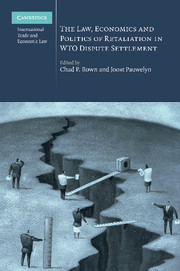
The Law, Economics and Politics of Retaliation in WTO Dispute Settlement
The WTO allows its members to retaliate in the face of continued non-compliance. After more than ten years' operation and ten arbitration disputes, this volume assesses the law, economics and politics of trade sanctions in WTO dispute settlement. Including more than thirty contributions from leading academics, trade diplomats and practitioners, it offers a thorough analysis of the legal rules on permissible WTO retaliation as well as an assessment of the economic rationale and calculations behind the mechanism. In addition, it provides first hand experiences of those countries that have obtained WTO authorisation to retaliate, ranging from the United States and the EC to Mexico and Antigua. In this assessment, the question of how to make the system work also for small countries is paramount. Finally, the volume spells out lessons that could be learned from related fields such as remedies for non-compliance in investment arbitration and competition or anti-trust regimes.
eBook

Comparison of model selection technique performance in predicting the spread of newly invasive species: a case study with Batrachochytrium salamandrivorans
Species distribution models (SDMs) increasingly have been used to anticipate the spread of invasive species. However, these models are powerful conservation tools only if they are biologically relevant, and thus validation of these models is essential. Here, we evaluate four model selection frameworks for their ability to identify a best fit model of spread under low data conditions early in an invasion, specifically testing the efficacy of methods that utilize absence data in addition to presence data in evaluating models. We test this question using a simulation where we generated data with varying confidence in the accuracy of the absence data, as absences in early invasions may become presences in the future, and increasing quantity of observation data to test the models. We create these simulations based on a real-world example of a newly emergent, invasive fungal pathogen, Batrachochytrium salamandrivorans (Bsal). The simulation demonstrated that AIC and Likelihood consistently outperform both Kappa and AUC in selecting the true model as the best model when data are limited and absence data are low quality, with AIC providing the most conservative results due to penalties for overparameterization. With these results, we then used these techniques to compare five candidate models for predicting the spread of Bsal. Consistent with the simulation, the best fit model of the candidate models for Bsal was inconsistent across the four metrics. However, AIC, which performed best in the simulation study, suggested that the spread of Bsal into Western Europe was best predicted by a combination of bioclimatic suitability, salamander richness, and number of salamander imports. Our results highlight the difficulty in evaluating predictive models when data are limited and of low quality, as with a newly invasive species, but show that these challenges can be partially addressed with the appropriate model selection approach. Use of this approach is critical as SDMs of invasive species are often used to inform conservation policy and efforts before the invasion spreads, when limited data are available.
Journal Article

Trade-based Diffusion of Labor Rights: A Panel Study, 1986–2002
This article investigates the nature of the linkages between trade and labor rights in developing countries. Specifically, we hypothesize that a “California effect” serves to transmit superior labor standards from importing to exporting countries, in a manner similar to the transmission of environmental standards. We maintain that, all else being equal, the labor standards of a given country are influenced not by its overall level of trade openness, but by the labor standards of its trading partners. We evaluate our hypothesis using a panel of 90 developing countries over the period 1986–2002, and we separately examine the extent to which the labor laws and the actual labor practices of the countries are influenced by those of their export destinations. We find that strong legal protections of collective labor rights in a country's export destinations are associated with more stringent labor laws in the exporting country. This California effect finding is, however, weaker in the context of labor rights practices, highlighting the importance of distinguishing between formal legislation and actual implementation of labor rights.
Journal Article