
Catalogue Search | MBRL


Are you sure you want to remove the book from the shelf?

{{itemTitle}}
13,112
result(s) for
"INTERNATIONAL RECOGNITION"
Sort by:


Recognizing States
This book examines recognition of new states, the practice historically employed to regulate membership in international society. The last twenty years have witnessed new or lingering demands for statehood in different areas of the world. The claims of some, like those of Bosnia and Herzegovina, Eritrea, Croatia, Georgia, and East Timor, have achieved general recognition; those of others, like Kosovo, Tamil Eelam, South Ossetia, Abkhazia, and Somaliland, have not. However, even as most of these claims gave rise to major conflicts and international controversies, the criteria for acknowledgment of new states have elicited little systematic scholarship. Drawing upon writings of English School theorists, this study charts the practice from the late eighteenth century until the present. Its central argument is that for the past 200 years state recognition has been tied to the idea of self-determination of peoples. Two versions of the idea have underpinned the practice throughout most of this period – self-determination as a negative and a positive right. The negative idea, dominant from 1815 to 1950, took state recognition to be acknowledgment of an achievement of de facto statehood by a people desiring independence. Self-determination was expressed through, and externally gauged by, self-attainment. The positive idea, prevalent since the 1950s, took state recognition to be acknowledgment of an entitlement to independence in international law. The development of self-determination as a positive international right, however, has not led to a disappearance of claims of statehood that stand outside of its confines. Groups that are deeply dissatisfied with the countries in which they presently find themselves continue to make demands for independence even though they may have no positive entitlement to it. The book concludes by expressing doubt that contemporary international society can find a sustainable basis for recognizing new states other than the original standard of de facto statehood.
eBook


The Pursuit of International Recognition After Kosovo
The international recognition of Kosovo exacerbated existing uncertainties over state recognition. By its supporters it was billed as a \"unique case,\" but others saw it as extending the right to self-determination. Unlike most literature on state recognition, this article adopts a bottom-up approach and analyzes how other aspiring states have reacted to the new politics of recognition. Drawing on the legitimation strategies observed in five de facto states since 2008, it argues that separatist strategies are not simply shaped by changes in the practice and norms of state recognition. They are constrained, both internally and externally. While there is greater divergence in official strategies since 2008 and a greater emphasis on international engagement, the substance of the strategies is much more homogenous and demonstrates a great deal of continuity.
Journal Article


Legitimacy in International Society
Policy makers and publics alike regularly debate the legitimacy of international events, such as the war on terror, or war in Iraq. But what exactly does legitimacy mean in an international setting? This major new work provides the first historically and theoretically grounded analysis of this critical issue in contemporary society.
eBook

An evolutionary paradigm for international law : philosophical method, David Hume, and the essence of sovereignty
\"This book conceptualizes international law as an expression of practical reason, focusing on the genesis of modern international law in the essence of the concept of sovereignty. Utilizing the philosophical method of R.G. Collingwood, the essence of sovereignty is sought in a dialectical model drawn from the philosophy of David Hume. John Martin Gillroy transcends conventional social scientific method, political theory, and its understanding of global governance to make the study of the philosophical underpinnings of international law accessible, grounded, and practical. This book provides analytic tools for understanding globalization, international legal thought, legal theory, and political philosophy, offering engaging insights on a complex field of study. It outlines the first of three arguments describing the evolution of international law as a manifestation of practical reason through an application of philosophical method to the source, locus, and scope of the concept of sovereignty. It moves from a dialectic balance favoring utility, to a balance dominated by legal right, and finally to a dialectic of duty to humanity and nature. \"-- Provided by publisher.
Book
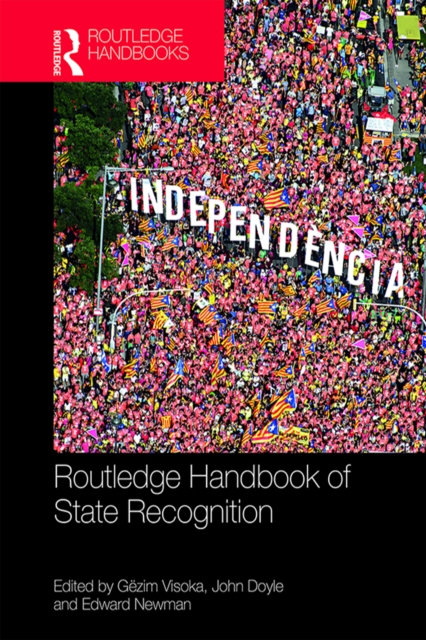
Routledge Handbook of State Recognition
This new handbook provides a comprehensive and multidisciplinary overview of the theoretical and empirical aspects of state recognition in international politics.
Although the recognition of states plays a central role in shaping global politics, it remains an under-researched and widely dispersed subject. Coherently and innovatively structured, the handbook brings together a group of international scholars who examine the most important theoretical and comparative perspectives on state recognition, including debates about pathways to secession and self-determination, the broad range of actors and strategies that shape the recognition of states and a significant number of contemporary case studies.
The handbook is organised into four key sections:
Theoretical and normative perspectives
Pathways to independent statehood
Actors, forms and the process of state recognition
Case studies of contemporary state recognition
This handbook will be of great interest to students of foreign policy, international relations, international law, comparative politics and area studies.
eBook

Nation Building in Contested States
This study provides an overview of current nation building processes in contested states. With a specific focus on the Turkish Republic of Northern Cyprus, Pridnestrovian Moldavian Republic, and Kosovo, original data is presented, collected in English in a single work for the first time. Viktoria Potapkina presents an analysis and comparison of contested states from an internal perspective, looking at the processes that help legitimize such entities from within and creating support for their ongoing existence.
The work strives to fill a gap in the literature on contested states, as well as to contribute to the overall understanding of nation and state building, state formation, and sovereignty. It provides a new way of looking at the puzzle that contested states are, offering insight into why they still exist in their current forms.
eBook

Revisiting the Causes of Russian Foreign Policy Changes: Incoherent Biographical Narrative, Recognition and Russia's Ontological Security-Seeking
This paper examines the relationship between international practices of recognition and state quest for ontological security, on the one hand, and Russia's most recent identity makeover as well as increasingly aggressive foreign policy, on the other. I argue that in order to understand Russia's growing belligerence in foreign and security policies we need to examine the connection between Western refusal to recognize Russia's great power self-image, the effects this refusal has had on Russia's ontological security, and a subsequent shift in Russia's self-description from pro-Western to civilizational.
Journal Article