
Catalogue Search | MBRL


Are you sure you want to remove the book from the shelf?

{{itemTitle}}
2,144
result(s) for
"INVESTISSEMENT"
Sort by:

There's always something to do : the Peter Cundill investment approach
Annotation The story of the origins and development of Peter Cundill's pioneering investment journey.
Book

The Multilateralization of International Investment Law
Attempts at developing a theory of international investment law are complicated by the fact that this field of international law is based on numerous, largely bilateral treaties and is implemented by arbitral panels established on a case-by-case basis. This suggests a fragmented and chaotic state of the law, with different levels of protection depending on the sources and targets of foreign investment flows. This book, however, forwards the thesis that international investment law develops, despite its bilateral form, into a multilateral system of law that backs up the functioning of a global market economy based on converging principles of investment protection. In discussing the function of most-favored-nation clauses, the possibilities of treaty-shopping and the impact of investor-State arbitration with its intensive reliance on precedent and other genuinely multilateral approaches to treaty interpretation, it offers a conceptual framework for understanding the nature and functioning of international investment law as a genuinely multilateral system.
eBook

Big money in franchising : scaling your enterprise in the era of private equity
\"In Big Money in Franchising, franchise thought leader, board advisor, franchise investor, and private equity consultant Alicia Miller shows how private equity is profoundly transforming the business of franchising, and how franchisors and franchisees can benefit from private equity's investment and guidance. Charting the evolution of private investment's role in franchising, from its nascent origins to the operational intricacies of today's high-growth franchises, Miller offers a deep-dive into the mechanics that drive this complex, fascinating sector. Packed with current case studies and thoughtful exploration of financial strategies, Big Money in Franchising reveals how to build brands and unlock value by learning private equity's growth playbook; shows both franchisors and franchisees how they can attract and work successfully with private equity investors; and shares valuable inside information about private equity's investing process, selection criteria, due diligence process, trading dynamics, and mindset. To aid the decision and planning process, Miller provides a detailed description of the broad landscape of different types of private capital players. The book also tracks the top challenges private capital has experienced in franchise investing, providing a roadmap to vet potential capital partners and how to avoid problems and flawed strategies. Highlighting best practices in both franchising and private equity, and featuring examples from the worlds of franchising and private equity as well as interviews with franchise business owners, brand founders, and private equity executives, Big Money in Franchising shows how working with private capital can challenge the thinking of founders and franchisees alike, empowering them to take their businesses to the next level of performance.\"-- Provided by publisher.
BOOK
Economist video. How to maximise your happiness when investing
How to invest your savings is one of the biggest questions in personal finance. Our finance correspondent, Joshua Roberts, explains why the conventional \"60-40\" wisdom is an arbitrary ratio and how a 50-year-old idea might make a better investment strategy.
Streaming Video

Contagious Capitalism
One of the core assumptions of recent American foreign policy is that China's post-1978 policy of \"reform and openness\" will lead to political liberalization. This book challenges that assumption and the general relationship between economic liberalization and democratization. Moreover, it analyzes the effect of foreign direct investment (FDI) liberalization on Chinese labor politics.
eBook

Gilles Y. Bertin: L’Investissement International
Gilles Y. Bertin, L ’ Investissement International, Paris, Presses Universitaires de France, 1967.
Journal Article
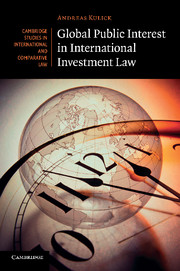
Global Public Interest in International Investment Law
The strengths of international investment law - above all, a strong focus on investor interests and an effective adjudication and enforcement system - also entail its weaknesses: it runs the danger of impeding or even sanctioning the host states' legitimate regulatory interests and ignoring other fields of public international law. How does it cope with public interest concerns such as human rights, the environment or the fight against corruption? At the heart of this book lies a fresh approach towards a general theory of such global public interest considerations in the investment realm. Delineating how and why those considerations matter, and why the current system does not accommodate them properly, Andreas Kulick fleshes out general principles and customary international law as defences the host state may raise against alleged investor rights infringements and promotes proportionality as the appropriate balancing mechanism.
eBook

When Capitalists Collide
Robert Vitalis's empirically rich study challenges the left-nationalist paradigm through which twentieth-century Egyptian history and politics has generally been interpreted. He argues with those who explain Egyptian economic development primarily in terms of class and of power struggles between British and Egyptian entrepreneurs and politicians. Vitalis offers a rare, detailed view of the objectives and political strategies of both international firms and Egypt's own big business rivals. He highlights the career of Muhammad Ahmad 'Abbud, modern Egypt's most successful businessman. Vitalis's argument can be effectively applied to many other developing countries and his book makes a major contribution to ongoing debates regarding class, underdevelopment, and nationalism. This title is part of UC Press's Voices Revived program, which commemorates University of California Press's mission to seek out and cultivate the brightest minds and give them voice, reach, and impact. Drawing on a backlist dating to 1893, Voices Revived makes high-quality, peer-reviewed scholarship accessible once again using print-on-demand technology. This title was originally published in 1995.
eBook

Economist video. The problem with diversifying investments
Is it still worth diversifying your investment portfolio? Joshua Roberts, our capital markets correspondent, explains why this strategy for safer returns is becoming increasingly ineffective.
Streaming Video