
Catalogue Search | MBRL


Are you sure you want to remove the book from the shelf?

{{itemTitle}}
61,383
result(s) for
"INVESTMENT CLIMATES"
Sort by:

Africa's silk road : China and India's new economic frontier
New horizons are opening for Africa, with a growing number of Chinese andIndian businesses fostering its integration into advanced markets. However,significant imbalances will have to be addressed on both sides of the equation to support long-term growth.
eBook

The emergence of green bonds as an integral component of climate finance in South Africa
One of the greatest challenges facing the global community is climate change. Over many years, global leaders have embarked on various platforms in a concerted effort to combat climate change. One of the key platforms has been the annual Conference of the Parties (COP) – a regular meeting in which climate negotiations and high-level political discussions have taken place. In 2015, the 21st COP was the most important because 195 countries agreed to ensure that rising global temperatures do not exceed the safe zone of 1.5 °C, as it is forecasted that temperatures will continue beyond this value between 2030 and 2050 if no action is taken to combat climate change. The parties further agreed that climate investments for countries are critical to make enormous transformational changes to reduce their greenhouse gases by scaling up climate adaptation and mitigation strategies.
Journal Article

THE CURRENT STATE OF INVESTMENT SECURITY IN UKRAINE IN THE CONTEXT OF COVID-19 AND ITS IMPACT ON THE FINANCIAL AND ECONOMIC SITUATION OF THE STATE
Ensuring stable economic development of the country is the main task of state authorities. Investment security is an important component of economic security, plays an important role during the sustainable development of the country’s economy. Modern globalization processes play an important role during the development of the system for the formation and protection of investment security. In addition, the emergence of the COVID-19 pandemic has led to the identification of new negative factors, endogenous and exogenous changes, which have made significant adjustments to the development of a stable economy in the country. To combat this pandemic, a state of emergency was introduced, it concerned either an entire country or a separate region or a separate sphere. The countries of the world, for their part, introduced sanitary and epidemiological measures to avoid the spread of the disease. The rapid introduction of these measures, as well as the development and implementation of steps that dealt with mitigating the consequences of the pandemic, caused a slowdown in economic development not only in the countries of the world, but also in Ukraine. The main factor in determining the level of investment security can be a study of the state of the investment climate in the country. The pandemic significantly affected the stability of the economy, in particular, created a negative field for ensuring investment security. Investments, being a long-term «feeding» of the economy, is not only a key condition for modernizing the national economy, but also the main factor of its economic security. The «safe» properties of investments are determined by the ability to make capital investments and production savings at a level that guarantees sufficient rates of expanded reproduction, technological re-equipment and economic restructuring, directly increases the potential for protecting economic interests from threats of various approaches. GDP. Assessment of the current level of investment made it possible to determine the adequacy of the provision of the Ukrainian economy with investments, is an indicator of the country’s investment security. Keywords: investment security, pandemic, GDP, financial and economic situation, government institutions, investment climate. JEL Classification H20, H83, H44, E44, L51, F52 Formulas: 3; fig.: 1; tabl.: 3; bibl.: 38.
Journal Article

Linking education policy to labor market outcomes
Contents: The conceptual framework -- Educational outcomes and their impact on labor market outcomes -- Employment outcomes and links to the broader economic context -- Conclusion : how education can improve labor market outcomes.
eBook

Climate risk disclosure and climate risk management in UK asset managers
Purpose>Framed within global policy debates over the need for private financial flows to align with the capital requirements of the Paris Agreement, this paper examines UK asset managers in their approaches to disclosing and managing climate risk. This paper identifies and evaluates climate risk management practices among this under-researched investor group in their capacity to address fundamental behavioural obstacles to low-carbon investment.Design/methodology/approach>This paper takes an inductive approach to document analysis, applying content and thematic analysis to the annual disclosures of the 28 largest UK asset managers (by assets under management), including the investment management arms of insurance and pension companies.Findings>The main takeaway from this research is that today’s climate risk management strategies hold potential to effectively address traditionally climate risk-averse investor behaviour and investment processes in the UK asset management context. However, this research finds that the use of environmental, social and governance (ESG) investment strategies to mitigate climate risks is a “grey area” in which climate risk management practices are undefined within broad sustainability and responsible investment agendas. In doing so, this paper invites further research into the extent to which climate risks are considered in ESG investment.Originality/value>This paper contributes to research in sustainable finance and behavioural finance, by identifying the latest climate risk management techniques used among UK-headquartered asset managers and uniquely evaluating these in their capacity to address barriers to low-carbon investment arising from organisational behaviours and processes.
Journal Article
Climate finance and green growth: reconsidering climate-related institutions, investments, and priorities in Nepal
Nepal, a least-developed, mountainous, and land-locked country is consistently ranked as one of the most vulnerable countries to the climate change. Poor socioeconomic development, rough and highly unstable geography, inadequate institutional capacity to deal with research, development and policy and mostly underdeveloped infrastructures, all have contributed to increasing vulnerability of communities and ecosystems, and have limited their adaptive capacity. Over the past decade, Nepal has made significant progress, particularly in developing and implementing policies and frameworks and establishing institutional mechanisms with the support of donor countries, UN and multilateral agencies. As the global climate politics is getting more complicated, international financing patterns—both climate and development finance—are shifting their ways, forcing the countries like Nepal to diversify the funding base for climate change actions and integrate them within national development plans and strategies. Using the data and information currently available, we analyze the existing financing situations, discuss the future scenarios and suggest policy recommendations to develop a set of long-term adaptation and impact mitigation strategies in specific and environmental change at large. When short-term adaptation strategies funded from existing financial arrangements and other related bilateral and multilateral sources particularly European countries, seem to be encouraging, we stress the need of “public–private partnership-driven full-fledged green economy” focusing on renewable energy and transport, agriculture and forestry, water and water-induced disasters, as well as tourism and hospitality.
Journal Article

Managing Rural Landscapes in the Context of a Changing Climate
Global competition for natural resources is intense and the supply of those resources is increasingly more constrained by climate variability and change. Governments and international development agencies have the dual responsibility to meet the socioeconomic needs of the poorest and most vulnerable people while preserving and enhancing their natural capital. These responsibilities often are at odds with each other and different stakeholder groups have prioritized one over the other. This paper suggests that the landscape approach provides a solution for stakeholders to achieve climate change mitigation, adaptation, and poverty reduction goals, though not without some trade-offs.
Journal Article

Study on the Coupled and Coordinated Development of Climate Investment and Financing and Green Finance of China
The growth of climate investment and financing highlights the growing global focus on climate change. In China, fostering the coordinated development of climate investment and financing and green finance is a crucial step toward accomplishing sustainable development objectives and addressing climate challenges effectively. By constructing the indicator system of climate investment and financing and green finance, and using the entropy method and the coupled coordination model, we comprehensively explored the development level and the coupling coordination relationship between climate investment and financing and green finance in 30 provinces in China during the period of 2013–2022. The findings of the research indicate that the development of climate investment and financing and green finance in China as a whole shows a growth trend, but the development of climate investment and financing remains relatively underdeveloped, and noticeable variations can be observed among regions. In respect to the level of coupling coordination, the overall coordination level of each province has not yet attained the desired level of optimality, and despite the yearly increase in the coordination degree at the national level, it is still in the state of mild dislocation. The eastern coastal region has the highest level of coupling coordination and is in the stage of verging on dislocation. And the great northwestern region has the lowest level of coordination and is in the stage of moderate dislocation. These findings provide an important reference for the formulation and execution of climate investment and financing and green finance policies in China.
Journal Article

Ukraine’s Policy in Developing the Domestic Investment Climate
The purpose of the article is to study the main trends occurring in the investment climate of Ukraine, to analyze the main factors that have both positive and negative impact on the competitiveness and investment attractiveness of the domestic economy. As a result of the analysis, Ukraine’s position in the international ratings on investment attractiveness was assessed; the main directions of capital investment were identified, and investor countries were pointed out. Priority state projects are indicated, which are to increase the level of high-quality investment resources. At the same time, significant problems were identified that need to be addressed immediately in order to prevent a slow-down in creating an attractive investment climate for foreign and domestic capital. Systematization of a number of factors allowed to emphasize the need not only to attract to the economy financial resources from other countries, but also to intensify state policy that would promote the investment of Ukrainian funds through a system of incentives, and create the rule of law. Investment plays a central part in the development of a country’s economy; it is investment that makes it possible to implement the latest technologies or innovation; or to significantly expand production capacity of a business entity; or to solve a number of social problems. At the same time, the intensification of investment activity is impossible without promoting the accumulation of domestic financial resources, through a system that would stimulate Ukrainian people to save, and through institutional investors, to transfer capital to the real sector of the economy. Prospects for further research in this area are the following: to determine the degree of the state involvement in the development of a competitive economy; to find the ways to eliminate the imbalances and exogenous and endogenous factors that have a chilling effect on the investment process in Ukraine.
Journal Article
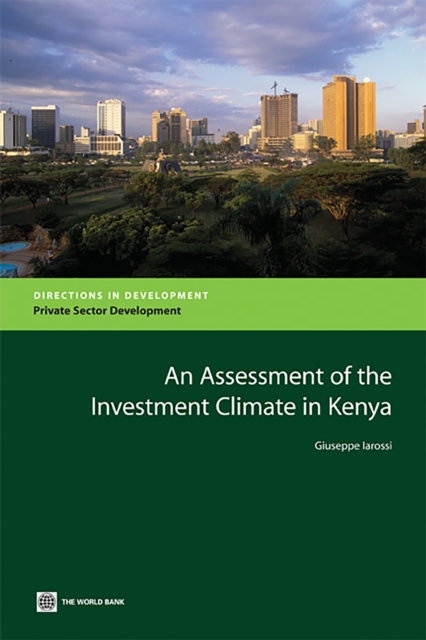
An assessment of the investment climate in Kenya
Although the circumstances in which Kenyan firms must do business have improved since 2004, including an increase in productivity, Kenyan firms still face an adverse business environment. 'An Assessment of the Investment Climate in Kenya' reports on the main impediments to productivity growth identified by managers of Kenyan businesses: -- Lack of access to financing. Despite a favorable lending regime, 90 percent of microenterprises and 60 percent of small firms in Kenya declared that they needed loans, compared to 40 percent of medium-sized and large firms. -- Corruption and crime. Seventy-five percent of firms in Kenya reported having to make informal payments to 'get things done'. This sort of corruption costs Kenyan firms approximately 4 percent of annual sales. In 2007, approximately one-third of Kenyan managers rated crime as a major business constraint. In addition, Kenyan companies lose 2.6 percent of their sales because of spoilage and theft during transportation. -- Unreliable infrastructure services. Transportation and energy remain significant bottlenecks. Close to 80 percent of firms in Kenya experience losses because of power interruptions. As a consequence, almost 70 percent of firms have generators, which are costly to obtain and operate. Managers also complained about taxes. Kenya has reduced corporate tax rates in recent years, but some objective indicators suggest that the country's tax burden remains higher than in most comparator countries. Given the potential impacts of high taxes—high evasion and the presence of a large informal economic sector—the report recommends a more detailed assessment of the effective rate of taxation. 'An Assessment of the Investment Climate in Kenya' recommends specific changes in each of these areas of constraint, as well as in the areas of transportation and regulatory reform. The book will be of interest to readers working in business and finance, economic policy, corproate governance, and poverty reduction.
eBook