
Catalogue Search | MBRL


Are you sure you want to remove the book from the shelf?

{{itemTitle}}
50,291
result(s) for
"INVESTMENT CORPORATION"
Sort by:


The Business Practices of a Chinese State-Owned Enterprise in Myanmar's Kyaukphyu Special Economic Zone: Perspectives of Local Non-State Stakeholders
The Kyaukphyu Special Economic Zone (KSEZ) in Myanmar is part of China's massive international development strategy known as the Belt and Road Initiative (BRI). To advance the KSEZ, the Chinese state-owned enterprise (SOE) China International Trust and Investment Corporation (CITIC) has asserted its commitment to the principles of corporate social responsibility (CSR). In this paper, we investigate how CITIC's CSR practices are perceived by two groups of local non-state stakeholders: Myanmar villagers and civil society organizations (CSOs). To this end, we conducted 31 qualitative interviews with non-state stakeholders in Kyaukphyu Township between March 2022 and October 2023. According to our interview results, there is a substantial though not universal local perception that CITIC's publicly broadcast commitment to CSR has served primarily to advance the KSEZ and left the concerns of local residents largely unaddressed. By examining CITIC's stated commitment and its actual commitment to CSR as perceived by the local non-state stakeholders, we aim in this study to deepen our understanding of the business practices of Chinese SOEs in overseas investments and to enrich the research on the BRI in Myanmar.
Journal Article


The World Bank Group guarantee instruments 1990-2007 : an independent evaluation
Foreign direct investment and private capital flows are highly concentrated geographically, with almost half of them reaching five top destinations. These flows tend to evade many high-risk countries. Regulatory and contractual risks, particularly in infrastructure, have inhibited investments in many parts of the developing world. A core objective of the World Bank Group (WBG) has been to support the flow of private investment for development; guarantees and insurance have been among the instruments that the WBG has used to pursue this objective. This study examines three main questions: • Should the WBG be in the guarantee business? • Have guarantee instruments in the three WBG institutions been used to their potential as reflected in WBG expectations and perceived demand? • Is the WBG appropriately organized to deliver its range of guarantee products in an effective and efficient manner?
eBook

KNOWLEDGE MANAGEMENT: WHY DO WE NEED IT FOR CORPORATES
This article gives a brief introduction about Knowledge Management (KM), its need, definition, components, KM assets, challenges and processes of KM initiative at any organisation. It also provides a narration on how the KM initiative has been adopted at ICICI OneSource, to support the achievement of its Business Process Outsourcing objectives. Both knowledge sharing as well as re-use need to be encouraged and recognized at the individual employee level as well as the company level. This is best done by measuring and rewarding knowledge-performance. Sustained strategic commitment and a corporate culture that is conducive to knowledge-performance are vital for success in Knowledge Management. The paper concludes with suggestions for the implication for policy and future practices
Journal Article

The Business Practices of a Chinese State-Owned Enterprise in Myanmar's Kyaukphyu Special Economic Zone: Perspectives of Local Non-State Stakeholders
The Kyaukphyu Special Economic Zone (KSEZ) in Myanmar is part of China’s massive international development strategy known as the Belt and Road Initiative (BRI). To advance the KSEZ, the Chinese state-owned enterprise (SOE) China International Trust and Investment Corporation (CITIC) has asserted its commitment to the principles of corporate social responsibility (CSR). In this paper, we investigate how CITIC’s CSR practices are perceived by two groups of local non-state stakeholders: Myanmar villagers and civil society organizations (CSOs). To this end, we conducted 31 qualitative interviews with non-state stakeholders in Kyaukphyu Township between March 2022 and October 2023. According to our interview results, there is a substantial though not universal local perception that CITIC’s publicly broadcast commitment to CSR has served primarily to advance the KSEZ and left the concerns of local residents largely unaddressed. By examining CITIC’s stated commitment and its actual commitment to CSR as perceived by
Journal Article
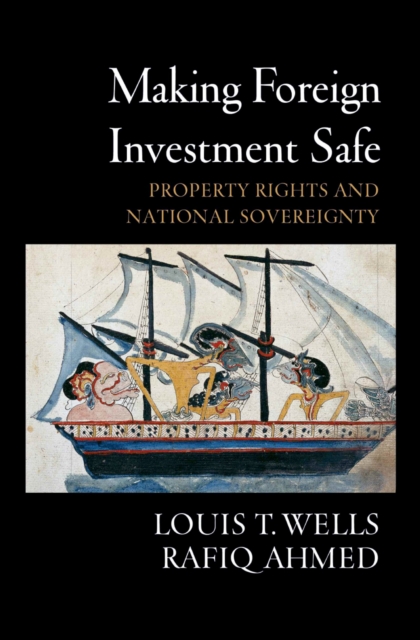
Making foreign investment safe : property rights and national sovereignty
In the 1990s, inexperienced firms from rich countries jumped directly into huge projects in some of the world's least developed countries. Their investments reflected almost unbridled enthusiasm for emerging markets and trust in new international guarantees. Yet within a few years, the business pages of the world press were reporting an exploding number of serious disputes between foreign investors and governments. As the expected bonanzas proved elusive and the protections weaker than anticipated, many foreign investors became disenchanted with emerging markets. So bad were the outcomes in some cases that a few notable infrastructure firms came close to bankruptcy; several others hurriedly fled poor countries as projects soured. This book shows why disputes developed, points out how investments and disputes have changed over time, explores why various firms responded differently to crises, and questions the basic wisdom of some of the enthusiasm for privatization. It tells how firms, countries, and multilateral development organizations can build a conflict-management system that balances the legitimate economic and social concerns of the host countries and those of investors. Without these changes, multinational corporations will lose profitable opportunities and poor countries will not gain the contributions that foreign investment can make toward alleviating poverty.
eBook

The power of public investment management
This publication consists of seven chapters: building a system for public investment management; a unified framework for public investment management; country experiences of public investment management; approaches to better project appraisal; public investment management under uncertainty; procurement and public investment management; and public investment management for public-private partnerships.
eBook

A principal-agent analysis of China's sovereign wealth system: Byzantine by design
The paper provides an explanation for a puzzling aspect of China's nascent sovereign wealth system, namely the ever-more obvious competition between China's officially designated sovereign wealth fund (SWF), the China Investment Corporation (CIC), and the foreign exchange reserve management agency, the State Administration of Foreign Exchange (SAFE). We outline an analytical framework which illuminates the various pathways by which state leaders seek to address a principal-agent problem common to all sovereign wealth funds. We suggest that state leaders select corporate governance regimes that mesh with what we call the state's 'governance endowments'. We then substantiate the claim that China's particular governance endowments have led China's leaders to embrace a corporate governance model premised on competition among the state's sovereign wealth investors. We trace the intense bureaucratic conflicts that shaped the creation of CIC and then show how SAFE was subsequently drawn into competition with CIC in the area of high risk, high yield investment. Although China's SWF tournament emerged as a quite unintended consequence of bureaucratic politics, China's leadership has since tacitly endorsed this rivalry because it has supplied the government with valuable carrot and stick mechanisms with which to discipline fund managers.
Journal Article

Investment strategy of sovereign wealth funds from emerging markets: the case of China
Chinese sovereign wealth funds SWFs continue to expand rapidly and have become increasingly active in real-time strategic transactions recently. They have focused not only on financial markets in developed countries, but they also concentrate on commodity investment in emerging markets (mainly in African or Central Asian markets). The main goal of this paper is to examine investment patterns and performance of two large Chinese sovereign wealth funds: the State Administration of Foreign Exchange Investment Company (SAFE IC) and the China Investment Corporation (CIC). In the absence of official data on the activities of the funds, the article is based largely on press releases relating to the operation of funds and corporate reports of the companies invested in by the Chinese SWFs. The paper presents sectoral and geographical directions of China's SWFs investment and tries to describe how the investment strategy of the aforementioned vehicles changed until mid-2013. The main limitation of the adopted methodology derives from the lack of information and poor transparency of the analysed vehicles. Moreover to obtain the correct information on the details of fund investments (size, value, date) each press release requires extensive verification.
Journal Article