
Catalogue Search | MBRL


Are you sure you want to remove the book from the shelf?

{{itemTitle}}
1,612
result(s) for
"IS (Organization) Fiction"
Sort by:

Tom Clancy's Op-center. Scorched earth
\"ISIS reigns supreme in huge swathes of Iraq and Syria and poses a threat to stability in the Middle East. When an American airstrike kills the ISIS leader's only son, he vows revenge. He discovers that a U.S. Navy admiral, now on duty in the Pentagon, led the strike. The ISIS leader has him kidnapped by American home-grown ISIS sympathizers. Their orders: smuggle him out of the United States and bring him to Mosul for execution\"-- Provided by publisher.
Book

The TV Series Severance as Speculative Organizational Critique: Control, Consent, and Identity at Work
The Apple TV+ series Severance (2022–present) offers a dystopian portrayal of workplace life that intensifies real-world dynamics of control, boundary management, and identity regulation. This paper analyzes Severance as a speculative case study in organizational theory, treating the show’s fictional world as a site for conceptual reflection. Drawing on critical management studies and labor process theory, we examine how mechanisms of control, the regulation of work–life boundaries, and the fragmentation of autonomy and subjectivity are depicted in extreme form. We argue that fiction—particularly speculative satire—can serve as a tool of theoretical production, not merely illustration. Rather than restating familiar critiques, Severance allows us to see workplace norms with renewed clarity, surfacing the moral and psychological consequences of surveillance, coercion, and instrumentalized consent. A methodological note outlines our interpretive approach to narrative fiction, and a discussion of implications situates the analysis within broader debates about organizational ethics, resilience, and critique.
Journal Article

Firefly
\"From the refugee camps of Greece to the mountains of Macedonia, a thirteen-year-old boy is making his way to Germany and to safety. Codenamed \"Firefly,\" he holds vital intelligence: unparalleled insight into a vicious ISIS terror cell, and details of their plans. But the terrorists are hot on his trail, determined he won't live to pass on the information. When MI6 become aware of Firefly and what he knows, the race is on to find him. Luc Samson, ex-MI6 agent and now private eye, finds himself recruited to the cause. Fluent in Arabic thanks to his Lebanese heritage and himself the product of an earlier era of violent civil war, Samson's job is to find Firefly, win his trust, and get him to safety.\"-- Provided by publisher.
Book

Expert views about missing AI narratives: is there an AI story crisis?
Stories are an important indicator of our vision of the future. In the case of artificial intelligence (AI), dominant stories are polarized between notions of threat and myopic solutionism. The central storytellers—big tech, popular media, and authors of science fiction—represent particular demographics and motivations. Many stories, and storytellers, are missing. This paper details the accounts of missing AI narratives by leading scholars from a range of disciplines interested in AI Futures. Participants focused on the gaps between dominant narratives and the untold stories of the capabilities, issues, and everyday realities of the technology. One participant proposed a “story crisis” in which these narratives compete to shape the public discourse on AI. Our findings indicate that dominant narratives distract and mislead public understandings and conceptions of AI. This suggests a need to pay closer attention to missing AI narratives. It is not simply about telling new stories, it is about listening to existing stories and asking what is wanted from AI. We call for realistic, nuanced, and inclusive stories, working with and for diverse voices, which consider (1) story-teller; (2) genre, and (3) communicative purpose. Such stories can then inspire the next generation of thinkers, technologists, and storytellers.
Journal Article

SEAL Team Six : hunt the Viper
When an American doctor working with an NGO in Aleppo is kidnapped by the vicious ISIS general Viper, Crocker pulls every string he can to launch a rescue mission.
Book
Robots beyond Science Fiction: mutual learning in human–robot interaction on the way to participatory approaches
Putting laypeople in an active role as direct expert contributors in the design of service robots becomes more and more prominent in the research fields of human–robot interaction (HRI) and social robotics (SR). Currently, though, HRI is caught in a dilemma of how to create meaningful service robots for human social environments, combining expectations shaped by popular media with technology readiness. We recapitulate traditional stakeholder involvement, including two cases in which new intelligent robots were conceptualized and realized for close interaction with humans. Thereby, we show how the robot narrative (impacted by science fiction, the term robot itself, and assumptions on human-like intelligence) together with aspects of power balancing stakeholders, such as hardware constraints and missing perspectives beyond primary users, and the adaptivity of robots through machine learning that creates unpredictability, pose specific challenges for participatory design processes in HRI. We conclude with thoughts on a way forward for the HRI community in developing a culture of participation that considers humans when conceptualizing, building, and using robots.
Journal Article
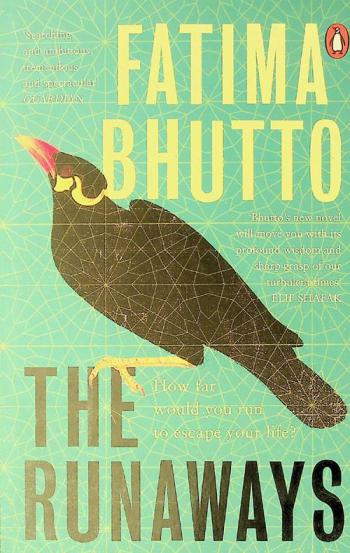
The runaways
Anita lives in Karachi's biggest slum. Her mother is a maalish wali, paid to massage the tired bones of rich women. But Anita's life will change forever when she meets her elderly neighbour, a man whose shelves of books promise an escape to a different world. On the other side of Karachi lives Monty, whose father owns half the city and expects great things of him. But when a beautiful and rebellious girl joins his school, Monty will find his life going in a very different direction. Sunny's father left India and went to England to give his son the opportunities he never had. Yet Sunny doesn't fit in anywhere. It's only when his charismatic cousin comes back into his life that he realises his life could hold more possibilities than he ever imagined. These three lives will cross in the desert, a place where life and death walk hand-in-hand, and where their closely guarded secrets will force them to make a terrible choice.
Fear of AI: an inquiry into the adoption of autonomous cars in spite of fear, and a theoretical framework for the study of artificial intelligence technology acceptance
Artificial intelligence (AI) is becoming part of the everyday. During this transition, people’s intention to use AI technologies is still unclear and emotions such as fear are influencing it. In this paper, we focus on autonomous cars to first verify empirically the extent to which people fear AI and then examine the impact that fear has on their intention to use AI-driven vehicles. Our research is based on a systematic survey and it reveals that while individuals are largely afraid of cars that are driven by AI, they are nonetheless willing to adopt this technology as soon as possible. To explain this tension, we extend our analysis beyond just fear and show that people also believe that AI-driven cars will generate many individual, urban and global benefits. Subsequently, we employ our empirical findings as the foundations of a theoretical framework meant to illustrate the main factors that people ponder when they consider the use of AI tech. In addition to offering a comprehensive theoretical framework for the study of AI technology acceptance, this paper provides a nuanced understanding of the tension that exists between the fear and adoption of AI, capturing what exactly people fear and intend to do.
Journal Article

The black widow
Gabriel Allon, the art restorer, spy, and assassin, is poised to become the chief of Israel's secret intelligence service. But on the eve of his promotion, events conspire to lure him into the field for one final operation. ISIS has detonated a massive bomb in the Marais district of Paris, and a desperate French government wants Gabriel to eliminate the man responsible before he can strike again. They call him Saladin, a terrorist mastermind whose ambition is as grandiose as his nom de guerre, a man so elusive that even his nationality is not known. Shielded by sophisticated encryption software, his network communicates in total secrecy, leaving the West blind to his planning -- and leaving Gabriel no choice but to insert an agent into the most dangerous terror group the world has ever known. She is an extraordinary young doctor, as brave as she is beautiful. At Gabriel's behest, she will pose as an ISIS recruit in waiting, a ticking time bomb -- a black widow out for blood.
Book
Strong and weak AI narratives: an analytical framework
The current debate on artificial intelligence (AI) tends to associate AI imaginaries with the vision of a future technology capable of emulating or surpassing human intelligence. This article advocates for a more nuanced analysis of AI imaginaries, distinguishing “strong AI narratives,” i.e., narratives that envision futurable AI technologies that are virtually indistinguishable from humans, from \"weak\" AI narratives, i.e., narratives that discuss and make sense of the functioning and implications of existing AI technologies. Drawing on the academic literature on AI narratives and imaginaries and examining examples drawn from the debate on Large Language Models and public policy, we underscore the critical role and interplay of weak and strong AI across public/private and fictional/non-fictional discourses. The resulting analytical framework aims to empower approaches that are more sensitive to the heterogeneity of AI narratives while also advocating normalising AI narratives, i.e., positioning weak AI narratives more firmly at the center stage of public debates about emerging technologies.
Journal Article