
Catalogue Search | MBRL


Are you sure you want to remove the book from the shelf?

{{itemTitle}}
462
result(s) for
"Identification (Religion) -- History"
Sort by:


Conversion and Narrative
In 1322, a Jewish doctor named Abner entered a synagogue in the Castilian city of Burgos and began to weep in prayer. Falling asleep, he dreamed of a \"great man\" who urged him to awaken from his slumber. Shortly thereafter, he converted to Christianity and wrote a number of works attacking his old faith. Abner tells the story in fantastic detail in the opening to his Hebrew-language but anti-Jewish polemical treatise, Teacher of Righteousness.In the religiously plural context of the medieval Western Mediterranean, religious conversion played an important role as a marker of social boundaries and individual identity. The writers of medieval religious polemics such as Teacher of Righteousness often began by giving a brief, first-person account of the rejection of their old faith and their embrace of the new. In such accounts, Ryan Szpiech argues, the narrative form plays an important role in dramatizing the transition from infidelity to faith.Szpiech draws on a wide body of sources from Christian, Jewish, and Muslim polemics to investigate the place of narrative in the representation of conversion. Making a firm distinction between stories told about conversion and the experience of religious change, his book is not a history of conversion itself but a comparative study of how and why it was presented in narrative form within the context of religious disputation. He argues that between the twelfth and fifteenth centuries, conversion narratives were needed to represent communal notions of history and authority in allegorical, dramatic terms. After considering the late antique paradigms on which medieval Christian conversion narratives were based, Szpiech juxtaposes Christian stories with contemporary accounts of conversion to Islam and Judaism. He emphasizes that polemical conflict between Abrahamic religions in the medieval Mediterranean centered on competing visions of history and salvation. By seeing conversion not as an individual experience but as a public narrative, Conversion and Narrative provides a new, interdisciplinary perspective on medieval writing about religious disputes.
eBook


Visions of Community in the Post-Roman World
This volume looks at 'visions of community' in a comparative perspective, from Late Antiquity to the dawning of the age of crusades. It addresses the question of why and how distinctive new political cultures developed after the disintegration of the Roman World, and to what degree their differences had already emerged in the first post-Roman centuries. The Latin West, Orthodox Byzantium and its Slavic periphery, and the Islamic world each retained different parts of the Graeco-Roman heritage, while introducing new elements. For instance, ethnicity became a legitimizing element of rulership in the West, remained a structural element of the imperial periphery in Byzantium, and contributed to the inner dynamic of Islamic states without becoming a resource of political integration. Similarly, the political role of religion also differed between the emerging post-Roman worlds. Anybody interested in the development of the post-Roman Mediterranean, but also in the relationship between the Islamic World and the West, will gain new insights from these studies on the political role of ethnicity and religion.
eBook


How happy to call oneself a Turk : provincial newspapers and the negotiation of a Muslim national identity
The modern nation-state of Turkey was established in 1923, but when and how did its citizens begin to identify themselves as Turks? Mustafa Kemal Atatrk, Turkeys founding president, is almost universally credited with creating a Turkish national identity through his revolutionary program to secularize the former heartland of the Ottoman Empire. Yet, despite Turkeys status as the lone secular state in the Muslim Middle East, religion remains a powerful force in Turkish society, and the country today is governed by a democratically elected political party with a distinctly religious (Islamist) orientation. In this history, Gavin D. Brockett takes a fresh look at the formation of Turkish national identity, focusing on the relationship between Islam and nationalism and the process through which a religious national identity emerged. Challenging the orthodoxy that Atatrk and the political elite imposed a sense of national identity from the top down, Brockett examines the social and political debates in provincial newspapers from around the country. He shows that the unprecedented expansion of print media in Turkey between 1945 and 1954, which followed the end of strict, single-party authoritarian government, created a forum in which ordinary people could inject popular religious identities into the new Turkish nationalism. Brockett makes a convincing case that it was this fruitful negotiation between secular nationalism and Islamrather than the imposition of secularism alonethat created the modern Turkish national identity.
eBook

Pluralism in the Middle Ages
The challenges of cultural and religious diversity that face European and American societies today are not a new phenomenon. People in the Middle Ages lived in pluralistic societies, and they found highly interesting ways of dealing with religious and cultural diversity. While religious and political authorities commanded people to stick to their kind, some people explored the borderland between religious identities. In medieval Iberia, Christians and Muslims challenged the legal authorities' prohibitions against crossing religious and cultural boundaries when they engaged in mixed marriages between Muslims and Christians or converted from one religion to the other. By examining the topics of conversion and mixed marriages in legal texts of Muslim and Christian origin, Pluralism in the Middle Ages explores the construction of boundaries as well as the reasons explaining such constructions. It demonstrates that the religious and social boundaries were not static, nor were they similarly defined by Islamic and Christian medieval cultures. Moreover, the book argues that Muslims and Christians in medieval Iberia did not constitute clearly separated groups, since various categories of people haunted the boundaries between them: false converts employing taqiya strategy (taking on an outward Christian identity while practicing Islam in secret), those engaged in mixed marriages or interreligious sexual relations (and their children), and converts, whose conversion may be perceived as sincere or insincere, total or partial.\"
eBook
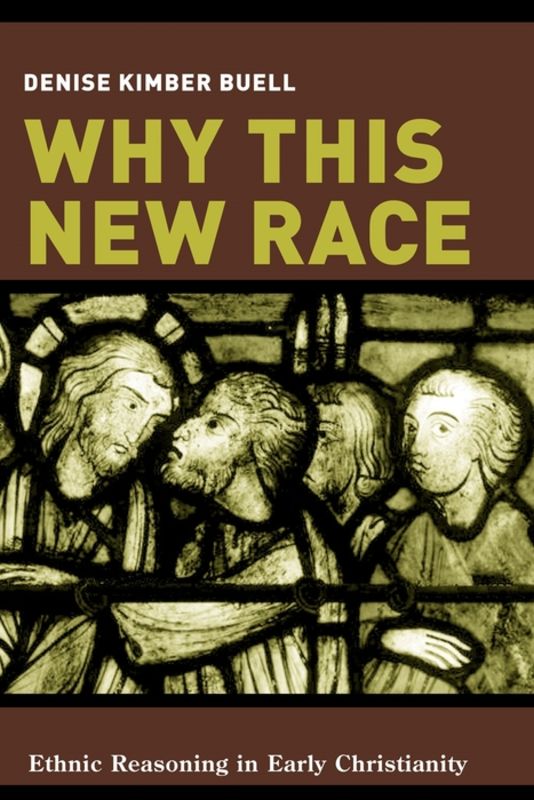
Why This New Race?
Why This New Race offers a radical new way of thinking about the origins of Christian identity. Conventional histories have understood Christianity as a religion that from its beginnings sought to transcend ethnic and racial distinctions. Denise Kimber Buell challenges this view by revealing the centrality of ethnicity and race in early definitions of Christianity. Buell's readings of various texts consider the use of \"ethnic reasoning\" to depict Christianness as more than a set of shared religious practices and beliefs. By asking themselves, \"Why this new race?\" Christians positioned themselves as members of an ethnos or genos distinct from Jews, Romans, and Greeks. Buell focuses on texts written before Christianity became legal in 313 C.E., including Greek apologetic treatises, martyr narratives, and works by Clement of Alexandria, Origen, and Tertullian. Philosophers and theologians used ethnic reasoning to define Christians as a distinct people within classical and ancient Near East society and in intra-Christian debates about what constituted Christianness. Many characterized Christianness as both fixed and fluid-it had a real essence (fixed) but could be acquired through conversion (fluid). Buell demonstrates how this dynamic view of race and ethnicity allowed Christians to establish boundaries around the meaning of Christianness and to develop universalizing claims that all should join the Christian people. In addressing questions of historiography, Buell analyzes why generations of scholars have refused to acknowledge ethnic reasoning in early Christian discourses. Moreover, Buell's arguments about the importance of ethnicity and religion in early Christianity provide insights into the historical legacy of Christian anti-Semitism as well as contemporary issues of race.
eBook

The Suffering Self
The Suffering Self is a ground-breaking, interdisciplinary study of the spread of Christianity across the Roman empire. Judith Perkins shows how Christian narrative representation in the early empire worked to create a new kind of human self-understanding - the perception of the self as sufferer. Drawing on feminist and social theory, she addresses the question of why forms of suffering like martyrdom and self-mutilation were so important to early Christians.This study crosses the boundaries between ancient history and the study of early Christianity, seeing Christian representation in the context of the Greco-Roman world. She draws parallels with suffering heroines in Greek novels and in martyr acts and examines representations in medical and philosophical texts.Judith Perkins' controversial study is important reading for all those interested in ancient society, or in the history `f Christianity.
eBook
Dining with John : communal meals and identity formation in the Fourth Gospel and its historical and cultural context
This book provides an analysis of the role of food, drink and meals in the Fourth Gospel, in the formation of early Christian identity, and of the historical circumstances in which Johannine meal practices may have developed.
eBook