
Catalogue Search | MBRL


Are you sure you want to remove the book from the shelf?

{{itemTitle}}
14
result(s) for
"Imazighen"
Sort by:

‘Technology is Everywhere, we have the Opportunity to Learn it in the Valley’: The Appropriation of a Socio-Technical Enabling Infrastructure in the Moroccan High Atlas
This paper describes the appropriation processes involved in establishing a socio-technical enabling infrastructure in a valley in the High Atlas of Morocco. We focus on the challenges of co-establishing such an intervention in a rural/mountainous region that is already undergoing a process of continuous development and profound transformation. We reflect upon the changes and unforeseen appropriation by our local partners and inhabitants in the valley of a computer club primarily used as an informal learning centre for school children. We followed an ethnographic approach and combined research perspectives from both socio-informatics and anthropology. This paper sheds light on what a successful cooperation and intervention in this kind of challenging environment can look like. It does this by taking seriously competing expectations, fragile infrastructural foundations and the socio-cultural context. Despite the challenges, the intervention managed to lead to the establishment of a socio-technical enabling infrastructure that plays a particularly valuable role in local educational endeavours and that is now moving towards supporting other members of the community. The paper thus provides insights regarding what has to be considered to create a mutually beneficial cooperation with all relevant stakeholders as well as a sustainable intervention.
Journal Article

The grammar of folklorization: An integrated critical discourse analysis of the linguistic depiction of Amazigh social actors in selected Moroccan EFL textbooks (1980s-present)
This study stands at the crossroads of folklorization, ethnicity, and curriculum. It seeks to criticize how the institutionalized production of knowledge about Amazigh folklore in Morocco has contributed to the creation and maintenance of a closed system of linguistic options for representing Amazigh ethnic groups through \"folklorizing\" their festivals, traditions, music, space, and marriage rituals. To investigate the micropolitics of folklorization in officially produced EFL textbooks in Morocco (1980-present), an integrated critical discourse analysis approach that oscillates between linguistic analysis and sociological analysis has been used. Results show that Amazighs have been mostly activated in relation to behavioral and relational processes and are therefore depicted as passive, deprived of sociological agency, with no effect(s) on others, or on the world. Excessive folklorization, results also indicate, commodifies Amazighs by reducing them to \"exotic\" commodities to be gazed upon. Amazigh females are caught in the realm of the \"physical\" and the \"sensual\" and are, hence, deprived of being represented as \"thinkers\" and \"sayers\" in mental and verbal processes. Non-Amazigh festivals and forms of folklore, on the other hand, are encoded primarily in material and transactive processes. Folklorization skews aspects of Amazigh identity to a flat set of criteria, such as \"entertainment\" and \"exoticism\", which would give students a partial view of who Amazighs are mainly by iconizing them in a \"celebratory\" way which lacks analytical depth, bypassing, thus, significant concepts and topics related to the discrimination and subjugation of minority groups and their symbolic fights for power and social equality.
Journal Article

The Berber Identity Movement and the Challenge to North African States
Like many indigenous groups that have endured centuries of subordination, the Berber/Amazigh peoples of North Africa are demanding linguistic and cultural recognition and the redressing of injustices. Indeed, the movement seeks nothing less than a refashioning of the identity of North African states, a rewriting of their history, and a fundamental change in the basis of collective life. In so doing, it poses a challenge to the existing political and sociocultural orders in Morocco and Algeria, while serving as an important counterpoint to the oppositionist Islamist current.
This is the first book-length study to analyze the rise of the modern ethnocultural Berber/Amazigh movement in North Africa and the Berber diaspora. Bruce Maddy-Weitzman begins by tracing North African history from the perspective of its indigenous Berber inhabitants and their interactions with more powerful societies, from Hellenic and Roman times, through a millennium of Islam, to the era of Western colonialism. He then concentrates on the marginalization and eventual reemergence of the Berber question in independent Algeria and Morocco, against a background of the growing crisis of regime legitimacy in each country. His investigation illuminates many issues, including the fashioning of official national narratives and policies aimed at subordinating Berbers in an Arab nationalist and Islamic-centered universe; the emergence of a counter-movement promoting an expansive Berber \"imagining\" that emphasizes the rights of minority groups and indigenous peoples; and the international aspects of modern Berberism.
eBook
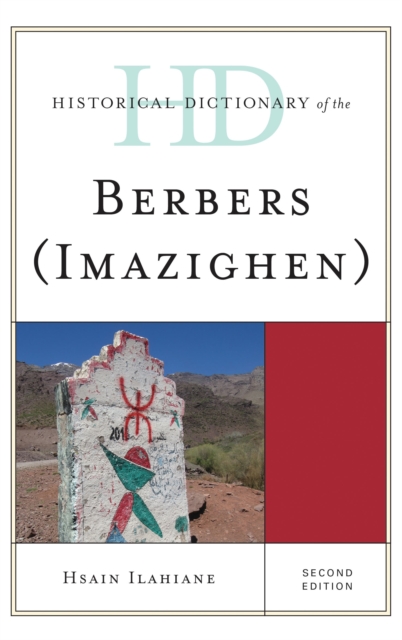
Historical Dictionary of the Berbers (Imazighen)
Berbers, also known as Imazighen, are the ancient inhabitants of North Africa, but rarely have they formed an actual kingdom or separate nation state. Ranging anywhere between 15-50 million, depending on how they are classified, the Berbers have influenced the culture and religion of Roman North Africa and played key roles in the spread of Islam and its culture in North Africa, Spain, and Sub-Saharan Africa. Taken together, these dynamics have over time converted to redefine the field of Berber identity and its socio-political representations and symbols, making it an even more important issue in the 21st century.
This second edition of Historical Dictionary of the Berbers contains a chronology, an introduction, appendixes, and an extensive bibliography. The dictionary section has over 200 cross-referenced entries on important personalities, places, events, institutions, and aspects of culture, society, economy, and politics. This book is an excellent resource for students, researchers, and anyone wanting to know more about the Berbers.
eBook

We share walls
We Share Walls: Language, Land, and Gender in Berber Morocco explores how political economic shifts over the last century have reshaped the language practices and ideologies of women (and men) in the plains and mountains of rural Morocco.
Offers a unique and richly textured ethnography of language maintenance and shift as well as language and place-making among an overlooked Muslim group Examines how Moroccan Berbers use language to integrate into the Arab-speaking world and retain their own distinct identity Illuminates the intriguing semiotic and gender issues embedded in the culture Part of the Blackwell Studies in Discourse and Culture Series
eBook

Kavky a kosatce
Publikace je výsledkem terénního výzkumu prováděného mezi etnickými Berbery, kteří obývají pohoří Vysoký Atlas ve vnitrozemí Maroka. Podrobuje analýze transformaci místního prostředí v návaznosti na objevující se diskursivní praktiky, jež jsou úzce spojené s postupným pronikáním prvků globální ekonomiky, environmentálních programů a programů rozvojové pomoci do života místní společnosti.
eBook

Berber culture on the world stage : from village to video
[S]ure to interest a number of different audiences, from language
and music scholars to specialists on North Africa... a superb book, clearly
written, analytically incisive, about very important issues that have not been
described elsewhere. -- John Bowen, Washington University In
this nuanced study of the performance of cultural identity, Jane E. Goodman travels
from contemporary Kabyle Berber communities in Algeria and France to the colonial
archives, identifying the products, performances, and media through which Berber
identity has developed. In the 1990s, with a major Islamist insurgency underway in
Algeria, Berber cultural associations created performance forms that challenged
Islamist premises while critiquing their own village practices. Goodman describes
the phenomenon of new Kabyle song, a form of world music that transformed village
songs for global audiences. She follows new songs as they move from their producers
to the copyright agency to the Parisian stage, highlighting the networks of
circulation and exchange through which Berbers have achieved global
visibility.
eBook

Decolonizing indigenous education : an Amazigh/Berber ethnographic journey
Using auto-ethnography, Taieb narrates the journey of developing a educational philosophy from and for the Kayble of Algeria and undertakes to write the sociological foundations of an Kayble education system.
eBook

Amazigh Arts in Morocco
In southeastern Morocco, around the oasis of Tafilalet, the Ait Khabbash people weave brightly colored carpets, embroider indigo head coverings, paint their faces with saffron, and wear ornate jewelry. Their extraordinarily detailed arts are rich in cultural symbolism; they are always breathtakingly beautiful—and they are typically made by women. Like other Amazigh (Berber) groups (but in contrast to the Arab societies of North Africa), the Ait Khabbash have entrusted their artistic responsibilities to women. Cynthia Becker spent years in Morocco living among these women and, through family connections and female fellowship, achieved unprecedented access to the artistic rituals of the Ait Khabbash. The result is more than a stunning examination of the arts themselves, it is also an illumination of women's roles in Islamic North Africa and the many ways in which women negotiate complex social and religious issues. One of the reasons Amazigh women are artists is that the arts are expressions of ethnic identity, and it follows that the guardians of Amazigh identity ought to be those who literally ensure its continuation from generation to generation, the Amazigh women. Not surprisingly, the arts are visual expressions of womanhood, and fertility symbols are prevalent. Controlling the visual symbols of Amazigh identity has given these women power and prestige. Their clothing, tattoos, and jewelry are public identity statements; such public artistic expressions contrast with the stereotype that women in the Islamic world are secluded and veiled. But their role as public identity symbols can also be restrictive, and history (French colonialism, the subsequent rise of an Arab-dominated government in Morocco, and the recent emergence of a transnational Berber movement) has forced Ait Khabbash women to adapt their arts as their people adapt to the contemporary world. By framing Amazigh arts with historical and cultural context, Cynthia Becker allows the reader to see the full measure of these fascinating artworks.
eBook

Agreement, pronominal clitics and negation in Tamazight Berber : a unified analysis
This book presents a study of various important aspects of Tamazight Berber syntax within the generative tradition. Work on Berber linguistics from a generative perspective remains in many ways uncharted territory. There has been hardly any published research on this language and its different dialects, especially in English -- this book fills.
eBook