
Catalogue Search | MBRL


Are you sure you want to remove the book from the shelf?

{{itemTitle}}
25,334
result(s) for
"Immigration reform"
Sort by:

Borders for Whom? The Role of NAFTA in Mexico-U.S. Migration
In this article, the authors first give attention to main factors that resulted in the passage of NAFTA and subsequently investigate Mexican migration to the United States during roughly the same period that the bilateral treaty has been in effect. At the center of the relationship between economic liberalization and immigration is the paradox of increasing capital mobility and attempts at controlling more tightly the movement of immigrant workers. Although immigration from Mexico has remained flat over the past ten years, the Mexican population in the United States has grown rapidly, partly as a result of the unanticipated effects of harsh immigration policies since 1986. Prior to that date, Mexicans engaged in cyclical movements, but as security measures became harsher, especially in the 9/11 period, more immigrants and their families settled in the United States hoping to avert the dangers of exit and reentry. This analysis shows the slanted function of borders that have become permeable for capital but increasingly restrictive for immigrants.
Journal Article

The New Labor Market: Immigrants and Wages after IRCA
We examine the effect of the Immigration Reform and Control Act (IRCA) on migrants' wages using data gathered in 39 Mexican communities and their U.S. destination areas. We examine changes in the determinants of wages before and after the passage of IRCA, as well as the effects of its massive legalization program. Migrants' wages deteriorated steadily between 1970 and 1995, but IRCA did not foment discrimination against Mexican workers per se. Rather, it appears to have encouraged greater discrimination against undocumented migrants, with employers passing the costs and risks of unauthorized hiring on to the workers. Although available data do not permit us to eliminate competing explanations entirely, limited controls suggest that the post-IRCA wage penalty against undocumented migrants did not stem from an expansion of the immigrant labor supply, an increase in the use of labor subcontracting, or a deterioration of the U.S. labor market.
Journal Article

Effects of Immigrant Legalization on Crime
I examine the effects that the 1986 Immigration Reform and Control Act (IRCA), which legalized almost 3 million immigrants, had on crime in the United States. I exploit the IRCA's quasi-random timing as well as geographic variation in the intensity of treatment to isolate causal impacts. I find decreases in crime of 3-5 percent, primarily due to decline in property crimes, equivalent to 120,000-180,000 fewer violent and property crimes committed each year due to legalization. I calibrate a labor market model of crime, finding that much of the drop in crime can be explained by greater labor market opportunities among applicants.
Journal Article
Immigration and the US farm labour supply
This paper uses unique data from rural Mexico to examine the supply of immigrant hired labour to US farms. Econometric evidence indicates that immigration policy reforms had unintended consequences for farm labour supply. The long-term trend in migration from rural Mexico to US farms is decreasing, and in recent years, US farms have drawn more labour from remote and less devel-oped areas of rural Mexico. Other high income countries, as well as some developing nations, mirror the US in reliance on foreign agricultural workers. Our analysis questions the sustainability of an agricultural system that depends on foreign sources of labour, and highlights the importance of labour productivity-enhancing technological change.
Journal Article

Explaining U.S. Immigration, 1971-1998
In this paper we develop and estimate a model to explain variations in immigration to the United States by source country since the early 1970s. The explanatory variables include ratios to the United States of source country income and education as well as relative inequality. In addition, we incorporate the stock of previous immigrants and a variety of variables representing different dimensions of the immigration quotas set by policy. We use the results to shed light on the impact of policy by simulating the effects of the key changes in immigration policy since the late 1970s. We also examine the factors that influenced the composition of U.S. immigration by source region over the entire period.
Journal Article

Rallying for immigrant rights
From Alaska to Florida, millions of immigrants and their supporters took to the streets across the United States to rally for immigrant rights in the spring of 2006. The scope and size of their protests, rallies, and boycotts made these the most significant events of political activism in the United States since the 1960s. This accessibly written volume offers the first comprehensive analysis of this historic moment. Perfect for students and general readers, its essays, written by a multidisciplinary group of scholars and grassroots organizers, trace the evolution and legacy of the 2006 protest movement in engaging, theoretically informed discussions. The contributors cover topics including unions, churches, the media, immigrant organizations, and immigrant politics. Today, one in eight U.S. residents was born outside the country, but for many, lack of citizenship makes political voice through the ballot box impossible. This book helps us better understand how immigrants are making their voices heard in other ways.
eBook

“Not Having Family as One Makes It even Harder for My Kids to Learn:” Understanding Benefits of Family-Based Migration
Abstract Current literature demonstrates the benefits of family-based migration and the impact that separation from family has on children. However, less is known about the specific role of extended family in shaping the development of immigrant youth. This article focuses on answering the question: How do low-income immigrants utilize extended families to aide in physical, social, emotional, and cognitive development of their preschool children? Semi-structured interviews were conducted with 12 Hispanic or Asian families in a diverse urban community located outside of New York City. In addition, to build a more thorough understanding of each immigrant child, teachers were interviewed, and classroom experiences were observed for a duration of 3 months. Using this data, the article describes specific ways immigrants leverage family ties for the well-being of children. Several, for example, pooled resources in the form of time, skills, and finances to support children’s needs. Some indicated that separation from extended family related to minimal support with children’s learning. Urie Bronfenbrenner’s Ecological Systems Theory is utilized to highlight this intricate connection between immigration policy and educational opportunity.
Journal Article
The Criminal Justice Response to Policy Interventions: Evidence from Immigration Reform
Changes in the treatment of individuals by the criminal justice system following a policy intervention may bias estimates of the effects of the intervention on underlying criminal activity. We explore the importance of such changes in the context of the Immigration Reform and Control Act of 1986 (IRCA). Using administrative data from San Antonio, Texas, we examine variation across neighborhoods and ethnicities in police arrests and in the rate at which those arrests are prosecuted. We find that changes in police behavior around IRCA confound estimates of the effects of the policy and its restrictions on employment on criminal activity.
Journal Article

Family Sponsorship and Late-Age Immigration in Aging America: Revised and Expanded Estimates of Chained Migration
We use the Immigrants Admitted to the United States (microdata) supplemented with special tabulations from the Department of Homeland Security to examine how family reunification impacts the age composition of new immigrant cohorts since 1980. We develop a family migration multiplier measure for the period 1981-2009 that improves on prior studies by including immigrants granted legal status under the 1986 Immigration Reform and Control Act and relaxing unrealistic assumptions required by synthetic cohort measures. Results show that every 100 initiating immigrants admitted between 1981 and 1985 sponsored an average of 260 family members; the comparable figure for initiating immigrants for the 1996-2000 cohort is 345 family members. Furthermore, the number of family migrants ages 50 and over rose from 44 to 74 per 100 initiating migrants. The discussion considers the health and welfare implications of late-age immigration in a climate of growing fiscal restraint and an aging native population.
Journal Article
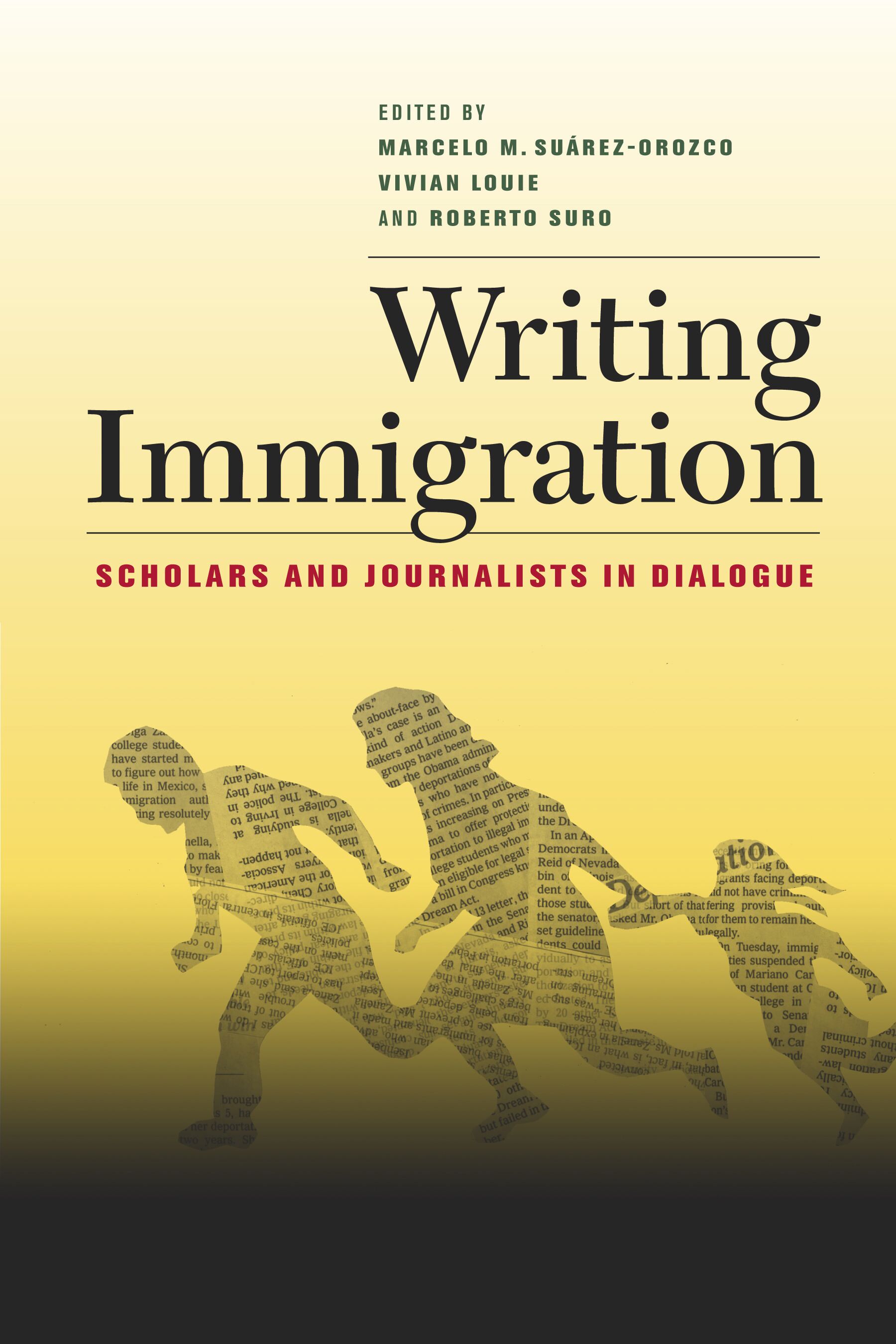
Writing Immigration
Bringing nuance, complexity, and clarity to a subject often seen in black and white, Writing Immigration presents a unique interplay of leading scholars and journalists working on the contentious topic of immigration. In a series of powerful essays, the contributors reflect on how they struggle to write about one of the defining issues of our time—one that is at once local and global, familiar and uncanny, concrete and abstract. Highlighting and framing central questions surrounding immigration, their essays explore topics including illegal immigration, state and federal mechanisms for immigration regulation, enduring myths and fallacies regarding immigration, immigration and the economy, immigration and education, the adaptations of the second generation, and more. Together, these writings give a clear sense of the ways in which scholars and journalists enter, shape, and sometimes transform this essential yet unfinished national conversation.
eBook