
Catalogue Search | MBRL


Are you sure you want to remove the book from the shelf?

{{itemTitle}}
1,391
result(s) for
"Imperialism -- Historiography"
Sort by:

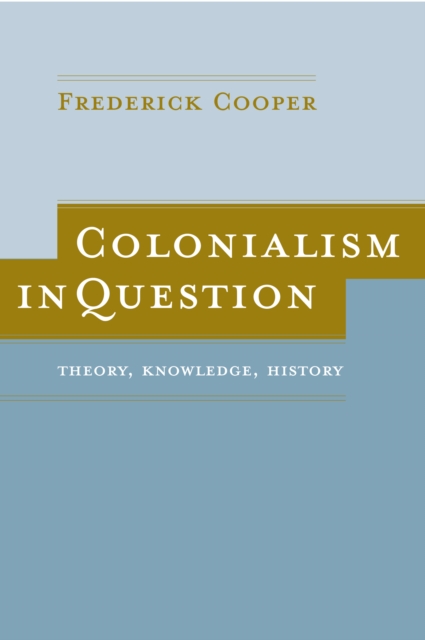
Colonialism in Question
In this closely integrated collection of essays on colonialism in world history, Frederick Cooper raises crucial questions about concepts relevant to a wide range of issues in the social sciences and humanities, including identity, globalization, and modernity. Rather than portray the past two centuries as the inevitable movement from empire to nation-state, Cooper places nationalism within a much wider range of imperial and diasporic imaginations, of rulers and ruled alike, well into the twentieth century. He addresses both the insights and the blind spots of colonial studies in an effort to get beyond the tendency in the field to focus on a generic colonialism located sometime between 1492 and the 1960s and somewhere in the \"West.\" Broad-ranging, cogently argued, and with a historical focus that moves from Africa to South Asia to Europe, these essays, most published here for the first time, propose a fuller engagement in the give-and-take of history, not least in the ways in which concepts usually attributed to Western universalism—including citizenship and equality—were defined and reconfigured by political mobilizations in colonial contexts.
eBook


Valorizing the Barbarians : enemy speeches in Roman historiography
Comparing and contrasting speeches attributed to barbarian leaders by ancient Roman historians, this book offers a systematic examination of the ways in which those historians valorized foreigners and presented criticisms of their own society.
eBook


Tributary empires in global history
A pioneering volume comparing the great historical empires, such as the Roman, Mughal and Ottoman. Leading interdisciplinary thinkers study tributary empires from diverse perspectives, illuminating the importance of these earlier forms of imperialism to broaden our perspective on modern concerns about empire and the legacy of colonialism.
eBook


The Political Economy of Empire in the Early Modern World
This collection of essays draws on fresh readings of classic texts as well as rigorous research in the archives of Europe's greatest imperial power. Its contributors paint a powerful picture of the nature and implementation of political economy in the long eighteenth century, from the East to the West Indies.
eBook


Into New Territory
The idea that the United States—a nation founded after a war of independence—operates as an imperialist power on the world stage has gained considerable traction since the turn of the twenty-first century. But just a few decades earlier, this position was considered radical and even “un-American.” How did this dramatic change come about? Tracing the emergence of the concept of US imperialism, James G. Morgan shows how radical and revisionist scholars in the 1950s and 1960s first challenged the paradigm of denying an American empire. As the Vietnam War created a critical flashpoint, bringing the idea of American imperialism into the US mainstream, radical students of the New Left turned toward Marxist critiques, admiring revolutionaries like Che Guevara. Simultaneously, a small school of revisionist scholars, led by historian William Appleman Williams at the University of Wisconsin, put forward a progressive, nuanced critique of American empire grounded in psychology, economics, and broader historical context. It is this more sophisticated strand of thinking, Morgan argues, which demonstrated that empire can be an effective analytical framework for studying US foreign policy, thus convincing American scholars to engage with the subject seriously for the first time.
eBook