
Catalogue Search | MBRL


Are you sure you want to remove the book from the shelf?

{{itemTitle}}
2,021
result(s) for
"Imperialism -- History -- 20th century"
Sort by:


The Atlantic realists : empire and international political thought between Germany and the United States
No detailed description available for \"The Atlantic Realists\".
eBook


Race for empire
Race for Empire offers a profound and challenging reinterpretation of nationalism, racism, and wartime mobilization during the Asia-Pacific war. In parallel case studies—of Japanese Americans mobilized to serve in the United States Army and of Koreans recruited or drafted into the Japanese military—T. Fujitani examines the U.S. and Japanese empires as they struggled to manage racialized populations while waging total war. Fujitani probes governmental policies and analyzes representations of these soldiers—on film, in literature, and in archival documents—to reveal how characteristics of racism, nationalism, capitalism, gender politics, and the family changed on both sides. He demonstrates that the United States and Japan became increasingly alike over the course of the war, perhaps most tellingly in their common attempts to disavow racism even as they reproduced it in new ways and forms.
eBook


The Trouble with Empire
While imperial blockbusters fly off the shelves, there is no comprehensive history dedicated to resistance in the 19th and 20th century British Empire. The Trouble with Empire is the first volume to fill this gap, offering a brief but thorough introduction to the nature and consequences of resistance to British imperialism. Historian Antoinette Burton's study spans the 19th and 20th centuries, when discontented subjects of empire made their unhappiness felt from Ireland to Canada to India to Africa to Australasia, in direct response to incursions of military might and imperial capitalism. The Trouble with Empire offers the first thoroughgoing account of what British imperialism looked like from below and of how tenuous its hold on alien populations was throughout its long, unstable life. By taking the long view, moving across a variety of geopolitical sites and spanning the whole of the period 1840-1955, Burton examines the commonalities between different forms of resistance and unveils the structural weaknesses of the British Empire. From the Indian Mutiny of 1857 to the Anglo-Zulu War to the Opium War, The Trouble with Empire reveals the often-overlooked indigenous agency throughout the British empire and illuminates the limits of imperial power, both official and unofficial.
eBook

The Oxford Handbook of the Ends of Empire
The Oxford Handbook of the Ends of Empire offers the most comprehensive treatment of the causes, course, and consequences of the ends of empire in the twentieth century. The volume's contributors convey the global reach of decolonization, with chapters analysing the empires of Western Europe, Eastern Europe, China and Japan. The Handbook combines broad, regional treatments of decolonization with chapter contributions constructed around particular themes or social issues. It considers how the history of decolonization is being rethought as a result of the rise of the 'new' imperial history, and its emphasis on race, gender, and culture, as well as the more recent growth of interest in histories of globalization, transnational history, and histories of migration and diaspora, humanitarianism and development,0and human rights. The Handbook, in other words, seeks to identify the processes and commonalities of experience that make decolonization a unique historical phenomenon with a lasting resonance. In light of decades of historical and social scientific scholarship on modernization, dependency, neo-colonialism, 'failed state' architectures and post-colonial conflict, the obvious question that begs itself is 'when did empires actually end?' In seeking to unravel this most basic dilemma the Handbook explores the relationship between the study of decolonization and the study of globalization. It connects histories of the late-colonial and post-colonial worlds, and considers the legacies of empire in European and formerly colonised societies.
Book

Tensions of empire
Starting with the premise that Europe was made by its imperial projects as much as colonial encounters were shaped by events and conflicts in Europe, the contributors to Tensions of Empire investigate metropolitan-colonial relationships from a new perspective. The fifteen essays demonstrate various ways in which \"civilizing missions\" in both metropolis and colony provided new sites for clarifying a bourgeois order. Focusing on the eighteenth, nineteenth, and early twentieth centuries, they show how new definitions of modernity and welfare were developed and how new discourses and practices of inclusion and exclusion were contested and worked out. The contributors argue that colonial studies can no longer be confined to the units of analysis on which it once relied; instead of being the study of \"the colonized,\" it must account for the shifting political terrain on which the very categories of colonized and colonizer have been shaped and patterned at different times.
eBook

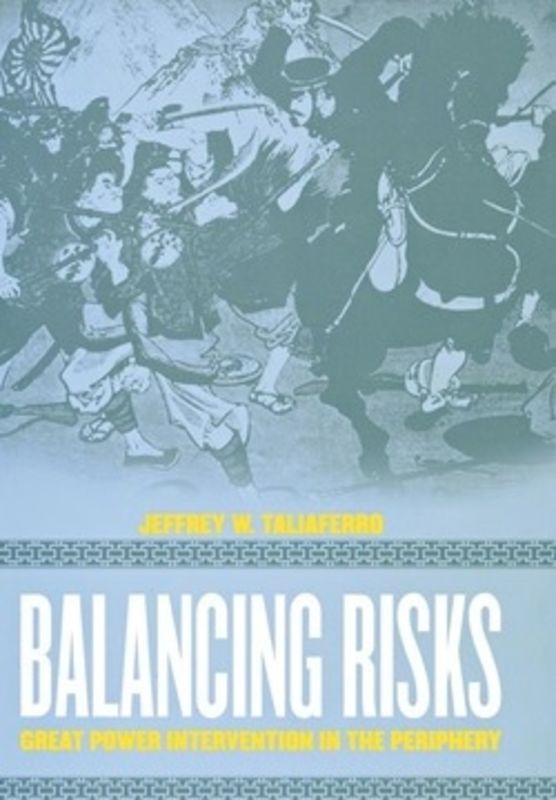
Balancing Risks
Great powers often initiate risky military and diplomatic
inventions in far-off, peripheral regions that pose no direct
threat to them, risking direct confrontation with rivals in
strategically inconsequential places. Why do powerful countries
behave in a way that leads to entrapment in prolonged, expensive,
and self-defeating conflicts?
Jeffrey W. Taliaferro suggests that such interventions are
driven by the refusal of senior officials to accept losses in their
state's relative power, international status, or prestige. Instead
of cutting their losses, leaders often continue to invest blood and
money in failed excursions into the periphery. Their policies may
seem to be driven by rational concerns about power and security,
but Taliaferro deems them to be at odds with the master explanation
of political realism.
Taliaferro constructs a \"balance-of-risk\" theory of foreign
policy that draws on defensive realism (in international relations)
and prospect theory (in psychology). He illustrates the power of
this new theory in several case narratives: Germany's initiation
and escalation of the 1905 and 1911 Moroccan crises, the United
States' involvement in the Korean War in 1950-52, and Japan's
entanglement in the second Sino-Japanese war in 1937-40 and its
decisions for war with the U.S. in 1940-41.
Great powers often initiate risky military and diplomatic
inventions in far-off, peripheral regions that pose no direct
threat to them, risking direct confrontation with rivals in
strategically inconsequential places. Why do powerful countries
behave in a way that leads to entrapment in prolonged, expensive,
and self-defeating conflicts? Jeffrey W. Taliaferro suggests that
such interventions are driven by the refusal of senior officials to
accept losses in their state's relative power, international
status, or prestige. Instead of cutting their losses, leaders often
continue to invest blood and money in failed excursions into the
periphery. Their policies may seem to be driven by rational
concerns about power and security, but Taliaferro deems them to be
at odds with the master explanation of political realism.
Taliaferro constructs a \"balance-of-risk\" theory of foreign policy
that draws on defensive realism (in international relations) and
prospect theory (in psychology). He illustrates the power of this
new theory in several case narratives: Germany's initiation and
escalation of the 1905 and 1911 Moroccan crises, the United States'
involvement in the Korean War in 1950-52, and Japan's entanglement
in the second Sino-Japanese war in 1937-40 and its decisions for
war with the U.S. in 1940-41.
eBook