
Catalogue Search | MBRL


Are you sure you want to remove the book from the shelf?

{{itemTitle}}
44
result(s) for
"Imperialism Economic aspects History 19th century."
Sort by:


The Purposes of Paradise
For half a century, the United States has treated Cuba and Hawai'i as polar opposites: despised nation and beloved state. But for more than a century before the Cuban revolution and Hawaiian statehood of 1959, Cuba and Hawai'i figured as twin objects of U.S. imperial desire and as possessions whose tropical island locales might support all manner of fantasy fulfillment-cultural, financial, and geopolitical.
Using travel and tourism as sites where the pleasures of imperialism met the politics of empire, Christine Skwiot untangles the histories of Cuba and Hawai'i as integral parts of the Union and keys to U.S. global power, as occupied territories with violent pasts, and as fantasy islands ripe with seduction and reward. Grounded in a wide array of primary materials that range from government sources and tourist industry records to promotional items and travel narratives,The Purposes of Paradiseexplores the ways travel and tourism shaped U.S. imperialism in Cuba and Hawai'i. More broadly, Skwiot's comparative approach underscores continuity, as well as change, in U.S. imperial thought and practice across the nineteenth and twentieth centuries and across the Atlantic and Pacific oceans. Comparing the relationships of Cuba and Hawai'i with the United States, Skwiot argues, offers a way to revisit assumptions about formal versus informal empire, territorial versus commercial imperialism, and direct versus indirect rule.
eBook


The Caribbean and the Atlantic world economy : circuits of trade, money and knowledge, 1650-1914
This collection of essays explores the inter-imperial connections between British, Spanish, Dutch, and French Caribbean colonies, and the 'Old World' countries which founded them. Grounded in primary archival research, the thirteen contributors focus on the ways that participants in the Atlantic World economy transcended imperial boundaries.
eBook

Opium and empire in Southeast Asia : regulating consumption in British Burma
\"This study investigates the connection between the regulation of opium and the exercise of imperial power in colonial Burma. It traces the opium industry from the British annexation of the Burmese territories of Arakan and Tenasserim in 1826 to the end of the colonial era, arguing that this connection was multi-dimensional. The British regime regulated opium to facilitate labour extraction, and the articulation of a rationale for opium policy was inextricable from the articulation of a rationale for colonial rule more generally. Evolving discourses about race invoked opium consumption. Finally, Burma's position in multiple transnational and imperial networks informed its colonial opium policy\"-- Provided by publisher.
Book

Material Powers
This edited collection is a major contribution to the current development of a 'material turn' in the social sciences and humanities. It does so by exploring new understandings of how power is made up and exercised by examining the role of material infrastructures in the organization of state power and the role of material cultural practices in the organization of colonial forms of governance.
A diverse range of historical examples is drawn on in illustrating these concerns - from the role of territorial engineering projects in seventeenth-century France through the development of the postal system in nineteenth-century Britain to the relations between the state and road-building in contemporary Peru, for example. The colonial contexts examined are similarly varied, ranging from the role of photographic practices in the constitution of colonial power in India and the measurement of the bodies of the colonized in French colonial practices to the part played by the relations between museums and expeditions in the organization of Australian forms of colonial rule. These specific concerns are connected to major critical re-examination of the limits of the earlier formulations of cultural materialism and the logic of the 'cultural turn'.
The collection brings together a group of key international scholars whose work has played a leading role in debates in and across the fields of history, visual culture studies, anthropology, geography, cultural studies, museum studies, and literary studies.
eBook

Eco-Cultural Networks and the British Empire
19th-century British imperial expansion dramatically shaped today‘s globalised world. Imperialism encouraged mass migrations of people, shifting flora, fauna and commodities around the world and led to a series of radical environmental changes never before experienced in history. Eco-Cultural Networks and the British Empire explores how these networks shaped ecosystems, cultures and societies throughout the British Empire and how they were themselves transformed by local and regional conditions. This multi-authored volume begins with a rigorous theoretical analysis of the categories of ‘empire’ and ‘imperialism’. Its chapters, written by leading scholars in the field, draw methodologically from recent studies in environmental history, post-colonial theory and the history of science. Together, these perspectives provide a comprehensive historical understanding of how the British Empire reshaped the globe during the 19th and 20th centuries. This book will be an important addition to the literature on British imperialism and global ecological change.
eBook
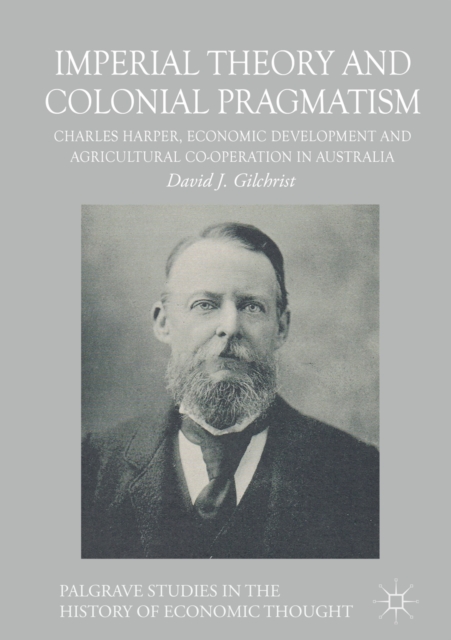
Imperial theory and colonial pragmatism : Charles Harper, economic development and agricultural co-operation in Australia
This book considers the role played by co-operative agriculture as a critical economic model which, in Australia, helped build public capital, drive economic development and impact political arrangements. In the case of colonial Western Australia, the story of agricultural co-operation is inseparable from that of the story of Charles Harper. Harper was a self-starting, pioneering frontiersman who became a political, commercial and agricultural leader in the British Empire's most isolated colony during the second half of the Victorian era. He was convinced of the successful economic future of Western Australia but also pragmatic enough to appreciate that the unique challenges facing the colony were only going to be resolved by the application of unorthodox thinking. Using Harper's life as a foil, this book examines Imperial economic thinking in relation to the co-operative form of economic organisation, the development of public capital, and socialism. It uses this discussion to demonstrate the transfer of socialistic ideas from the centre of the Empire to the farthest reaches of the Antipodes where they were used to provide a rhetorical crutch in support of purely pragmatic co-operative establishments.
eBook

Silencing race : disentangling blackness, colonialism, and national identities in Puerto Rico
Silencing Race provides a historical analysis of the construction of silences surrounding issues of racial inequality, violence, and discrimination in Puerto Rico. Examining the ongoing racialization of Puerto Rican workers, it explores the 'class-making' of race.
eBook

Beyond Nation and Empire? Questioning the Role of Religious Missions under Portuguese Colonial Rule at the Turn of the Twentieth Century
From the beginning of European overseas expansion in the fifteenth century, religious missions occupied an important place in the internal organisation of colonial empires. Their contribution to the ideological structuring of imperialism and the interaction with local populations is undeniable. With the emergence of the new imperialism and the scramble for Africa (after the 1870s), the missions, often anticipating the colonial political and administrative presence, enhanced their role as advocates of Europe’s “civilising mission”, above all through the education of the colonised peoples. For Portuguese decision-makers, the religious missions, with a multi-century tradition, had an important role in defending territorial claims overseas and promoting the empire’s nationalisation. However, the lack of national missionaries, Christianity’s inter-confessional competition in the nineteenth century and the emergence of international legal rules protecting missionary activities hindered Portugal’s strategies. Using sources from several archives (in Lisbon, the Vatican, and elsewhere) to emphasise the role of a transnational missionary staff and the international law of missions, this text intersects these aspects, examining their convergence in the controversial case of the exit and replacement of Jesuit missionaries in Mozambique in 1910–1911, to demonstrate the need to look at the missionary issues in the Portuguese overseas domains from perspectives that go beyond nation and empire.
Journal Article