
Catalogue Search | MBRL


Are you sure you want to remove the book from the shelf?

{{itemTitle}}
13,701
result(s) for
"Impressionism"
Sort by:

Impressionism in Canada : a journey of rediscovery
Impressionist paintings are among the most prized artworks in the world, yet little has been written about Canadian impressionism. Now, with this book, we have a full account of the development of this revolutionary style in painting during the four decades after 1875, first in France, then in the United States, and finally in Canada.
Book
After Impressionism : Poetry and Painting, 1874-1914
This study explores English poetry after impressionism: 'after' in the sense of being written 'later in time'; but also 'in imitation of' and, more broadly, 'in response to', often in a corrective or revisionary spirit. Specifically, it considers how a number of Anglophone poets-namely, Arthur Symons, W. B. Yeats, Ford Madox Ford, T. E. Hulme, Edward Storer, F. S. Flint, and Ezra Pound-reacted to (and often against) various forms of impressionism, and treats these responses as contexts for their poetry. Its approach to this subject takes two related courses. While its focus is not wholly confined to poetic responses to visual art, at various points this study pays close attention to the ways poets thought and wrote about impressionist painting. Beyond this, the dissertation is also concerned with how their writings respond to an older philosophical language of impressions which was formative of (and eventually formed by) impressionist art. Taking both into account, it addresses the various and often contradictory ways in which ideas about impressionism informed the writings of its central figures, drawing attention to how several important ideas in the history of modern poetry-ideas such as Decadence, Symbolism, vers libre, Imagism-were formulated as expressions of, or antidotes to, impressionist aesthetics. As it does so, the thesis mounts a broader argument, which is that impressionism was one of the crucial terms through and against which English verse of the late nineteenth and early twentieth centuries was defined.
Dissertation

Impressionism
Born in the mid-1800s, the Impressionist movement redefined the way artists approached their craft, opening the doors to previously unheard-of freedom in methods, viewpoint, and execution. This book examines Impressionist art, the tools, the techniques, the artists, and the artwork that so many generations have come to know and love.
Book
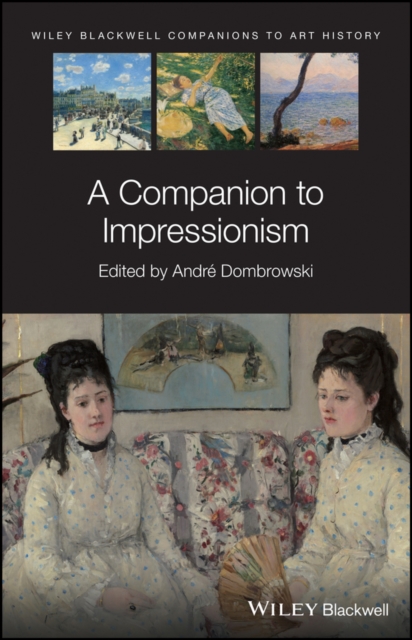
Wiley Blackwell Companion to Impressionism
Presenting an expansive view of the study of Impressionism, this volume breaks new thematic ground while also reconsidering established questions surrounding the definition, chronology, and membership of the Impressionist movement. In 34 original essays from established and emerging scholars, this collection considers a diverse range of developing topics and offers new critical approaches to the interpretation of Impressionist art.
eBook


Impressionism
This book is a pioneering reading of Impressionism from a feminist perspective by a noted art historian. Norma Broude analyzes the philosophical underpinnings of landscape painting in the late nineteenth century discussing the critical misconceptions attached to Impressionism, in particular the work of Monet.
eBook

Impressionism
It is often forgotten just how provocative Impressionist canvases seemed when they were first exhibited in 1874. The advocates of the new style rejected the established principles of art prevalent at that time in France. This book traces Impressionism's origins to its spread to America and Australia. Ralph Skea shows how Impressionist artists transformed everyday subject matter. Daringly using colour and rapid brushstrokes, the Impressionists worked out of doors, creating paintings that captured the transient effects of light and feeling. Impressionism's initial shock factor gradually gave way to widespread acceptance, but only now can we appreciate how profound its influence has been on modern art.
Book
Impressions of an analyst: reassessing sigmund freud's literary style through a comparative study of the principles and fiction of ford madox ford, henry james, virginia woolf & dorothy richardson
The connection between Sigmund Freud and modernism is firmly established and there is an increasing (though still limited) body of scholarship that adopts methods of literary analysis in approaching Freud's texts. This thesis adds depth and specificity to a broad claim to literariness by arguing that Freud can be considered a practitioner of modern literary impressionism. The claim is substantiated through close textual analysis of key texts from James Strachey' s Standard Edition of the Complete Psychological Works of Sigmund Freud, alongside theory and fiction by significant impressionist authors Ford Madox Ford, Henry James, Virginia Woolf and Dorothy Richardson. The authors' respective approaches to various aspects of literary impressionism are considered, such as the methods of textual development, the instability of genre, and the stylised techniques utilised to convey the impression. This research illustrates that whilst each of the chosen novelists engages with literary impressionism differently, Freud's texts share common practice with each, facilitating the reassessment of the analyst as a specifically 'impressionist' author.
Dissertation

Impressionist art
Some of the most famous artists of all time were from the Impressionist School. Claude Monet, Georges Seurat, and Edgar Degas all created works that have stood the test of time, and they were impressionists. Readers learn about the characteristics of impressionist art and the techniques used to create it.
Book

Color in the age of impressionism : commerce, technology, and art
This study analyzes the impact of color-making technologies on the visual culture of nineteenth-century France, from the early commercialization of synthetic dyes to the Lumière brothers' perfection of the autochrome color photography process. Focusing on Impressionist art, Laura Anne Kalba examines the importance of dyes produced in the second half of the nineteenth century to the vision of artists such as Edgar Degas, Pierre-Auguste Renoir, and Claude Monet.
The proliferation of vibrant new colors in France during this time challenged popular understandings of realism, abstraction, and fantasy in the realms of fine art and popular culture. More than simply adding a touch of spectacle to everyday life, Kalba shows, these bright, varied colors came to define the development of a consumer culture increasingly based on the sensual appeal of color. Impressionism—emerging at a time when inexpensively produced color functioned as one of the principal means by and through which people understood modes of visual perception and signification—mirrored and mediated this change, shaping the ways in which people made sense of both modern life and modern art.
Demonstrating the central importance of color history and technologies to the study of visuality, Color in the Age of Impressionism adds a dynamic new layer to our understanding of visual and material culture.
eBook