
Catalogue Search | MBRL


Are you sure you want to remove the book from the shelf?

{{itemTitle}}
34
result(s) for
"Impressionistic Criticism"
Sort by:

A crítica literária de Álvaro Lins
Álvaro Lins was one of the biggest names in Brazilian literary criticism between the 40s and 60s. Working in the Correio da Manhã newspaper in Rio de Janeiro between 1941 and 1963, Lins published weekly critical texts whose main function was to analyze the works of new writers and discuss pertinent points about literary subjects. In addition to making several critical comments about literary works Alvaro Lins also published a series of articles in which he investigated the role of literary criticism. More than simple Impressionist criticism, as his work was later to be recognized, Lins understood criticism as an intellectual activity associated with free spirit that comments, analyzes and, above all, judges the literary works. In order to analyze its meta-critical texts, this article aims to investigate the importance of literary criticism for Álvaro Lins and, mainly, to demonstrate how he projected critical work. In tepid times often marked by criticism devoid of creativity and interpretive sensitivity, returning to Lins' thinking becomes a kind of survival manual for future critics and the means of understanding the disenchantment surrounding current literary criticism.
Journal Article

Boro, L'île d'amour
There has been a recent revival of interest in the work of Polish film director Walerian Borowczyk, a label-defying auteur and \"escape artist\" if there ever was one. This collection serves as an introduction and a guide to Borowczyk's complex and ambiguous body of work, including panoramic views of the director's output, focused studies of particular movies, and more personal, impressionistic pieces. Taken together, these contributions comprise a wide-ranging survey that is markedly experimental in character, allowing scholars to gain insight into previously unnoticed aspects of Borowczyk'soeuvre.
eBook

Boro, L'Île d'Amour
There has been a recent revival of interest in the work of Polish film director Walerian Borowczyk, a label-defying auteur and \"escape artist\" if there ever was one. This collection serves as an introduction and a guide to Borowczyk's complex and ambiguous body of work, including panoramic views of the director's output, focused studies of particular movies, and more personal, impressionistic pieces. Taken together, these contributions comprise a wide-ranging survey that is markedly experimental in character, allowing scholars to gain insight into previously unnoticed aspects of Borowczyk'soeuvre.
eBook
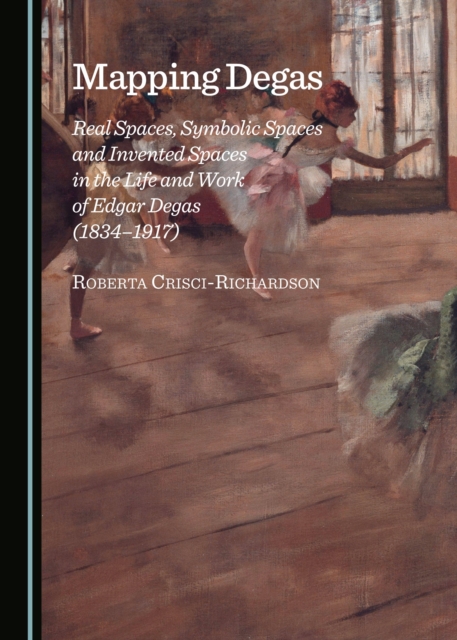
Mapping Degas
The New Art History and the Impressionist canon seem to have successfully claimed Edgar Degas as a misogynist, rabid nationalist and misanthrope whose art was both masterly and experimental. By analysing Degass approach to space and his self-fashioning attitude towards identity within the ambiguities of the political and artistic culture of nineteenth-century France, this book questions the characterisation of Degas as a right-wing Frenchman and artist, and will change the way in which Degas.
eBook

Reflections on Breughel's \Icarus\ from a Kohutian Perspective
Pieter Breughel's famous 1558 painting, Landscape with the Fall of Icarus, is discussed. Breughel's work suggests the tendency of individuals to ignore the suffering of others in favor of their own absorbing agendas.
Journal Article

Resisting Colonial Mastery: Becoming Animal, Becoming Ethical in The Impressionist
Theories about Third Space or “in-betweeness” often lack an ethics that responds to the position of the majority of people who experience the violence of colonialism, as Amar Acheraïou argues. How can we think about hybridity with a more committed ethics? Hari Kunzru’s The Impressionist suggests that much of the violence experienced by humans and animals under dominant or colonial thought stems from a traditional view of subjectivity as fixed, stable, knowable, distinct, and independent from others and the material world. Colonial logic views as “disposable” those regarded as not human or somehow less than human and often sacrifices them in order to maintain a stable, dominant notion of subjectivity, an exclusionary definition of Man, a continuous flow of extractionary capital from the colonies, and a particular hierarchy or ordering of the world. This article argues that The Impressionist portrays subjectivity not as fixed but in process, after Deleuze and Guattari’s “becoming animal,” as a way to challenge dominant thinking. The novel also emphasizes the nonhuman nature of subjectivity and human dependence on the nonhuman, including the environment, for existence. The Impressionist offers an important corrective to concepts of hybridity by emphasizing that those humans and nonhumans regarded as “disposable” demand ethical treatment.
Journal Article

Johnny Depp Starts Here
From beloved bad-boy to cool and captivating maverick, Johnny Depp has inspired media intrigue and has been the source of international acclaim since the early 1990s. He has attracted attention for his eccentric image, his accidental acting career, his beguiling good looks, and his quirky charm. In Johnny Depp Starts Here, film scholar Murray Pomerance explores our fascination with Depp, his riddling complexity, and his meaning for our culture. Moving beyond the actor's engaging and inscrutable private life, Pomerance focuses on his enigmatic screen performances from A Nightmare on Elm Street to Secret Window.The actor's image is studied in terms of its ambiguities and its many strange nuances: Depp's ethnicity, his smoking, his tranquility, his unceasing motion, his links to the Gothic, the Beats, Simone de Beauvoir, the history of rationality, Impressionist painting, and more. In a series of treatments of his key roles, including Rafael in The Brave, Bon Bon in Before Night Falls, Jack Kerouac in The Source, and the long list of acclaimed performances from Gilbert Grape to Cap'n Jack Sparrow, we learn of Johnny onscreen in terms of male sexuality, space travel, optical experience, nineteenth-century American capitalism, Orientalism, the vulnerability of performance, the perils of sleep, comedy, the myth of the West, Scrooge McDuck, Frantois Truffaut, and more.Johnny's face, Johnny's gaze, Johnny's aging, and Johnny's understatement are shown to be inextricably linked to our own desperate need to plumb performance, style, and screen for a grounding of reality in this ever-accelerating world of fragmentation and insecurity. Both deeply intriguing and perpetually elusive, Depp is revealed as the central screen performer of the contemporary age, the symbol of performance itself.No thinker has meditated on Johnny Depp this way before-and surely not in a manner worthy of the object of scrutiny.
eBook
Paul Gauguin : sweet dreams
'1000 Masterpieces from the Great Museums of the World' is one of the most successful TV series about art. The original, with improved image quality, takes us on a fascinating journey through the history of art. Comprehensively illustrated and compellingly presented – the well-known authors of five short art surveys provide a deeper insight into the masterpieces of painting. This is one of the greatest museums on earth and with its historic buildings in the heart of St Petersburg it is one of the most popular sites of pilgrimage within the UNESCO portfolio of world culture. Founded in 1764 by Catherine the Great as a private collection, the Hermitage is a magical center of attraction for art lovers from around the world, with just under three million works. The collection of European art enjoys a particular reputation for its paintings from Rembrandt to Gauguin. Paul Gauguin: SWEET DREAMS (1894) Lucas Cranach the Elder - VENUS and CUPID (1509)Bartolome Murillo: THE REST ON THE FLIGHT INTO EGYPT (1665-70) Rembrandt Harmensz. van Rijn: THE RETURN OF THE PRODIGAL SON (c. 1668) Michelangelo Caravaggio: THE LUTE PLAYER (c. 1596).
Streaming Video
Kandinsky
Colour, form, area: this is the formula of the greatest pioneer of abstract painting. Kandinsky came to art late in life, but his impact through Der Blaue Reiter (The Blue Rider) and Bauhaus paved the way for modern art. In 1913, he created one of the first abstract pictures, the theoretical basis of which was inspired by his essay Über das Geistige in der Kunst (On the Spiritual in Art). Accompanied by Mussorgsky's Pictures From An Exhibition Labarthe goes on a sensual journey which makes the soul resound with colours and forms. 'A picture has to resound and must be bathed in an inner glow.' Kandinsky.
Streaming Video