
Catalogue Search | MBRL


Are you sure you want to remove the book from the shelf?

{{itemTitle}}
26,412
result(s) for
"In Colombia"
Sort by:

Resisting war : how communities protect themselves
\"In civil conflicts around the world, unarmed civilians take enormous risks to protect themselves and confront heavily armed combatants. This is not just counterintuitive - it is extraordinary. In this book, Oliver Kaplan explores cases from Colombia, with extensions to Afghanistan, Pakistan, Syria, and the Philippines, to show how and why civilians influence armed actors and limit violence. Based on fieldwork and statistical analysis, the book explains how local social organization and cohesion enable both covert and overt nonviolent strategies, including avoidance, cultures of peace, dispute resolution, deception, protest, and negotiation. These 'autonomy' strategies help civilians retain their agency and avoid becoming helpless victims by limiting the inroads of armed groups\"-- Provided by publisher.
Book

Salt and the Colombian State
In republican Colombia, salt became an important source of revenue not just to individuals, but to the state, which levied taxes on it and in some cases controlled and profited from its production. Focusing his study on the town of La Salina, Joshua M. Rosenthal presents a fascinating glimpse into the workings of the early Colombian state, its institutions, and their interactions with local citizens during this formative period.
eBook
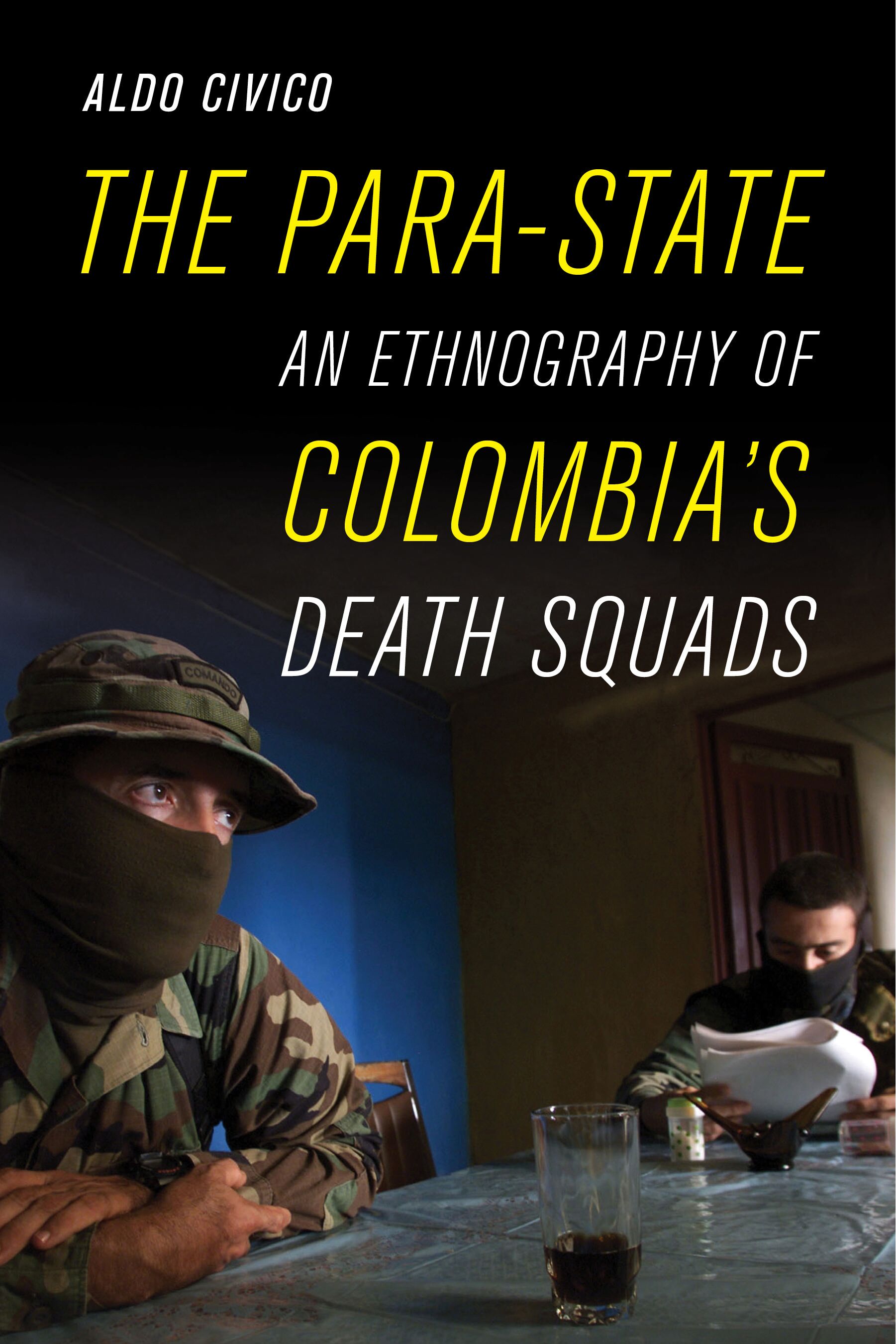
The para-state
Since its independence in the nineteenth century, the South American state of Colombia has been shaped by decades of bloody political violence. In The Para-State, Aldo Civico draws on interviews with paramilitary death squads and drug lords to provide a cultural interpretation of the country's history of violence and state control. Between 2003 and 2008, Civico gained unprecedented access to some of Colombia's most notorious leaders of the death squads. He also conducted interviews with the victims of paramilitary, with drug kingpins, and with vocal public supporters of the paramilitary groups. Drawing on the work of Deleuze and Guattari, this riveting work demonstrates how the paramilitaries have in essence become a war machine deployed by the Colombian state to control and maintain its territory and political legitimacy.
eBook

Of Beasts and Beauty
All societies around the world and through time value beauty highly. Tracing the evolutions of the Colombian standards of beauty since 1845, Michael Edward Stanfield explores their significance to and symbiotic relationship with violence and inequality in the country. Arguing that beauty holds not only social power but also economic and political power, he positions it as a pacific and inclusive influence in a country \"ripped apart by violence, private armies, seizures of land, and abuse of governmental authority, one hoping that female beauty could save it from the ravages of the male beast.\" One specific means of obscuring those harsh realities is the beauty pageant, of which Colombia has over 300 per year. Stanfield investigates the ways in which these pageants reveal the effects of European modernity and notions of ethnicity on Colombian women, and how beauty for Colombians has become an external representation of order and morality that can counter the pathological effects of violence, inequality, and exclusion in their country.
eBook

Democracy and Displacement in Colombia's Civil War
Democracy and Displacement in Colombia's Civil War is
one of few books available in English to provide an overview of the
Colombian civil war and drug war. Abbey Steele draws on her own
original field research as well as on Colombian scholars' work in
Spanish to provide an expansive view of the country's political
conflicts. Steele shows how political reforms in the context of
Colombia's ongoing civil war produced unexpected, dramatic
consequences: democratic elections revealed Colombian citizens'
political loyalties and allowed counterinsurgent armed groups to
implement political cleansing against civilians perceived as loyal
to insurgents.
Combining evidence collected from remote archives, more than two
hundred interviews, and quantitative data from the government's
displacement registry, Steele connects Colombia's political
development and the course of its civil war to purposeful
displacement. By introducing the concepts of collective targeting
and political cleansing, Steele extends what we already know about
patterns of ethnic cleansing to cases where expulsion of civilians
from their communities is based on nonethnic traits.
eBook

Of Love and Other Passions
In Of Love and Other Passions Guiomar Dueñas-Vargas delves into the world of emotions among the bourgeois elite in Bogotá from the end of the colonial period to 1870. While most studies of the period focus solely on the country’s political activity, Dueñas-Vargas shows how Colombia’s social, cultural, and political changes transformed the meaning of love, which contributed to the evolution of new models of femininity and masculinity.
By examining sources such as personal letters and diaries, Dueñas-Vargas presents the emotional profiles of families and couples, demonstrating how their conduct challenged the established order. As lovers insisted on choosing their own mates rather than marrying spouses selected by their parents, they undermined the patriarchal structure of Colombian society. Such decisions unveil the many functions women assumed in both public and private life and how they participated in the invention of a nation.
eBook

Organic Waste Buyback as a Viable Method to Enhance Sustainable Municipal Solid Waste Management in Developing Countries
Many developing countries have inadequate Municipal Solid Waste (MSW) management systems due to lack of not only the awareness, technologies, finances, but also a proper governance that is able to enforce and monitor the regulations. Not all the solutions practiced by and in developed countries fit to the developing country contexts. The local conditions and limitations must always be taken into account when proposing waste management options for developing countries. The excessively high organic waste fraction in MSW and relatively inexpensive labor markets available in developing countries are two of the strengths that have not yet been utilized fully. This manuscript is an attempt to point out the benefits we receive from the above two strengths if we establish organic waste buyback programs. This can only become successful if we find solutions to: (1) collect source-separated organic waste, and then (2) find stable markets for the products made from organic waste. Compost or biogas could be the best bet developing countries can consider as products. However, there must be some policy interventions to support buyback programs at the waste collection stage as well as at the product marketing stage. Implementation of such organic waste buyback centers that can offer some incentives can indirectly motivate residents to do source separation. This will in turn also help promote more recycling, as any waste bin that has no organics in it is much easier for anyone (e.g., waste pickers) to look for other recyclables. Developing country settings such as the Green Container composting program in Cajicá, Colombia, and buyback centers in South Africa that are presented later in the manuscript are thought to be the places where the concept can be implemented with little effort. The environment, economy, and society are considered to be the three dimensions (or pillars) of sustainability. Interestingly, the organic waste buyback centers solution has positive implications on all three aspects of sustainability. Thus, it also supports the 2030 Agenda of the United Nations (UN), by making specific contributions to the Sustainable Development Goals (SDGs) such as zero hunger (SDG 2), affordable and clean energy (SDG 7), climate action (SDG 13), clean water and sanitation (SDG 6), and sustainable cities and communities (SDG 11).
Journal Article

The FARC
Garry Leech has written the definitive introduction to the FARC, examining the group's origins, aims, and ideology, and looking at its organizational and operational structures. The book also investigates the FARC's impact on local, regional, and global politics and explores its future direction. 'Rebels' is an exciting and innovative new series looking at contemporary rebel groups and their place in global politics. Written by leading experts, the books serve as definitive introductions to the individual organizations, whilst seeking to place them within a broader geographical and political framework. They examine the origins, ideology and future direction of each group, whilst posting such questions as 'When does a \"rebel\" political movement become a \"terrorist\" organization?' and 'What are the social-economic drivers behind political violence?'. Provocative and original, the series is essential reading for anyone interested in how rebel groups operate today.
eBook

Hydroinformatic tools and their potential in the search for missing persons in rivers
This research proposes a methodological approach to search floating bodies or floating body parts in rivers using hydroinformatic tools. These tools may allow possible search locations and potential release sites to be determined. The approach draws from hydrometric field information, two-dimensional (2D) hydrodynamic modeling, particle tracking (PT) models, and large-scale particle image velocimetry (LSPIV). This methodology was applied to a case study of the La Miel river in Colombia, where existing reports of deceased persons are available. A series of hydraulic accidents have been defined to represent the hydrodynamic and transport processes that occur in such situations. The results indicate that potential search locations, namely places where human floating bodies or floating body parts may be found, are principally on the left and right shores of recirculation systems.
Journal Article

Life cycle impacts assessment of two gold extraction systems in Colombia: open-pit and alluvial mining
PurposeGold mining has historically and significantly contributed to the Colombian economy. Gold extraction in Colombia is mainly done through two techniques: open-pit and alluvial mining. In this study, the environmental impacts of both these mining systems were analyzed using the life cycle assessment (LCA) framework, including identification of the system components that contribute most to impacts.MethodsInventory data were obtained for two medium-scale mines in Colombia, one representing the open-pit method and the other the alluvial method. Environmental impacts were classified and characterized by mid-point impact categories and further aggregated into end-point indicators through the ReCiPe (v. 1.11) methodology, which uses a hierarchist perspective.ResultsResults for end-point indicators show that the open-pit mining presents higher values in the human health damage category, influenced primarily by tailings and by the excavation process. For the alluvial mining, the overall impacts were an order of magnitude lower, with ecosystem quality as the most significant contributor due to the stripping of soil and vegetation. In the case of mid-point indicators, freshwater and marine ecotoxicity contribute the most to open-pit mining, while for alluvial mining, metal depletion and natural land transformation contribute the most. Climate change is also a significant impact category for alluvial and open-pit mining.ConclusionsThe is a substantial difference in environmental impacts between the two mining systems: the quantified total environmental impact was 1.0 × 1004 points for the open-pit mine and 2.4 × 1003 points for the alluvial mine. Since these mines represent specific Colombian operational conditions, this conclusion cannot be confidently extended to other operational contexts. For example, results in other cases may depend on the local geological features and natural environment conditions. Knowing the critical mining supply chain stages for environmental performance will allow the decision-makers to provide the tools for more sustainable extraction and production.
Journal Article