
Catalogue Search | MBRL


Are you sure you want to remove the book from the shelf?

{{itemTitle}}
251
result(s) for
"Inca architecture."
Sort by:


At Home with the Sapa Inca
By examining the stunning stone buildings and dynamic spaces of the royal estate of Chinchero, Nair brings to light the rich complexity of Inca architecture. This investigation ranges from the paradigms of Inca scholarship and a summary of Inca cultural practices to the key events of Topa Inca's reign and the many individual elements of Chinchero's extraordinary built environment. What emerges are the subtle, often sophisticated ways in which the Inca manipulated space and architecture in order to impose their authority, identity, and agenda. The remains of grand buildings, as well as a series of deft architectural gestures in the landscape, reveal the unique places that were created within the royal estate and how one space deeply informed the other. These dynamic settings created private places for an aging ruler to spend time with a preferred wife and son, while also providing impressive spaces for imperial theatrics that reiterated the power of Topa Inca, the choice of his preferred heir, and the ruler's close relationship with sacred forces. This careful study of architectural details also exposes several false paradigms that have profoundly misguided how we understand Inca architecture, including the belief that it ended with the arrival of Spaniards in the Andes. Instead, Nair reveals how, amidst the entanglement and violence of the European encounter, an indigenous town emerged that was rooted in Inca ways of understanding space, place, and architecture and that paid homage to a landscape that defined home for Topa Inca.
eBook

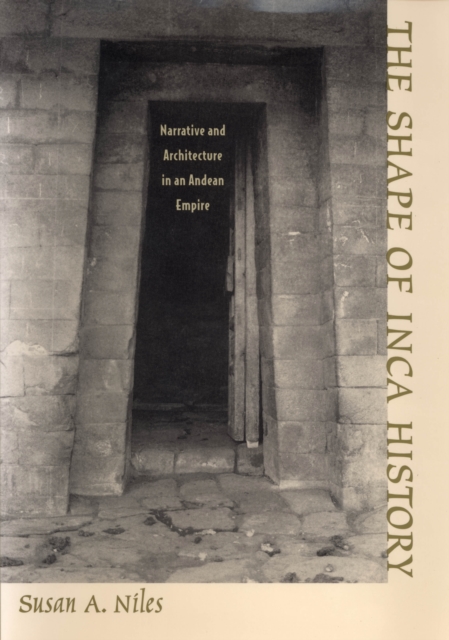
The shape of Inca history: narrative and architecture in an Andean empire
In The Shape of Inca History, Susan Niles considers the ways in which the Inca concept of history informed their narratives, rituals, and architecture. Using sixteenth-century chronicles of Inca culture, legal documents from the first generation of conquest, and field investigation of architectural remains, she strategically explores the interplay of oral and written histories with the architectural record and provides a new and exciting understanding of the lives of the royal families on the eve of conquest.Niles focuses on the life of Huayna Capac, the Inca king who ruled at the time of the first European incursions on the Andean coast. Because he died just a few years before the Spaniards overturned the Inca world, eyewitness accounts of his deeds as recorded by the invaders can be used to separate fact from propaganda. The rich documentary sources telling of his life include extraordinarily detailed legal records that inventory lands on his estate in the Yucay Valley. These sources provide a basis-unique in the Andes-for reconstructing the social and physical plan of the estate and for dating its construction exactly.Huayna Capac's country palace shows a design different from that devised by his ancestors. Niles argues that the radical stylistic and technical innovations documented in the buildings themselves can be understood by referring to the turbulent political atmosphere prevalent at the time of his accession. Illustrated with numerous photographs and reconstruction drawings, The Shape of Inca History breaks new ground by proposing that Inca royal style was dynamic and that the design of an Inca building can best be interpreted by its historical context. In this way it is possible to recreate the development of Inca architectural style over time.
eBook

The Shape of Inca History
InThe Shape of Inca History,Susan Niles considers the ways in which the Inca concept of history informed their narratives, rituals, and architecture. Using sixteenth-century chronicles of Inca culture, legal documents from the first generation of conquest, and field investigation of architectural remains, she strategically explores the interplay of oral and written histories with the architectural record and provides a new and exciting understanding of the lives of the royal families on the eve of conquest.
Niles focuses on the life of Huayna Capac, the Inca king who ruled at the time of the first European incursions on the Andean coast. Because he died just a few years before the Spaniards overturned the Inca world, eyewitness accounts of his deeds as recorded by the invaders can be used to separate fact from propaganda. The rich documentary sources telling of his life include extraordinarily detailed legal records that inventory lands on his estate in the Yucay Valley. These sources provide a basis-unique in the Andes-for reconstructing the social and physical plan of the estate and for dating its construction exactly.
Huayna Capac's country palace shows a design different from that devised by his ancestors. Niles argues that the radical stylistic and technical innovations documented in the buildings themselves can be understood by referring to the turbulent political atmosphere prevalent at the time of his accession. Illustrated with numerous photographs and reconstruction drawings,The Shape of Inca Historybreaks new ground by proposing that Inca royal style was dynamic and that the design of an Inca building can best be interpreted by its historical context. In this way it is possible to recreate the development of Inca architectural style over time.
eBook

Ancestral Inca Construction Systems and Worldview at the Choquequirao Archaeological Site, Cusco, Peru, 2024
Limited accessibility, mountainous geography, and seismic conditions have posed challenges to both the preservation and the transmission of knowledge inherited from the Incas. Therefore, this research aims to analyze the ancestral Inca construction systems and their relationship with the Inca worldview through an architectural and structural study of the archaeological site of Choquequirao, located in Cusco, Peru. The research integrates geographic, climatic, spatial, functional, and constructive dimensions, applying digital 3D modeling tools (AutoCAD 2025, SketchUp 2024, and Sun-Path 2024) to assess the orientation, stability, and symbolic configuration of the main sectors. The results of the functional and constructive analysis reveal that Choquequirao incorporates adaptive principles in response to seismic and microclimatic conditions, as well as constructive typologies planned from an integral architectural perspective. These elements allow a clearer understanding of the spatial organization of the site and its cultural significance. Moreover, the study covers ten sectors distributed across 1800 hectares. The upper sector (4 ha) stands out for its architecture and political–ceremonial function; the lower sector (4 ha) includes ritual, administrative, residential, and storage areas for camelids; the southern sector (5 ha) contains the ushnu and priestly enclosures on terraces; and the eastern (7 ha) and western (2 ha) slopes integrate agricultural and residential uses. The study of Choquequirao highlights its complex organization and addresses contemporary challenges in terms of conservation and development. These findings provide essential insights for future restoration and conservation strategies that respect traditional construction systems and their environmental adaptation.
Journal Article

Cusco
One person’s lifelong research pursuit is brought to fruition here, in the first major publication on the planning and archaeology of the Inka capital of Cusco. No other book to date has focused so extensively on the oldest existing city in the Americas, the “navel of the world\" according to the Inka Empire, a fascinating and complex urban landscape that grew and evolved over 3,000 years of continuous human habitation.
eBook

Complejo Arquitectonico Cerro Mercachas: arquitectura y ritualidad incaica en Chile central
Se discute la dinámica de la ocupación del Tawantinsuyu en la zona central de Chile a partir del estudio de la instalación más extensa ubicada en la zona: el Complejo Arquitectónico Cerro Mercachas. A partir de un análisis intra-sitio se reconoce una organización lineal y tripartita del asentamiento, lo que sumado al escaso registro de cultura material mueble llevan a proponerle una función ritual relacionada con las festividades del calendario metropolitano inca asociadas, al menos, a la observación del solsticio de diciembre y el culto al cerro Aconcagua. El contexto sugiere un uso esporádico y por pocos sujetos del sitio, implicando una ritualidad exclusiva para ciertos personajes. A una escala regional, la alta visibilidad del sitio hace que esta ritualidad se inserte en el paisaje cotidiano de las poblaciones locales, reproduciendo estrategias de construcción social del espacio que el Tawantinsuyu aplica en otras áreas. A través de ella se crea una diferencia y jerarquización con los otros espacios rituales locales, estableciendo una estrategia de integración y exclusión entre el Tawantinsuyu y las poblaciones locales. A partir de estos resultados, se discute el modelo administrativo tradicionalmente utilizado para entender la ocupación inca en la zona.
Journal Article

At the Other End of the Sun’s Path: A New Interpretation of Machu Picchu
The Inca citadel of Machu Picchu is usually interpreted as a “royal estate” of the Inca ruler Pachacuti. This idea is challenged here by a critical reappraisal of existing sources and a re-analysis of existing evidence. It is shown that such evidence actually point at a quite different interpretation suggested, on one hand, by several clues coming from the urban layout (the interior arrangement of the town, the ancient access ways, the position with respect to the landscape and the cycles of the celestial bodies in Inca times), and, on the other hand, by a comparison with known information about the Inca pilgrimage center on the Island of the Sun of Lake Titicaca. Altogether, these clues lead us to propose that Machu Picchu was intentionally planned and built as a pilgrimage center connected with the Inca “cosmovision”.
Journal Article

The Inka Married the Earth: Integrated Outcrops and the Making
\"According to a Quechua story told in the Andes today, the ancient Inka (Inca) of that area married Pachamama (Mother Earth) and produced human offspring. A trace of that union is still manifest in the ruins of Inka buildings in the form of rock outcrops--masses of bare rock protruding from the surface of the earth--that were integrated by Inka builders into masonry structures in the fifteenth and early sixteenth centuries throughout the Inka realm, an empire that eventually reached the greatest extent of any pre-Hispanic state in the Americas.\" (Art Bulletin) \"[T]he significance of outcrops that have been used as fundamental, inextricable parts of Inka architecture\" is examined. Ways in which the Inka \"perceived and deployed visual culture within, and as part of, the natural environment\" are highlighted.
Journal Article