
Catalogue Search | MBRL


Are you sure you want to remove the book from the shelf?

{{itemTitle}}
593
result(s) for
"Inca art."
Sort by:

Art and vision at Inca Cajamarca
\"In 1500 CE, the Inca empire covered most of South America's Andean region. The empire's leaders first met Europeans on November 15, 1532, when a large Inca army confronted Francisco Pizarro's band of adventurers in the highland Andean valley of Cajamarca, Peru. At few other times in its history would the Inca royal leadership so aggressively showcase its moral authority and political power. Glittering and truculent, what Europeans witnessed at Inca Cajamarca compels revised understandings of pre-contact Inca visual art, spatial practice, and bodily expression. This book takes a fresh look at the encounter at Cajamarca, using the episode to offer a new, art-historical interpretation of pre-contact Inca culture and power. Adam Herring's study offers close readings of Inca and Andean art in a variety of media: architecture and landscape, geoglyphs, sculpture, textiles, ceramics, featherwork, and metalwork. The volume is richly illustrated with over sixty color images\"-- Provided by publisher.
Book

Memory Landscapes of the Inka Carved Outcrops
Memory Landscapes of the Inka Carved Outcrops: From Past to Present presents a comprehensive analysis of the carved rocks the Inka created in the Andean highlands during the fifteenth and early sixteenth centuries.
eBook

Spatial Analysis and the Interpretation of Rock Art at the Cajamarca Site of Callacpuma, Peru
Callacpuma is a multicomponent archaeological site in the Cajamarca Basin of the northern highlands of Peru with a long and complex history of human occupation spanning from at least 1000 BC to approximately AD 1500. An estimated 3,000-4,000 rock art panels dot the landscape of Callacpuma. This thesis utilizes a sample of 87 rock art panels to examine the spatial relationships of the rock panels to each other and to other important features on the landscape. It provides a case study of how GIS-based spatial analysis can be used to employ rock art panels in understanding the patterns of human occupation at sites. The work also presents preliminary conclusions regarding the chronology and function of the Callacpuma rock art. In doing this analysis, I hope to contribute to our understanding of both the development of prehistory in the Cajamarca Basin as well as the use of spatial analysis in rock art studies.
Dissertation
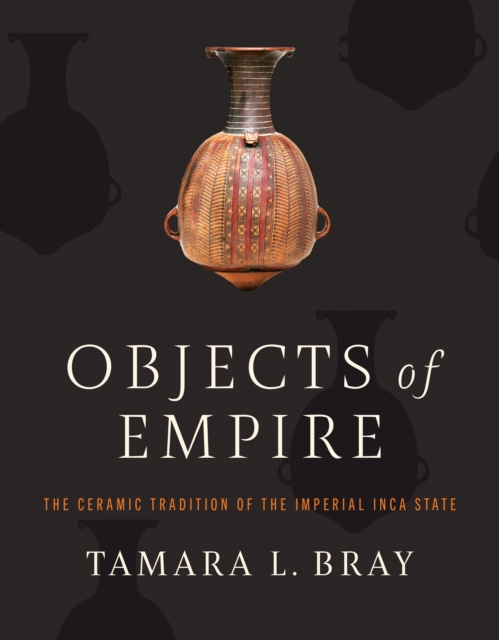
Objects of Empire
A comparative, empire-wide study of the ceramics associated with the imperial Inca state, theorizing the role of these highly recognizable vessel forms in legitimizing Inca rule and establishing imperial identities.
eBook

At Home with the Sapa Inca
By examining the stunning stone buildings and dynamic spaces of the royal estate of Chinchero, Nair brings to light the rich complexity of Inca architecture. This investigation ranges from the paradigms of Inca scholarship and a summary of Inca cultural practices to the key events of Topa Inca's reign and the many individual elements of Chinchero's extraordinary built environment. What emerges are the subtle, often sophisticated ways in which the Inca manipulated space and architecture in order to impose their authority, identity, and agenda. The remains of grand buildings, as well as a series of deft architectural gestures in the landscape, reveal the unique places that were created within the royal estate and how one space deeply informed the other. These dynamic settings created private places for an aging ruler to spend time with a preferred wife and son, while also providing impressive spaces for imperial theatrics that reiterated the power of Topa Inca, the choice of his preferred heir, and the ruler's close relationship with sacred forces. This careful study of architectural details also exposes several false paradigms that have profoundly misguided how we understand Inca architecture, including the belief that it ended with the arrival of Spaniards in the Andes. Instead, Nair reveals how, amidst the entanglement and violence of the European encounter, an indigenous town emerged that was rooted in Inca ways of understanding space, place, and architecture and that paid homage to a landscape that defined home for Topa Inca.
eBook

The Two Faces of Inca History
Drawing on a redefinition of Inca royal descent and a comparative literary analysis of the chronicles, this book offers new insights into the dynamics of dualistic oppositions in the historical narratives, rituals and cosmology of the Inca ruling elite.
eBook

Ancestral Inca Construction Systems and Worldview at the Choquequirao Archaeological Site, Cusco, Peru, 2024
Limited accessibility, mountainous geography, and seismic conditions have posed challenges to both the preservation and the transmission of knowledge inherited from the Incas. Therefore, this research aims to analyze the ancestral Inca construction systems and their relationship with the Inca worldview through an architectural and structural study of the archaeological site of Choquequirao, located in Cusco, Peru. The research integrates geographic, climatic, spatial, functional, and constructive dimensions, applying digital 3D modeling tools (AutoCAD 2025, SketchUp 2024, and Sun-Path 2024) to assess the orientation, stability, and symbolic configuration of the main sectors. The results of the functional and constructive analysis reveal that Choquequirao incorporates adaptive principles in response to seismic and microclimatic conditions, as well as constructive typologies planned from an integral architectural perspective. These elements allow a clearer understanding of the spatial organization of the site and its cultural significance. Moreover, the study covers ten sectors distributed across 1800 hectares. The upper sector (4 ha) stands out for its architecture and political–ceremonial function; the lower sector (4 ha) includes ritual, administrative, residential, and storage areas for camelids; the southern sector (5 ha) contains the ushnu and priestly enclosures on terraces; and the eastern (7 ha) and western (2 ha) slopes integrate agricultural and residential uses. The study of Choquequirao highlights its complex organization and addresses contemporary challenges in terms of conservation and development. These findings provide essential insights for future restoration and conservation strategies that respect traditional construction systems and their environmental adaptation.
Journal Article
The Huánuco Pampa acoustical field survey: an efficient, comparative archaeoacoustical method for studying sonic communication dynamics
The 2015 acoustical field survey on and around the central plaza platform (“ushnu”) at the Inca administrative complex of Huánuco Pampa advances understanding of Inca communication dynamics and innovates archaeoacoustical methodologies. We detail here a new archaeoacoustics method that cross-compares a sequence of human-performed sound sources along with a standard electronic acoustical test signal across survey points. This efficient and rigorous archaeological experiment produced extensible data and observations regarding Inca-designed site sonics and multi-directional communication dynamics. Our experiment design combines ecologically valid acoustical measurements with subjective researcher-observer data to chart sound transmission and reception of different classes of sound-producers, enabling the identification of environmental contingencies, and the estimation of site acoustical features. Calibrated, multiply repeated sonic test signals were measured from a strategically chosen set of geo-located and photo-documented source and receiver locations in absolute, relative, and subjective terms, simultaneously for each source-receiver pair. This method offers a systematic and comprehensive understanding of site-specific sonic dynamics via in-field observations and data recording, frequency-range comparison across test signals, attention to acoustical metrics and psychoacoustical precedents, and emphasis on practical repeatability for a range of archaeologically relevant sound sources. Our study posits the central platform at Huánuco Pampa as a strategic point for Inca elites to both observe and influence activities across the site, a finding extensible to other such platforms. The prominent architectural platform would serve as a tool for multi-directional communication, as well as to facilitate messaging about elite presence and imperial identity through the projection of sonic-visual displays. Beyond producing data about Huánuco Pampa and Inca architecture, our case-study implementation of this new method demonstrates an efficient and systematic approach to tracing the acoustical contingencies of architectural materials in archaeological contexts.
Journal Article

Ophir de España and Fernando de Montesinos’s scientific background, pursuits, and colonial defense
Ophir de España: Memorias historiales y políticas del Perú (1644) was written by a seventeenth-century metallurgist and scientist named Fernando de Montesinos. As a colonial author and chronicler, who is recognized for his protracted and peculiar version of pre-Columbian Andean history, he was deeply invested in mining and metallurgy in the New World for nearly fifteen years. He frequently abandoned his ecclesiastical responsibilities as an assigned priest and dedicated his time to mining, extracting silver from negrillos, and writing various literary works associated with these subjects and intellectual pursuits. Ophir de España is the culmination of Montesinos’s research. This three-book chronicle utilizes mining, metallurgy, natural history, and scientific thought to safeguard the Spanish Empire’s continual access to the mining industry and wealth of the New World while simultaneously representing Montesinos as an intelligent and accomplished scientist. Considering the totality of Ophir de España, reading the chronicle through a natural history lens, and incorporating an extended biography on Montesinos based on his unexplored personal life located in obscured colonial legal and archival documents, this study establishes that Montesinos was an early colonial scholar who was determined to make a name for himself, sought to protect the Spanish Crown from rising threats of corporatism, and yearned for a generous financial reward for his scientific endeavors. Instead of debating the authenticity and origins of Book II of Ophir de España, this study takes a more holistic approach to Montesinos and the entirety of the chronicle to show that Montesinos used Book II to support his primary objectives and was, in all reality, following recognizable academic trends of his time. He employed pre-Inca history to advance political, legal, and religious arguments that justified the presence of Spain and its representatives in the New World. Delving deeper into colonial Latin American archives and relying more on unpublished manuscripts and documents can shed light on lesser known or even unknown colonial authors, which in turn can help broaden the colonial canon and provide a richer understanding of colonial Latin America. Correspondingly, the continual exploration of colonial archives might provide additional insights on authorial motives and intentions and challenge dominant scholarly discourse and thought.
Journal Article
Memory landscapes of the inka carved outcrops
This book investigates the Inka carved outcrops in the Andean highlands in the context of pan-Andean stone cults which predated the Inka and continue to be practiced in modified forms to the present day.
eBook