
Catalogue Search | MBRL


Are you sure you want to remove the book from the shelf?

{{itemTitle}}
457
result(s) for
"Inclusive Community Development"
Sort by:

Community-based rehabilitation intervention for people with schizophrenia in Ethiopia (RISE): a 12 month mixed methods pilot study
Background
Community-based rehabilitation (CBR), or community-based inclusive development, is an approach to address the complex health, social and economic needs of people with schizophrenia in low and middle-income countries. Formative work was undertaken previously to design a culturally appropriate CBR intervention for people with schizophrenia in Ethiopia. The current study explored the acceptability and feasibility of CBR in practice, as well as how CBR may improve functioning among people with schizophrenia.
Methods
This mixed methods pilot study took place in rural Ethiopia between December 2014 and December 2015. Ten people with schizophrenia who were unresponsive to treatment with medication alone, and their caregivers, participated in CBR. CBR was led by lay workers with five weeks training and involved home visits (education, family intervention and support returning to work) and community mobilisation. Theory of change was used to guide the pilot evaluation. Qualitative and quantitative data were collected at baseline, six months and 12 months. Forty in-depth interviews and two focus group discussions were conducted with 31 individuals comprising people with schizophrenia, caregivers, CBR workers, supervisors, health officers and community members.
Results
The RISE CBR intervention may have a positive impact on functioning through the pathways of enhanced family support, improved access to health care, increased income and improved self-esteem. CBR was acceptable to CBR workers, community leaders and health officers. Some CBR workers found it challenging to accept the choices of people with schizophrenia. These concerns were felt to be resolvable with supplementary training for CBR workers. The intervention was feasible but further evaluation is needed on a larger scale.
Conclusion
In low and middle-income countries, CBR may be an acceptable and feasible adjuvant approach to facility-based care for people with schizophrenia. However, contextual factors, including poverty and inaccessible anti-psychotic medication, remain substantial challenges. There were indications that CBR can impact on functioning but the RISE trial will determine effectiveness.
Journal Article

Community-Based Rehabilitation Indicators: Validation and Preliminary Evidence for Disability in Italy
Community-based rehabilitation (CBR) is a multi-sectorial community strategy for guaranteeing that people with disabilities enjoy the same rights and opportunities as all other community members. CBR is organized in a five-component matrix—namely, health, education, social, livelihood, and empowerment. To measure the effectiveness of CBR, the World Health Organization (WHO) has developed standardized indicators. The objective of the present study is to translate and validate the CBR indicators (CBR-Is), providing preliminary evidence of their use for disability in Italy. After obtaining permission from the WHO, the CBR-Is followed a process of translation and cross-cultural adaptation according to international guidelines. An examination of internal consistency and reliability was than performed. The intra-rater reliability was estimated using the Intraclass Correlation Coefficient with a 95% confidence interval. In order to measures the differences between people with and without disabilities, an independent sample t-test was used for quantitative indicators. The Italian version of the CBR-Is (IT-CBR-Is) was administered to 234 people. The internal consistency showed a good value, with a Cronbach’s alpha coefficient of 0.862, and the intra-rater reliability analysis showed solid values for each domain (range: 0.723–0.882). Statistically significant differences between people with and without disabilities were found for each domain of the CBR matrix—namely, health, social, education, livelihood, and empowerment. The IT-CBR-Is are consistent and reliable measures when used to investigate disability in a community-based inclusive development perspective. National stakeholders can now have specific indicators to implement services and actions for people with disabilities.
Journal Article

Disability-inclusive community development: A case of a community garden in Limpopo province in South Africa
Background: Persons with disabilities living in rural areas are marginalised and excluded in most developmental initiatives in South Africa. They face many economic, political and social problems; hence, improving their quality of life is a daunting and challenging task which needs interventions from both the state and non-governmental stakeholders.Objectives: This study aimed to examine the role played by community gardens in rural Limpopo province in uplifting the lives of persons living with disabilities as well as their communities as a whole. Its main objectives were to assess the social and economic benefits they have provided to this group of people.Method: A qualitative research design was used for this study. Twenty-one participants were identified through purposive sampling. They were made up of people with disabilities, officials from Departments of Agriculture and Social Development. Face-to-face interviews were used to collect data which was analysed thematically.Results: Key results were that community gardens have contributed to the economic and social well-being of persons with disabilities. They have assisted them with income to supplement their social grants. They also created jobs for their members and contributed to improved livelihoods of their families.Conclusion: The study demonstrated that people with disabilities are capable people who, if given the necessary support, can transform their livelihoods both socially and economically. The study recommends that a disability access audit be conducted to resolve the accessibility challenges of the garden.
Journal Article

The Role of Community-Based Rehabilitation and Community-Based Inclusive Development in Facilitating Access to Justice for Persons with Disabilities Globally
Community-based rehabilitation (CBR) is a multi-sectoral strategy that addresses the human rights and inclusion of persons with disabilities. Justice is a core component within the social pillar of the CBR Matrix, however, there is limited understanding of how CBR and Community-Based Inclusive Development (CBID) programs are implementing this component globally. The CBR Global Network and partners facilitated five online dialogues in different regions of the world to understand current practices and the future of the field as it relates to justice, choice, and power in CBR/CBID. Analysis was completed both deductively and inductively, to explore the trends and issues and any similarities or differences in practice across the regions. Participants discussed (i) challenges in policy implementation and law enforcement; (ii) the role of CBR/CBID programs; (iii) the role of family (as both facilitator and barrier to accessing justice); and (iv) engagement of people with disabilities. Findings detail important experiences of the CBR/CBID stakeholders around the globe, and may inform future funding, practice, and advocacy.
Journal Article
Development of a Digital Case Management Tool for Community Based Inclusive Development Program
Disability inclusive development practices require reliable data to identify people with disabilities, their barriers to participation and support needs. Although several tools are available for measuring different components of disability, it is often difficult for program teams in low resource settings, including lay community workers of community based inclusive development (CBID) programs, to collect and analyze data for program monitoring and evaluation. This paper presents the development of a digital CBID Modular Tool with automated data analysis to support routine case management processes and monitoring of a CBID program in Laos PDR. The tool was developed in different phases involving stakeholder consultations, auditing of existing tools, content development for the different modules for disability assessment and support needs, software development and testing. The tool was developed in a participatory process including people with disabilities. The tool measures needs and support requirements of people with disabilities in health, functioning, economic, education and caregiver support domains, and enables intervention planning. The content included is both context specific and universal as derived from the widely used validated tools. This unique digital CBID Modular Tool can support data collection by lay community workers and support reliable data collection to measure disability inclusion in a development program.
Journal Article

Roma and a Social Europe: the role of redistribution, intervention and emancipatory politics
The article explores what impact the concept of a Social Europe might have on Europe's Roma and how economic intervention and redistribution might alleviate Roma poverty and diminish Anti-Gypsyism. The article also makes the case for new deliberative forms of democracy being developed in tandem with social justice orientated policy through a renewed EU Framework for National Roma Integration Strategies. A version of this paper was presented in a keynote speech to the Council of Europe's fourth Dialogue with Roma and Traveller Civil Society in Strasbourg in September 2017.
Journal Article
Restricted participation: Drivers, experiences and implications of disability stigma in Ethiopia
BackgroundCommunity-based inclusive development (CBID) acknowledges society’s critical role in supporting the active participation of persons with disabilities. However, research on how this approach relates to the context-sensitive socially situated barriers of disability stigma is underexplored.ObjectivesThis study aimed to understand the drivers and experiences of disability stigma in Ethiopia, from the perspective of persons with disabilities engaged in CBID programmes, and to establish how disability stigma acts as a barrier to participation.MethodsAn inductive methodological approach guided the research design. Mixed methods were used including a narrative review of disabilities studies literature, 16 semi-structured interviews with persons with disabilities, and a quantitative survey of 970 persons with disabilities across three communities in Ethiopia.ResultsInformed by theories of epistemic justice, this study identified specific indicators of meaningful participation and examined how these relate to experiences of disability stigma. The study found that the participation of adults with disabilities in society is restricted across different areas of life. Misconceptions about the causes of disability and social perceptions regarding the capacities of persons with disabilities are found to exacerbate stigma and act as a barrier to participation.ConclusionTargeted efforts to challenge internalised norms and harmful beliefs within CBID approaches are required to address disadvantages arising from embedded disability stigma.ContributionThis study makes conceptual, empirical and practical contributions that advance insights into the relationship between disability stigma and participation in Ethiopia and the dimensions of epistemic justice relevant to understanding the nature and drivers of disability stigma.
Journal Article
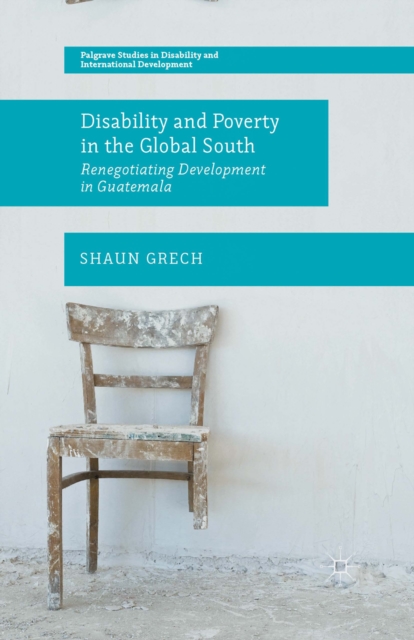
Disability and poverty in the global South : renegotiating development in Guatemala
Drawing from long term ethnographic work and practice in Guatemala, this incisive and interdisciplinary text brings in perspectives from critical disability studies, postcolonial theory and critical development to explore the various interactions and dynamics between disability and extreme poverty in rural areas.
eBook
Development of self-help groups for caregivers of children with disabilities in Kilifi, Kenya : process evaluation
Background: Caring for a child with disabilities in a resource-poor setting brings many challenges to the caregiver. We examined the development of self-help groups for caregivers in a rural part of Kenya. Objectives: To conduct a process evaluation on the development of self-help groups during a 10-month set-up period, focusing on implementation and mechanisms associated with their functional status. Methods: Using a realist evaluation design, we set up 20 self-help groups for 254 caregivers. An evaluation was conducted to investigate implementation and mechanisms of impact. Implementation focused on caregiver registration, community group support and monitoring visit compliance. Data were collected from group registers, records of meetings and field notes. Mechanisms of impact employed a framework of strengths–weaknesses–opportunities– threats to review the groups at the end of the 10-month set-up period. Results: Recruitment resulted in registration of 254 participants to 18 groups – two groups disbanded early. Post-evaluation included 11 active and 7 inactive groups. Compliance with the monitoring visits was consistent across the active groups. All groups engaged in ‘merrygo-round’ activities. The active groups were characterised by strong leadership and at least one successful income generation project; the inactive had inconsistent leadership and had dishonest behaviour both within the group and/or externally in the community. Mediators associated with functional status included the following: available literacy and numeracy skills, regular meetings with consistent attendance by the members, viable income generating projects, geographical proximity of membership and strong leadership for managing threats. Conclusion: Self-help groups have the potential to progress in resource-poor settings. However, critical to group progression are literacy and numeracy skills amongst the members, their geographical proximity, regular meetings of the group, viable income generating projects and strong leadership.
Journal Article