
Catalogue Search | MBRL


Are you sure you want to remove the book from the shelf?

{{itemTitle}}
3
result(s) for
"India -- Economic conditions -- To 1000"
Sort by:

Worlds apart trading together : the organisation of long-distance trade between Rome and India in antiquity
\"'Worlds Apart Trading Together' sets out to replace the outdated notion of 'Indo-Roman trade' with a more informed perspective integrating the new findings of the last 30 years. In order to accomplish this, a perspective focusing on concrete demand from the ground up is adopted, also shedding light on the role of the market in long-distance exchange. Accordingly, the analysis conducted demonstrates that an economically highly substantial trade took place between the Mediterranean and the Indian Ocean in the 1st-6th cen. CE, altering patterns of consumption and modes of production in both India, South Arabia and the Roman Empire. Significantly, it can be documented that this trade was organised at the centres of demand and supply, in Rome and India, respectively, by comparable urban associations, the transport in-between being handled by equally well-organised private networks and diasporas of seagoing merchants. Consequently, this study concludes that the institution of the market in Antiquity was able to facilitate trade over very long distances, acting on a scale which had a characteristic impact on the economies of the societies involved, their economic structures converging by adapting to trade and the market.\"--Cover page 4.
Book
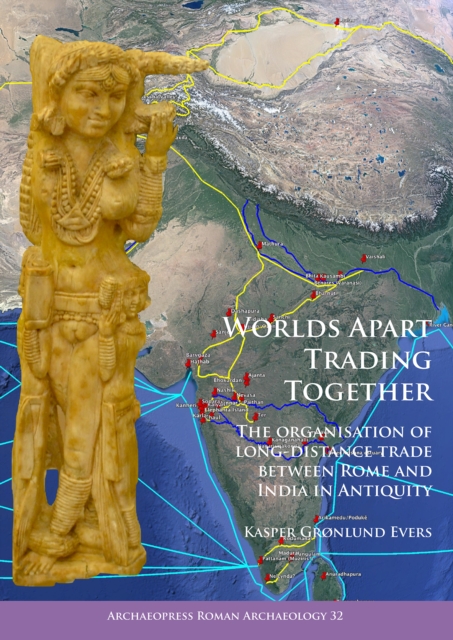
Worlds Apart Trading Together
Worlds Apart Trading Together sets out to replace the outdated notion of ‘Indo-Roman trade’ with a more informed perspective integrating the new findings of the last 30 years. In order to accomplish this, a perspective focusing on concrete demand from the ground up is adopted, also shedding light on the role of the market in long-distance exchange. Accordingly, the analysis conducted demonstrates that an economically highly substantial trade took place between the Mediterranean and the Indian Ocean in the 1st–6th cen. CE, altering patterns of consumption and modes of production in both India, South Arabia and the Roman Empire. Significantly, it can be documented that this trade was organised at the centres of demand and supply, in Rome and India, respectively, by comparable urban associations, the transport in-between being handled by equally well-organised private networks and diasporas of seagoing merchants. Consequently, this study concludes that the institution of the market in Antiquity was able to facilitate trade over very long distances, acting on a scale which had a characteristic impact on the economies of the societies involved, their economic structures converging by adapting to trade and the market.
eBook
The Meeting of Two Oceans
The fifth episode in the series The Story of India takes us to the time of the Renaissance in Europe, when India was the richest, most populous civilization in the world. We visit the desert cities of Rajasthan and travel among the fabulous Mughal cities of Delhi, Agra and Fatepur Sikri. At the Taj Mahal\"”just voted one of the new Seven Wonders of the World by 100 million voters worldwide\"”Wood demolishes an old myth about the Taj and offers a startling new theory about its construction. Exploring the legacy of the Mughal empire that stretched across today's political borders Michael Wood tells the tale of the early Mughals, starting with the redoubtable Babur, founder of the dynasty, and his grandson Akbar the Great, a Muslim king who tried to make India a multi racial and multi-religious state. The story of the Mughals has some of the most fascinating characters in all of history but ends in tragedy as two brothers fought over Akbar's legacy, in a battle that in the end broke Akbar's dream. While waiting in the wings to pick over the spoils were...the British.
Streaming Video