
Catalogue Search | MBRL


Are you sure you want to remove the book from the shelf?

{{itemTitle}}
174
result(s) for
"India Sikkim."
Sort by:

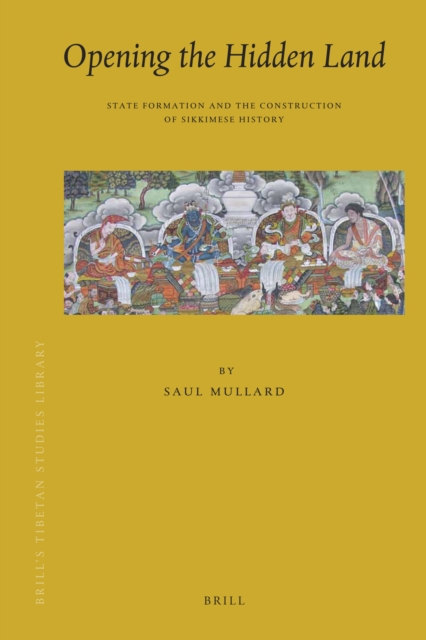
Opening the hidden land : state formation and the construction of Sikkimese history
Using seventeenth and eighteenth century sources from the former Himalayan kingdom of Sikkim, this book examines the construction of Sikkimese historiography and presents an interpretation of the history of state formation of Sikkim.
eBook


Ethnicity and Democracy in the Eastern Himalayan Borderland
This book presents a close look at the growth, success, and proliferation of ethnic politics on the peripheries of modern South Asia, built around a case study of the Nepal ethnic group that lives in the borderlands of Sikkim, Darjeeling, and east Nepal. Grounded in historical and ethnographic research, it critically examines the relationship between culture and politics in a geographical space that is home to a diverse range of ethnic identities, showing how new modes of political representation, cultural activism, and everyday politics have emerged from the region.
eBook


Lamas, Shamans and Ancestors
Presented as a village ethnography, this book contributes to the ongoing debate regarding the relationship between Buddhist lamas and shamans by considering their co-existence and everyday interactions, as seen among the Lhopo (Bhutia) people of Sikkim.
eBook

Their footprints remain
By the end of the 19th century, British imperial medical officers and Christian medical missionaries began to introduce Western medicine to Tibet, Sikkim and Bhutan. Their Footprints Remain uses archival sources, personal letters, diaries, and oral sources in order to tell the fascinating story of how this once-new medical system became imbedded in the Himalayas. Of interest to anyone with an interest in medical history and anthropology, as well as the Himalayan world, this volume not only identifies the individuals involved and describes how they helped to spread this form of imperialist medicine, but also discusses its reception by a local people whose own medical practices were based on an entirely different understanding of the world.
Het boek is een baanbrekende studie naar de invoering van 'Westerse geneesmiddelen' in Kalimpong, Sikkim, centraal Tibet en Bhutan. Their Footprints Remain legt de wortels bloot van de inspanningen van medisch getrainde missionarissen en Britse beambten in de koloniale dienst in India om bio-medicijnen in te voeren in deze regio's, en gaat in op de kwestie hoe en waarom het hen lukte.
eBook


New insights into the position and geometry of the Main Central Thrust from Sikkim, eastern Himalaya
The Main Central Thrust (MCT) features prominently in the Cenozoic evolution of the Himalaya, but no consensus exists on its definition and position. The MCT is best defined by a protolith boundary-structural definition: a high-strain zone with thrust-sense transporting the Greater Himalayan Sequence (GHS) rocks over the Lesser Himalayan Sequence (LHS) rocks. Protolith signatures have proved useful in distinguishing the GHS and LHS, but delineating the structural break of the MCT is still challenging. We have used the conceptual framework of shear zones to delineate the structural break of the MCT at different structural levels in Sikkim Himalaya, India, and identified rock units on either of its sides by available protolith signatures. Previous workers placed the MCT at different locations in Sikkim, varying up to ∼12 km structural distance, without providing any insights on its geometry. Our study shows that thickness and geometry of the MCT vary spatially along and across strike. In the relatively thicker exposures (∼2.5–5.4 km), the MCT shows “island-channel geometry” with mylonites anastomosing around relatively undeformed rocks, transporting the GHS over the LHS and straddling both units. In the thinner exposures (∼1 km), the MCT shows three-dimensional zone-type geometry with a core of highly deformed mylonites flanked by relatively less-deformed protomylonite zones and has a minor portion of the GHS in its footwall. We define the MCT in Sikkim as a mappable shear zone that transported the GHS over the LHS, straddling both units in the thicker exposures, but has a minor part of the GHS in the footwall of the thinner exposures. Our shear zone framework–based approach can be used with protolith signatures along the Himalayan arc to map and study the MCT in detail.
Journal Article