
Catalogue Search | MBRL


Are you sure you want to remove the book from the shelf?

{{itemTitle}}
474
result(s) for
"Indian activists."
Sort by:

In defense of loose translations : an Indian life in an academic world
\"In Defense of Loose Translations: An Indian Life in a Mainstream Academic World is Elizabeth Cook-Lynn's memoir that bridges personal and professional experiences of the provocative, and often controversial, writer who narrates the story of her intellectual life in the field of Indian Studies\"--Provided by publisher.
Book

From the Skin
In this volume, contributors demonstrate the real-world
application of Indigenous theory to the work they do in their own
communities and how this work is driven by urgency, responsibility,
and justice-work that is from the skin . In From the
Skin , contributors reflect on and describe how they apply the
theories and concepts of Indigenous studies to their communities,
programs, and organizations, and the ways the discipline has
informed and influenced the same. They show the ways these efforts
advance disciplinary theories, methodologies, and praxes. Chapters
cover topics including librarianship, health programs, community
organizing, knowledge recovery, youth programming, and gendered
violence. Through their examples, the contributors show how they
negotiate their peoples' knowledge systems with knowledge produced
in Indigenous studies programs, demonstrating how they understand
the relationship between their people, their nations, and academia.
Editors J. Jeffery Clark and Elise Boxer propose and develop the
term practitioner-theorist to describe how the
contributors theorize and practice knowledge within and between
their nations and academia. Because they live and exist in their
community, these practitioner-theorists always consider how their
thinking and actions benefit their people and nations. The
practitioner-theorists of this volume envision and labor toward
decolonial futures where Indigenous peoples and nations exist on
their own terms. Contributors Randi Lynn
Boucher-Giago Elise Boxer Shawn Brigman J. Jeffery Clark Nick Estes
Eric Hardy Shalene Joseph Jennifer Marley Brittani R. Orona
Alexander Soto
eBook

Native defenders of the environment
The stories of twelve Native Americans who are working to save the environment.
Book

Zitkala-Ša
Zitkala-Sa: Letters, Speeches, and Unpublished Writings, 1898-1929, edited by Tadeusz Lewandowski, offers a revealing selection of the American Indian activist's correspondence and lesser-known works.
eBook

Speaking of indigenous politics : conversations with activists, scholars, and tribal leaders
On her radio program Indigenous Politics, J. Kēhaulani Kauanui talked candidly and in an engaging way about how settler colonialism depends on erasing Native peoples and about how Native peoples can and do resist, bringing Indigenous activism to the mainstream. Collected here, these conversations speak with clear and compelling voices about a range of Indigenous politics that shape everyday life--Provided by publisher.
Book

Indianizing Film
Latin American indigenous media production has recently experienced a noticeable boom, specifically in Bolivia, Ecuador, and Colombia.Indianizing Filmzooms in on a selection of award-winning and widely influential fiction and docudrama shorts, analyzing them in the wider context of indigenous media practices and debates over decolonizing knowledge. Within this framework, Freya Schiwy approaches questions of gender, power, and representation.
Schiwy argues that instead of solely creating entertainment through their work indigenous media activists are building communication networks that encourage interaction between diverse cultures. As a result, mainstream images are retooled, permitting communities to strengthen their cultures and express their own visions of development and modernization.Indianizing Filmencourages readers to consider how indigenous media contributes to a wider understanding of decolonization and anticolonial study against the universal backdrop of the twenty-first century.
eBook

Standing with Standing Rock : voices from the #NoDAPL movement
\"Amid the Standing Rock movement to protect the land and the water that millions depend on for life, the Oceti Sakowin (the Dakota, Nakota, and Lakota people) reunited. Through poetry and prose, essays, photography, interviews, and polemical interventions, the contributors reflect on Indigenous history and politics and on the movement's significance. Their work challenges our understanding of colonial history not simply as \"lessons learned\" but as essential guideposts for activism\"-- Provided by publisher.
Book
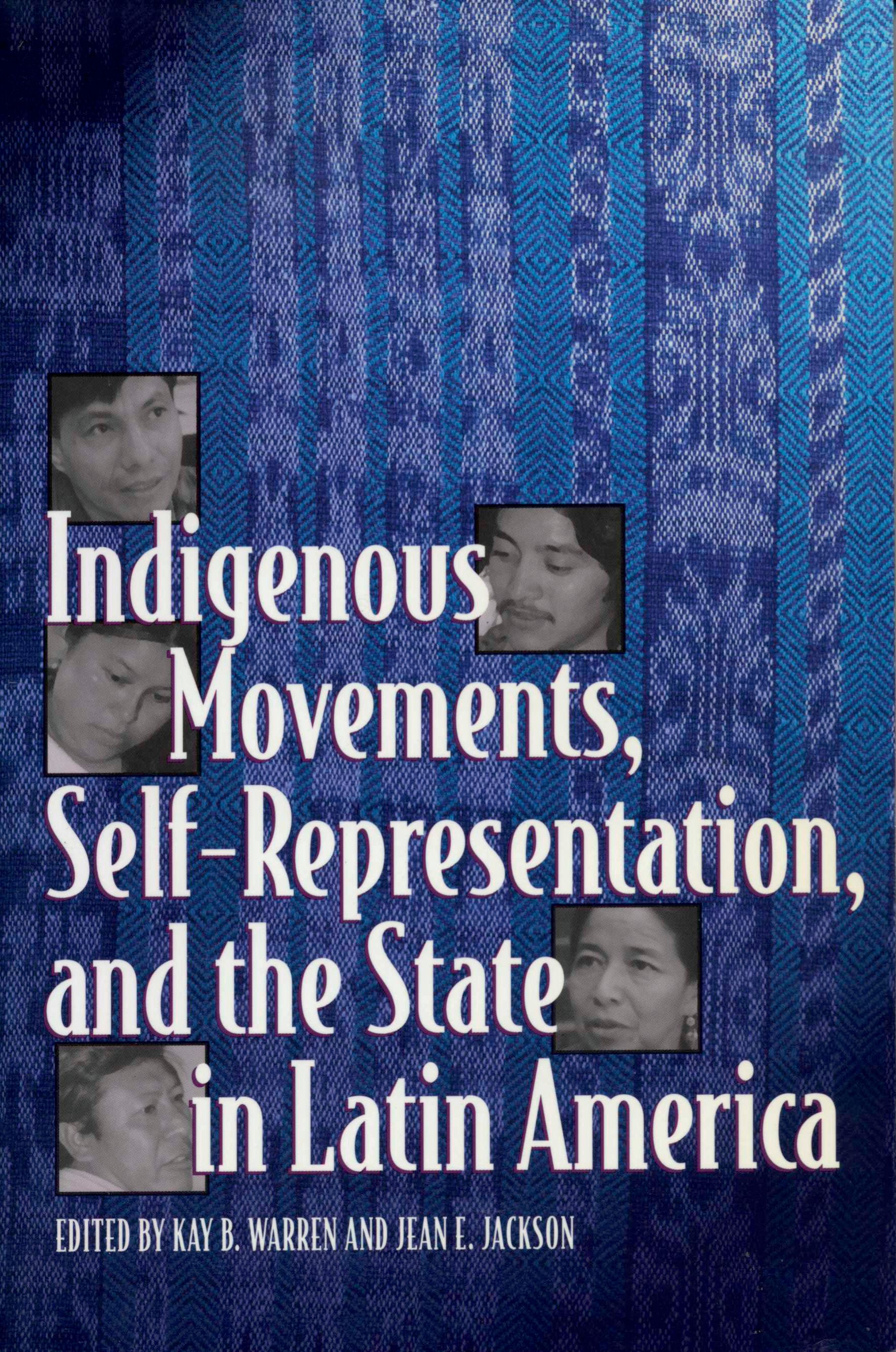
Indigenous Movements, Self-Representation, and the State in Latin America
Throughout Latin America, indigenous peoples are responding to state violence and pro-democracy social movements by asserting their rights to a greater measure of cultural autonomy and self-determination. This volume's rich case studies of movements in Colombia, Guatemala, and Brazil weigh the degree of success achieved by indigenous leaders in influencing national agendas when governments display highly ambivalent attitudes about strengthening ethnic diversity. The contributors to this volume are leading anthropologists and indigenous activists from the United States and Latin America. They address the double binds of indigenous organizing and \"working within the system\" as well as the flexibility of political tactics used to achieve cultural goals outside the scope of state politics. The contributors answer questions about who speaks for indigenous communities, how indigenous movements relate to the popular left, and how conflicts between the national indigenous leadership and local communities play out in specific cultural and political contexts. The volume sheds new light on the realities of asymmetrical power relations and on the ways in which indigenous communities and their representatives employ Western constructions of subjectivity, alterity, and authentic versus counterfeit identity, as well as how they manipulate bureaucratic structures, international organizations, and the mass media to advance goals that involve distinctive visions of an indigenous future.
eBook

Zitkala-Sa : letters, speeches, and unpublished writings, 1898-1929
\"Zitkala-Sa: Letters, Speeches, and Unpublished Writings, 1898-1929, edited by Tadeusz Lewandowski, offers a fascinating, intimate portrait of the Yankton Sioux writer and activist Gertrude Simmons Bonnin (1876-1938). Gertrude Bonnin, better known by her Lakota name, Zitkala-Sa, was one of the most prominent American Indians of the early 20th century. A talented writer, orator, and musician, she devoted much of her life to the protection of Native peoples. As such, Bonnin corresponded with many other distinguished persons within the early Native rights movement, including Carlos Montezuma, Richard Henry Pratt, and Arthur C. Parker, as well as Fathers Martin Kenel and William H. Ketcham of the Bureau of Catholic Indian Missions. This volume gathers together Bonnin's letters, lesser-known writings and speeches, illuminating her private and public struggles.\"--Provided by publisher.
Book

Strong Hearts, Native Lands
In December 2002 members of the Grassy Narrows First Nation blocked a logging road to impede the movement of timber industry trucks and equipment within their 2,500-square-mile traditional territory. The Grassy Narrows blockade went on to become the longest-standing protest of its type in Canadian history. The story of the blockade is a story of convergences. It takes place where cultural, political, and environmental dimensions of indigenous activism intersect; where history combines with current challenges and future aspirations to inspire direct action. When members of this semiremote northwestern Ontario Anishinaabe (Ojibwe) community took action to protect their land, they did so with the recognition that the fate of the earth and the fate of much more are tightly interwoven. Anna J. Willow demonstrates that indigenous people's decisions to take environmentally protective action cannot be understood apart from motives that Western observers have most often considered political or cultural rather than purely environmental. By recounting how and why one Anishinaabe community was able to take a stand against the industrial logging that threatened their land-based subsistence and way of life, Willow offers a more complex—and more constructive—understanding of human-environment relationships.
eBook